Why Purposeful Pathways Matter
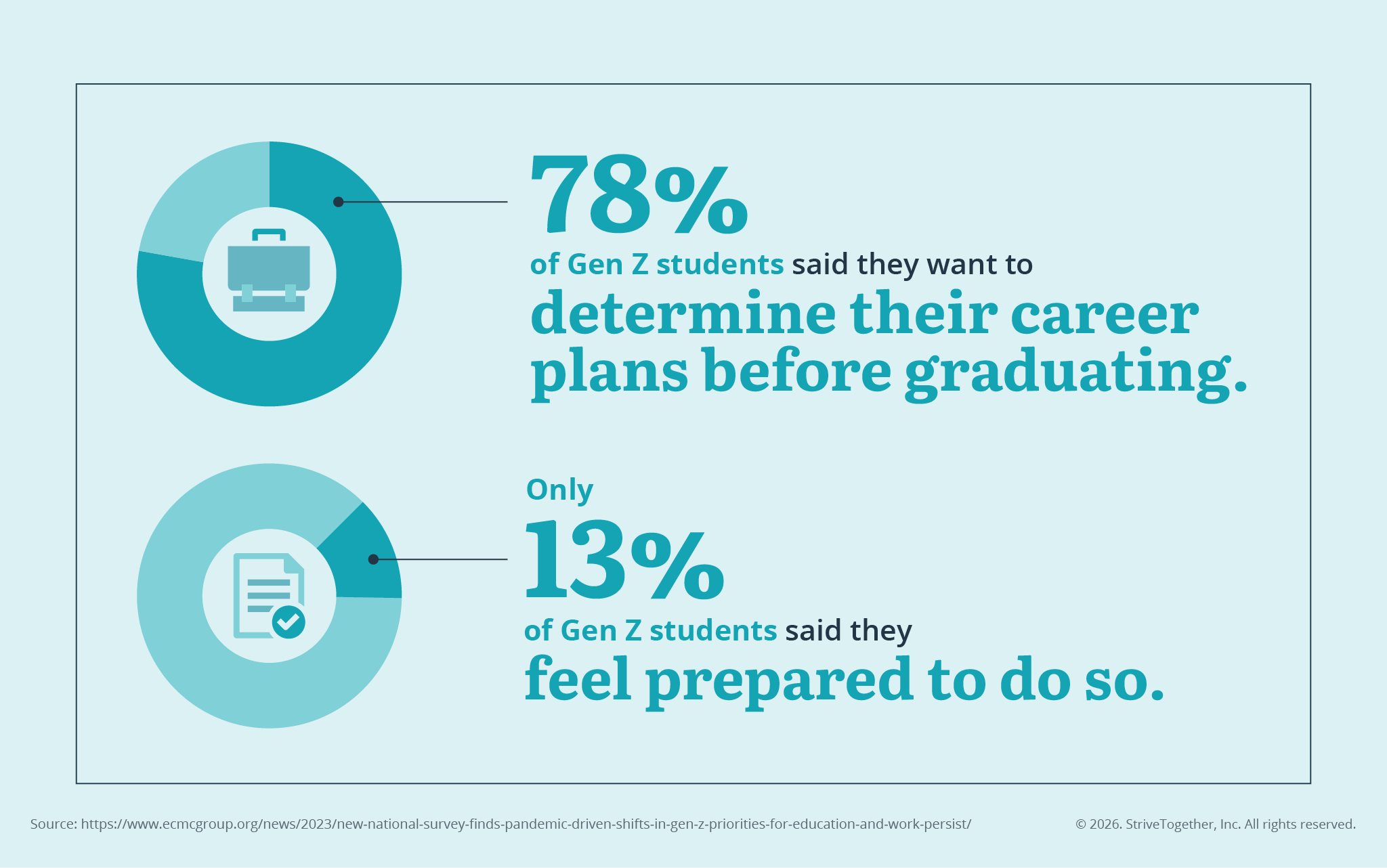
Every student deserves a clear path forward. Too often, they are navigating their future without a trusted guide or the real-world experience to match. According to ECMC Group’s pulse survey, 78% of Gen Z students said they want to determine their career plans before graduating. Only 13% feel prepared to do so. Nearly half plan to pursue college, and only 26% feel very prepared to apply.
That gap reflects what young people encounter between where they start and where they are trying to go. Most are not lacking ambition. What they are missing is a connected, well-designed system to support them.
A purposeful pathway is the intentionally designed journey that connects a young person’s experiences in high school and beyond: education, training and career preparation that leads to work with family-sustaining wages. It is a connected progression from high school graduation and postsecondary enrollment through credential completion and into employment, where each experience builds on the last. No student should navigate this journey alone.
The connection between pathways and economic opportunity
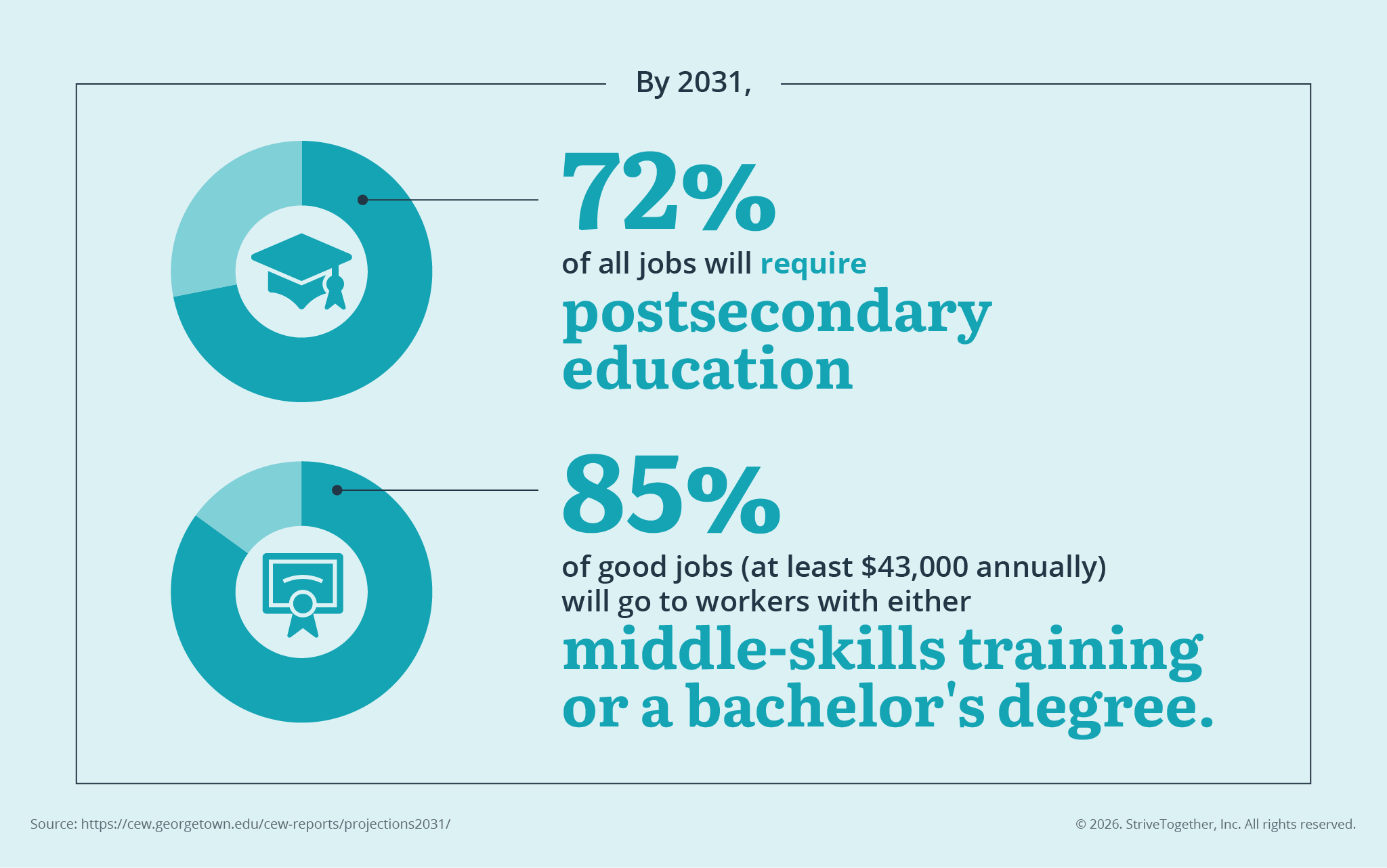
The labor market has shifted faster than the systems designed to prepare students for it. According to Georgetown University Center on Education and the Workforce report, by 2031, 72% of all jobs will require postsecondary education and 85% of good jobs, defined as paying at least $43,000 annually, will go to workers with either middle-skills training or a bachelor’s degree. The path forward runs through credentials, and those credentials take many forms.
92% of U.S. jobs require digital skills, yet nearly one-third of workers lack them. At the same time, college enrollment remains below its 2010 peak, and nearly 40% of first-time undergraduates do not complete a degree within eight years.
Students need a range of options, and each option needs to be just as intentional, well-supported and connected to real opportunity as any other. Whether a student is pursuing a four-year degree or an industry-recognized credential, the strongest path combines rigorous instruction, real-world work experience and the durable skills that prepare them for what comes next.
What matters is that young people can access those options, understand them and move through them with support.
Why fragmented systems leave students behind
High school graduation, postsecondary enrollment and credential completion all matter. In isolation, they do not add up to a pathway. When the experiences leading to those milestones are designed independently, students lose momentum between them. A student might graduate high school without a plan. They might enroll in college without the advising or financial support to stay. They might complete a credential that does not connect to a job. Each gap is a point where students, especially those in the most complex circumstances, can fall through.
Most students today encounter a patchwork of programs and services built separately, rarely coordinated and often out of reach for the students who need them most. A student from a low-income household may not know what accelerated coursework options exist. A multilingual learner may not have access to an advisor who can help them navigate financial aid. A student with a disability may encounter barriers that keep them from the career-connected learning experiences their peers access easily.
The gaps young people face are the result of system design, and system design can change.
What the journey looks like when it works
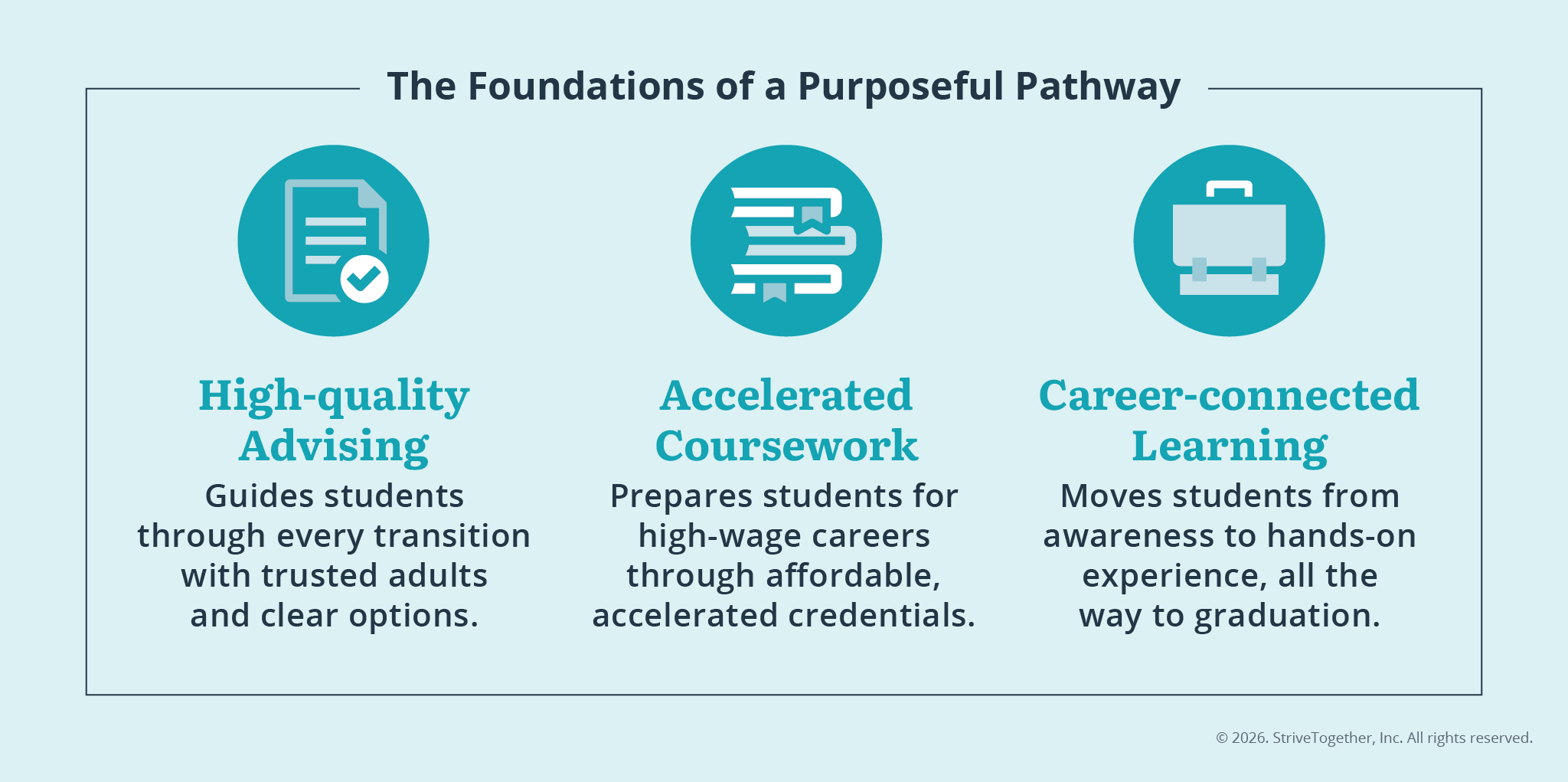
The Commission on Purposeful Pathways was a coalition of students and leaders from K12, higher ed, research, policy and implementation who released a research-backed framework in March 2026. Its report, A Launchpad for Life: A Vision for Purposeful Pathways for All Students, identifies three core experiences that form the foundation of a purposeful pathway: high-quality advising, accelerated coursework and career-connected learning. Their power comes from being sequenced and coordinated, with each experience building on the last.
- High-quality advising helps students develop goals, understand their options and stay connected to trusted adults throughout the journey, at every transition.
- Accelerated coursework gives students access to college credit and industry-recognized credentials at little or no cost, aligned to high-wage, high-demand careers.
- Career-connected learning bridges the classroom and the real world, from awareness and exploration early on to preparation and hands-on training closer to graduation.
Alongside these experiences, are those that cultivate student agency and shape where the journey leads: purpose, belonging and social capital. Purpose means connecting learning to their own values and interests. Belonging means feeling seen, supported and confident enough to pursue new opportunities. Social capital means building the relationships and networks that open doors credentials alone cannot.
Gen Z data reinforces why these outcomes matter. Students who feel a sense of belonging and can see themselves in their pathway are more likely to persist and succeed. Nearly half of Gen Z students say they lack confidence in their postsecondary plans. Confidence is built through experience, relationships and systems that treat students as capable of reaching their goals.
What it takes to build pathways that last
A purposeful pathway requires K-12, postsecondary institutions, employers and workforce systems to function as a connected ecosystem, with each sector playing a role and students moving through rather than between them.
Regional intermediaries are place-based partnerships that bridge systems, coordinate the experiences students need and keep all partners accountable to shared outcomes. Their role goes beyond program delivery. They leverage enabling conditions for lasting systems change: the combination of policies, practices, systems and structures that create positive change on a large scale.
Building systems that allow cross-sector partnerships to grow and last is especially important. These systems establish the models, incentives and accountability measures that expand pathways and sustain the work over time. Tennessee created a model in which dual enrollment students spend time in both a classroom and an employer setting, earning college credit while building career-readiness skills. The state is now scaling that approach statewide.
In Illinois, the Postsecondary and Workforce Readiness (PWR) Act aligned school districts, postsecondary institutions and employers around career-connected learning and credentials.
Communities across the country are producing similar results: doubling career pathway enrollment in Boston, coordinating thousands of employers in Indianapolis, scaling career-connected learning sequences statewide in Ohio and strengthening pathway systems that reach nearly 75% of high school students in Delaware.
Each of these examples reflects what becomes possible when implementation, shared data, governance and funding work together and when the ecosystem is designed around students and regional economic mobility.
Pathways and the cradle-to-career continuum
Purposeful pathways sit at the most consequential stretch of the cradle-to-career continuum. The four outcomes at this stage — high school graduation, postsecondary enrollment, postsecondary completion and employment — are the moments where early investments either build into lasting opportunity or lose their force.
When the journey is strong, each experience is integrated, coherent and aligned to a pathway. These types of purposeful pathways compound student momentum on a trajectory towards meaningful careers. Students accumulate credentials of value, deepen their networks and reach economic mobility with clarity and resilience. When integration is missing, momentum stalls at the exact moment young people are making the decisions that will shape the rest of their lives.
The goal is for every student on a purposeful pathway to say, “I know who I am, I know where I’m going, and I know who can help me get there.”
At StriveTogether, the Pathways Impact Fund is working to make that possible. Launched in 2025 and backed by several of the nation’s largest philanthropies, the Fund is a national initiative to ensure more young people are on purposeful pathways and gaining the experiences, beginning in high school, that build momentum toward well-paying careers and economic mobility.
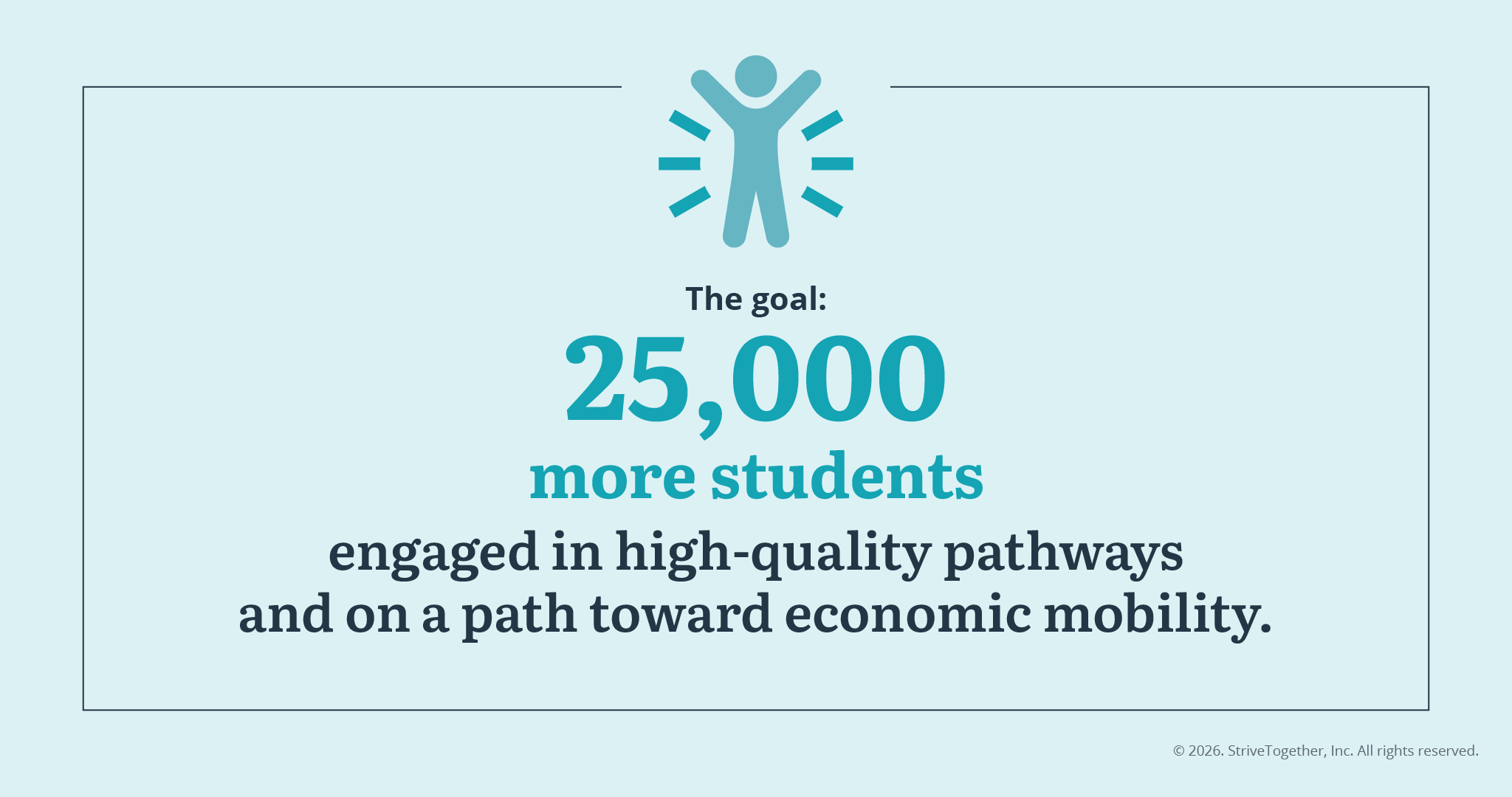
The Fund invests in and supports regional, place-based intermediaries that connect education and workforce systems. With plans to direct more than $25 million to communities across the country, it streamlines field investments and builds shared understanding of what high-quality pathways look like in practice. Initial investments awarded $7.5 million across five regional organizations working to expand students’ options after graduation. The goal: 25,000 more students engaged in high-quality pathways and on a path toward economic mobility.
The Fund also supports field-building through the Pathways Impact Collaborative, bringing together national partners and regional organizations to align on shared principles and develop resources that strengthen pathways work across the country.
When communities invest in connected, purposeful pathways, they create the conditions for every young person to graduate knowing who they are, where they are going and who can help them get there.