Cradle to career is a community-led approach to supporting young people through every stage of life, from early childhood through adulthood.
Across the StriveTogether Cradle to Career Network®, communities align partners, track shared data and improve the outcomes that lead to economic mobility. By measuring progress across key milestones, we focus strategies and resources where they matter most and create lasting change.
Cradle to career™ powers success
At StriveTogether, we believe everyone deserves the opportunity to succeed, from cradle to career. Our approach supports young people at every stage of life, from early childhood through adulthood, by aligning systems like education, health, housing and workforce development around seven measurable outcomes that lead to economic mobility.
This is the work happening across our national Cradle to Career Network®, where communities are coming together to improve these outcomes and transform systems. StriveTogether helps communities move from isolated interventions to lasting change by providing them with connections, visibility and support.
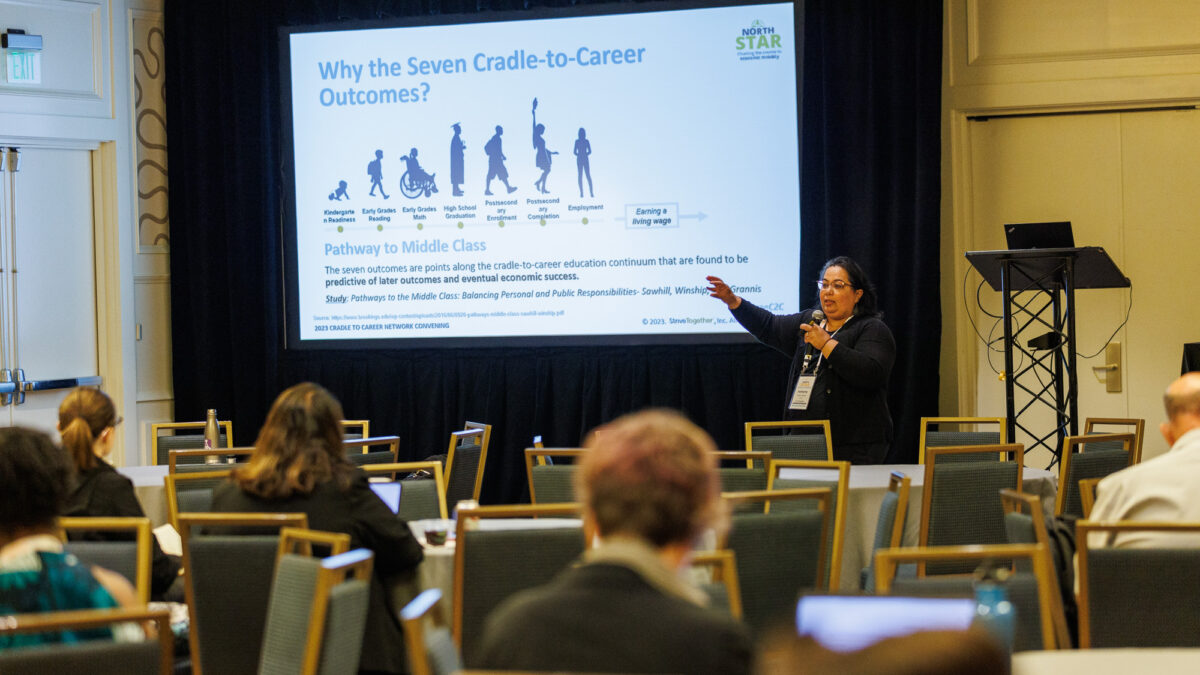
Research shows that reaching seven key milestones, from birth through employment, increases a young person’s ability to achieve economic opportunity later in life. These cradle-to-career outcomes are:
Kindergarten Readiness
Early Grade Reading
Middle Grade Math
High School Graduation
Postsecondary Enrollment
Postsecondary Completion
Employment
Cradle to career™-led community change
Cradle-to-career transformation starts with strong civic infrastructure: the way a community collectively holds itself accountable to better outcomes for children. Civic infrastructure includes local relationships, shared goals and clear ways of working together. This foundation helps communities move from intention to impact by building trust, using data to make decisions and staying focused on outcomes that matter for children and families.
Each community brings this approach to life in ways that reflect its local context, grounded in a shared commitment to accountability and measurable outcomes. Communities use the cradle-to-career model to expand early learning access, strengthen transitions from high school to career and ensure that all young people can reach their full potential.
Cradle-to-career strategies are designed for long-term change. They build systems that promote opportunity and deliver stronger outcomes for children and communities.
Improving These Outcomes
Elements of community impact in the cradle to career™ approach
Outcomes from cradle to career™
Economic mobility includes economic success, autonomy and feeling valued in one’s community. StriveTogether’s seven cradle-to-career outcomes are key milestones on the path to economic mobility.
Kindergarten readiness is critical to lifelong success, and it starts well before a child enters their first classroom. The years from birth to age 5 shape future academic achievement, well-being and opportunity.
When we ensure that all students have strong starts, we set them up for success for the rest of their lives. According to the American Academy of Pediatrics, children’s kindergarten classroom engagement is a predictor of outcomes like high school graduation, school connectedness and health.
Factors that impact kindergarten readiness include:
Preschool enrollment and attendance
Access to early developmental screening
Parental engagement
Access to culturally or linguistically inclusive programs
Reading sets the foundation for long-term success. In the early grades, children shift from learning to read to reading to learn.
When students have what they need to be proficient in reading by the end of third grade, they’re four times more likely to complete high school (The Annie E. Casey Foundation). And there’s a big economic impact, too. Bringing all adults to the equivalent of a sixth grade reading level would generate an additional $2.2 trillion in total annual income for the U.S. (Barbara Bush Foundation for Family Literacy).
Math proficiency in middle school leads to better outcomes related to high school graduation, postsecondary success and access to higher-wage careers.
According to the Center for Education Policy Research, recent declines in math proficiency have a big economic impact, representing a $19,400 decline in present value of lifetime earnings for the average K-12 student. That decline would total $900 billion for the 48 million public school students in 2020-21. Math support and success is a key factor in future career trajectories. Students who have a positive attitude about math are more likely to pursue careers in STEM fields (University of Kansas).
Factors that impact middle grade math include:
Students’ mathematical self-concept, or their beliefs about their skills
Graduating from high school is a critical step toward economic opportunity. On average, high school graduates make at least $10,000 more every year than individuals who don’t complete high school, according to the Census Bureau.
High school graduation is also related to other life outcomes, like health, mortality, teen childbearing, marital outcomes and crime. Increasing the educational attainment of one generation improves the next generation’s academic and social outcomes (Journal of Labor Economics).
Factors that impact high school graduation include:
Postsecondary enrollment is a critical step toward economic mobility and living-wage careers. According to the Georgetown University Center on Education and the Workforce, 72% of jobs in the U.S. will require some kind of postsecondary education or training by 2031. Enrollment in one option, public four-year institutions, can increase students’ household income by 20% around age 30 (Annenberg Brown University).
Factors that impact postsecondary enrollment include:
Summer melt prevention, or making sure students enter the programs they enroll in
Completing some kind of education or training after high school significantly increases lifetime earnings. An associate or bachelor’s degree holder earns an average of $442,000-$1,051,000 more over a 40-year career than a high school graduate (Census Bureau). For each level of education reached after high school, earning potential increases.
Factors that impact postsecondary completion include:
Employment is the last outcome on the cradle-to-career journey, translating knowledge and skills into contributions to the workforce. Access to quality employment is central to long-term economic mobility. Employment creates individual fulfillment and economic prosperity for families, communities and future generations.