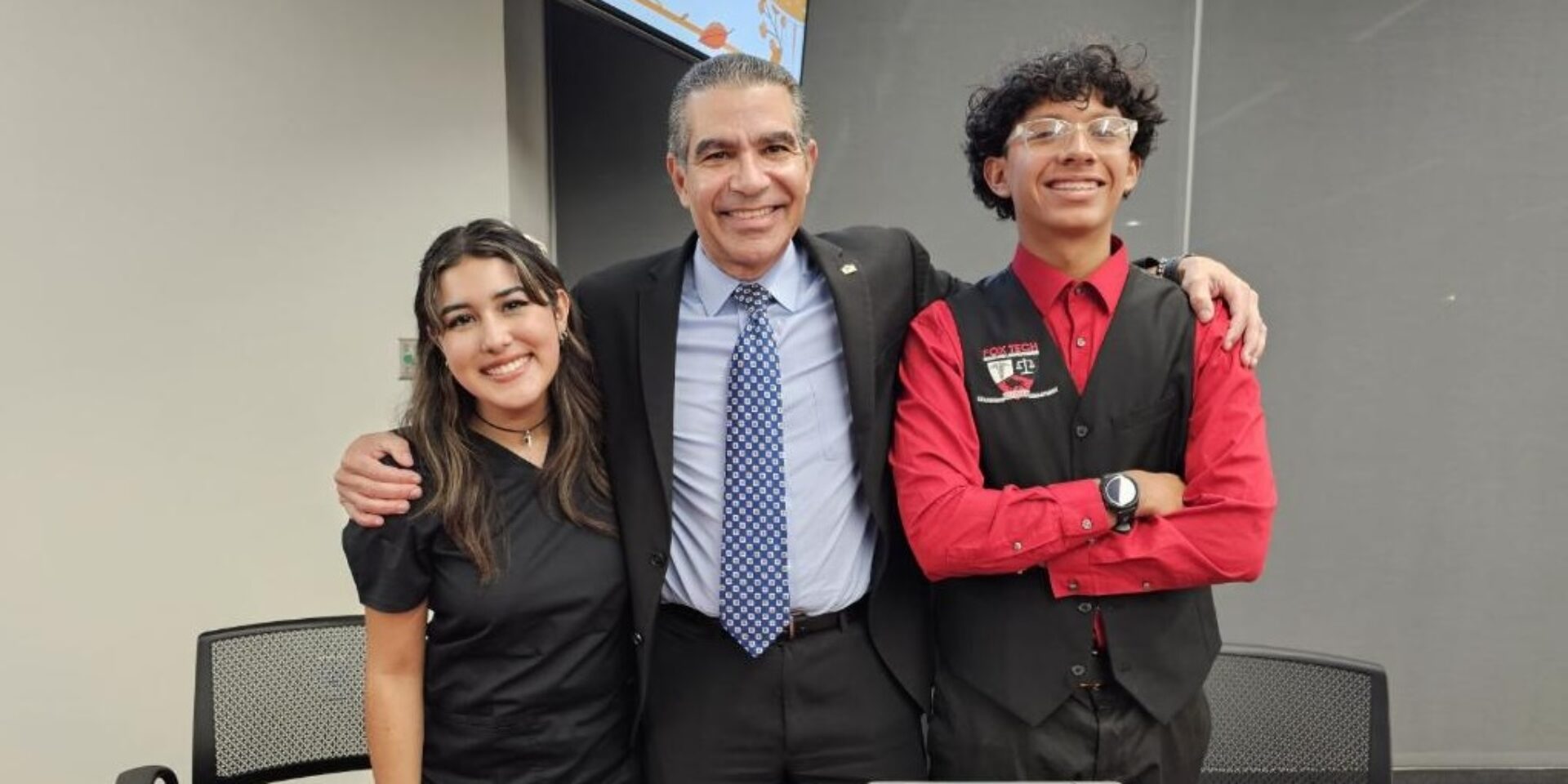
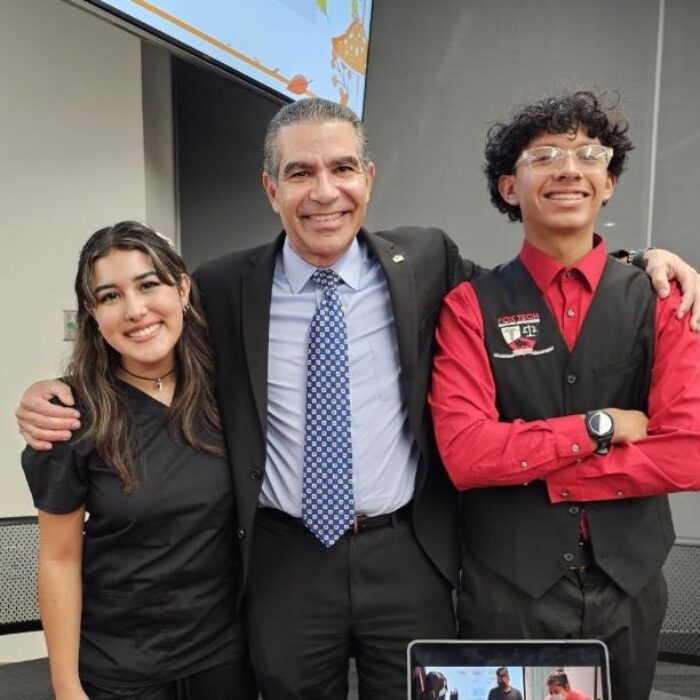
Stronger Future Spotlight: Kendra in San Antonio
Growing up in San Antonio, Kendra always knew she wanted a career in healthcare. What she didn’t know, walking into high school as one of the first cohorts of a brand-new dual credit program, was whether that path was even possible.
Four years later, through dual enrollment, she graduated with an associate degree and a pharmacy technician certification already in hand, and as of summer 2026, she’s a few months from earning her bachelor’s degree in nursing. Her journey shows what a place-based partnership can build when it commits to closing the gap between a high school diploma and a postsecondary credential, one student at a time.
A City-Wide Investment in Dual Credit
Leading that work in San Antonio is UP Partnership, a StriveTogether Cradle to Career Network member and the lead convener of the Future Ready Bexar County Plan. They have aligned more than 100 partners across education, youth development, philanthropy, business and local government around raising the county’s postsecondary enrollment rate to 70% by 2030.
Being part of the StriveTogether network has been key to making that alignment possible. “One of the most valuable aspects of StriveTogether is its focus on shared outcomes, measurable goals and continuous improvement,” said Dr. Cathy Jones, UP Partnership’s CEO. “In Bexar County, that has helped move us from isolated efforts to coordinated action.”
Dual credit sits at the heart of that coordinated approach. “Dual credit has been one of the most powerful strategies in our work because it helps address three of the biggest barriers students face: cost, confidence and access,” Dr. Cathy said.
Dr. Cathy credits research from E3 Alliance, a fellow StriveTogether network member in Austin, with helping shape UP Partnership’s own strategy, a reflection of how the Network is designed to help communities learn from and build on each other’s work. The research found that dual credit is one of the strongest predictors of postsecondary success, significantly increasing the likelihood that students like Kendra, enroll in and complete college.
Bexar County has climbed 14 points since 2020, reaching a 64% postsecondary enrollment rate, and dual credit enrollment at Alamo Colleges District surged 31% in fall 2025. But that progress has landed unevenly: highest-poverty high schools see just 6% dual credit participation, versus 37% at the lowest-poverty schools.
Kendra sees that same imbalance in her own city. “Something very eye-opening that I was reading was how less than 20% of Hispanic adults in the San Antonio area hold a bachelor’s degree, even though we make up about 65% of the population here,” she said. “Programs like H-TECH really help close that gap.”
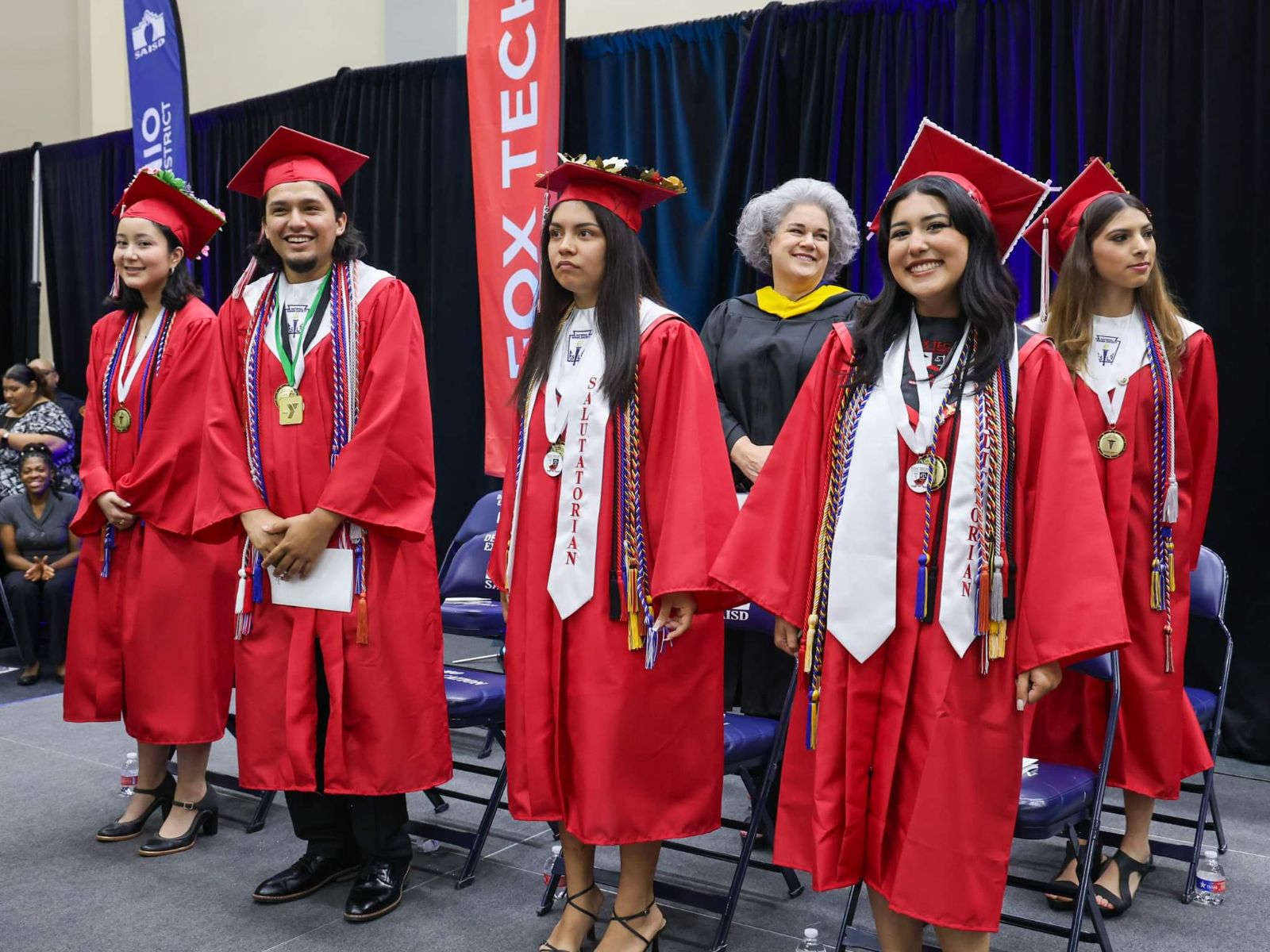
That was the landscape Kendra entered in 2020, enrolling in one of the first cohorts of H-TECH, a Pathways in Technology Early College High School (P-TECH) program — a public high school model that lets students earn a high school diploma and an associate degree simultaneously, at no cost, while also gaining hands-on career experience.
Most early college options she knew of were built around the liberal arts; H-TECH was different, pairing college coursework specifically with healthcare experience. “No one had really heard of a one-of-a-kind, science-space, early college program,” she said.
Getting there took more than enrolling in courses. During their freshman year, students had to pass the TSI (Texas Success Initiative) exam, a state-mandated test of college readiness in reading, writing and math, before they could move from high school honors classes into actual college-level courses — some taught by faculty from UT Austin rather than high school teachers. That early access to college coursework was already shaping the future Kendra was working toward.
Building the Support System at Scale
Closing that gap takes coordinated effort across an entire system, and that coordination is UP Partnership’s role. Where school counselors are stretched thin, programs like Advise Me 210, one of UP Partnership’s own initiatives, trains trusted youth workers to guide students through college and career decisions; 83% of students who go through a session request another one.
Districts are building their own versions of that same shift, with UP Partnership acting as the convener that brings them together rather than the one doing the work directly. At San Antonio Independent School District, Yvonne Benton, executive director of College, Career and Military Readiness (CCMR), who connected with Kendra in her H-TECH years, credits dedicated dual credit advisors with a jump in the number of students completing what they start. “We’re worried about ensuring our advising programs on our campuses are happening day to day,” she said. “So partnering with UP Partnership and other local intermediaries, youth development organizations and colleges, gives us all a role to play to make sure advising happens.”
That same level of support showed up for Kendra at multiple points in her journey at same level of support firsthand. There was Mr. Vargas, her College Career and Military Readiness (CCMR) coordinator, and Mrs. Byrne-Sharp, her Post Secondary Navigator & College Bound advisor, who kept guiding her even after graduation. There was Mr. Q, her chemistry teacher, and Mr. Garza, who helped foster her leadership, alongside her mother, who she calls the biggest reason she made it through. She needed all of the guidance and support because by sophomore year, at just 15 years old, she was already taking college-level chemistry. “I really do believe it takes the village,” she said, “and I really don’t know where I would be without mine.”
I really do believe it takes the village, and I really don’t know where I would be without mine.”
Kendra, H-TECH alumna and nursing student
San Antonio, Texas
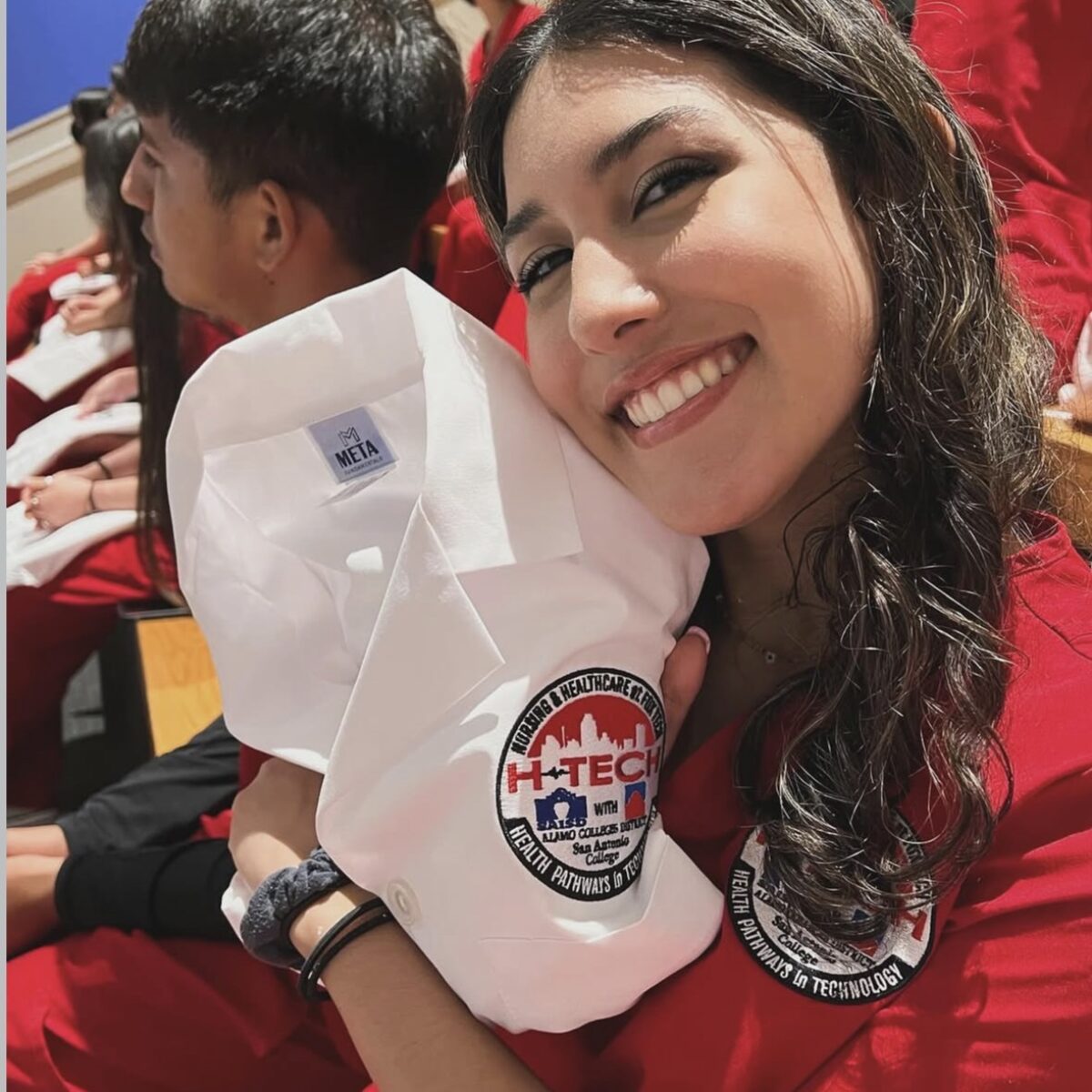
Even the campuses played their part in that village, sitting close enough together that both worlds stayed within reach. “Being dual enrolled really means you’re dual enrolled,” she said. “You get the benefits of both having someone from your high school and then you’re also able to seek out the benefits of being on the campus you’re taking college courses at.” She leaned on teachers who’d known her for years while also drawing on the writing center and tutoring available through San Antonio College — support that doubled rather than divided.
It’s that same principle, Dr. Cathy says, that drives the strategy citywide. “When combined with strong advising, college and career coaching, TSI assessment preparation, and financial aid guidance, dual credit becomes a powerful tool for helping young people achieve the education and credentials that lead to long-term economic mobility.”
Kendra is proof of what that combination can do for one student, and UP Partnership’s work is building it out for the whole region.
More Than a Head Start
Freshman year for Kendra was fully virtual during COVID, and the coursework only accelerated from there once back in person. The hardest part, Kendra says, wasn’t any single class. It was carrying a full college course load and a full high school schedule at once. What pulled her through was community: professors and staff who understood exactly what her course load looked like, and classmates carrying the same weight — full-time high schoolers taking a full college course load, sometimes 12 credits at a time.
Out of that, Kendra came to see dual credit as something bigger than an academic shortcut. “Dual credit is such an amazing opportunity. It helps you learn more about yourself and what you want for your own future, but it also puts you ahead of your peers academically,” she said. “When people think dual credit, they often just think of being advanced on a credit scale and graduating early. But by learning valuable skills like time management, how to manage stress and what study methods actually work for you, those are essential skills you need to function at any level,” she said.
We’ve seen dual credit change the trajectory of students’ lives because it builds confidence and helps students begin to identify as college students before they ever set foot on a college campus.
Dr. Cathy Jones, CEO of UP Partnership
San Antonio, Texas
That growth carried Kendra through H-TECH and into her career. She earned her pharmacy technician certification through the program and, within a month of graduating high school, landed a job with one of UP Partnership’s employer partners, where she’s now marked two years on staff. Outside of work and two jobs, she likes to slow down with journaling, digital media and collecting trinkets.
Long term, she plans to go to graduate school for an advanced nursing degree with dual certification in family practice and psychiatric mental health. She shared that growing up sick often solidified her choice to go into healthcare, but the specific direction came later, watching what COVID did to her own generation. “I think it did create a big need for mental health and psychiatric care,” she said. “That’s what further pushed me into that direction.” She’s set to graduate in spring 2027 with her Bachelor of Science in nursing before pursuing that path further.
A Stronger Future for the Next Cohort
UP Partnership is already planning to reach more students like Kendra. “One of our key priorities is scaling strategies that are already demonstrating strong results,” Dr. Jones said. “That includes expanding access to dual credit, growing direct admissions opportunities, strengthening college and career advising, and increasing early awareness so students and families begin planning for life after high school long before senior year.”
As postsecondary enrollment increases, she added, the focus is expanding beyond access to persistence and completion. “It is not enough to help students get to college,” she said. “We want to ensure they earn credentials with labor market value, complete their programs, and enter careers that provide long-term economic opportunity and financial stability.”
Kendra’s story is one piece of a much larger system UP Partnership and its partners are building around dual credit. Each piece is designed to make what Kendra experienced — a healthcare pathway, backed by advising, leading straight into a four-year nursing track — feel less like something she had to find her way into and more like the path the system was built to offer.
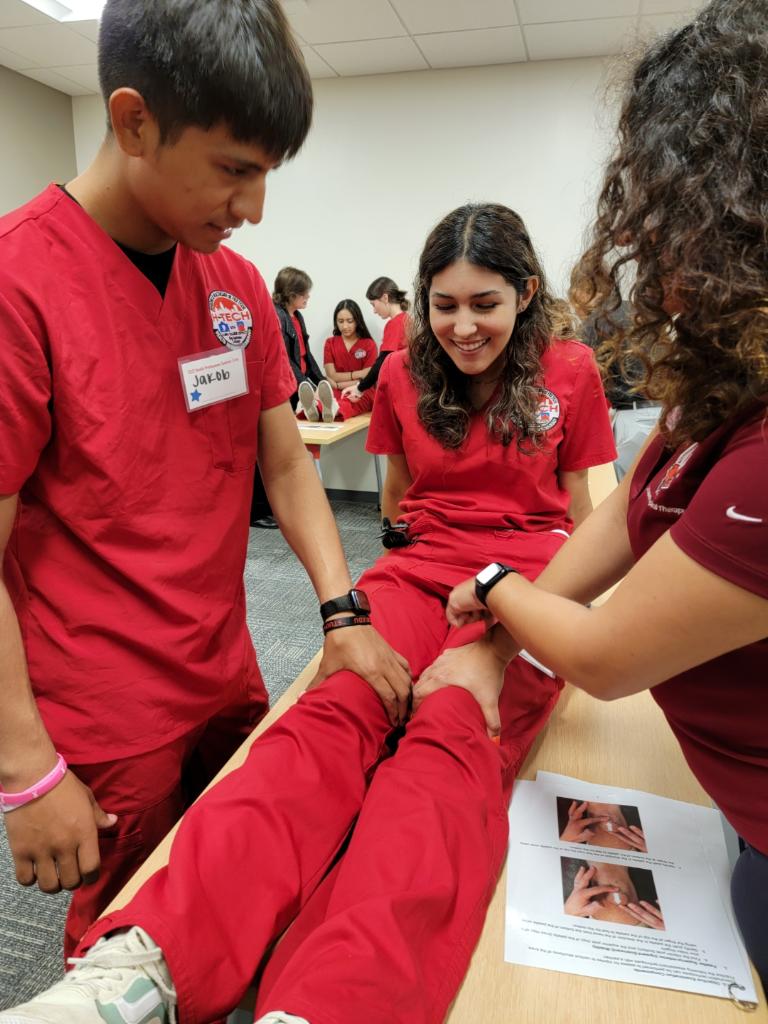
That’s not a lesson Kendra keeps to herself. She’s made a point of staying connected to the coordinators, teachers and mentors who carried her through H-TECH, and of passing that same support on to students coming up behind her. These days, that mentorship has followed her into nursing school. Despite working two jobs while enrolled full time, Kendra took on a role as a peer mentor champion for her senior year, helping guide other nursing students through the same program she’s now finishing, the kind of hands-on navigation she once needed herself. “You’re only as good as what you do for others,” she said.
Kendra still remembers being part of the early cohort with no one ahead of her to point to. Now, as she finishes nursing school, she is that proof for the students coming up behind her showing that dual credit can hand a student a debt-free associate degree, an industry certification, a job before graduation and a real head start on a four-year degree, all before they’ve even left high school.
The village and systems it takes to make that possible is exactly the infrastructure UP Partnership is working to make available to every student in Bexar County.
Additional Stories
Stronger Future Spotlight: Kendra in San Antonio