From Local Results to Texas Law: E3 Alliance and The Commit Partnership Widen Access to Advanced Math
Overview
A Texas student’s path to Algebra I in eighth grade once depended on who noticed. E3 Alliance and The Commit Partnership, both StriveTogether Network members, used local data to show who was being missed.
Their evidence helped lead to Senate Bill (SB) 2124, which automatically enrolls qualifying sixth graders in advanced math courses. This is Nested Civic Infrastructure™ at work — local evidence turning into policy, and that policy being implemented across the state to support more classrooms.
-
Texas passed SB 2124
In 2023, lawmakers voted to place qualifying sixth graders in advanced math automatically, unless parents opt out.
-
Access doubled statewide
32% of Texas seventh graders took the Grade 8 math state test (STAAR) in 2026, up from 16% in 2023.
-
Students from low-income households gained access
65,418 students experiencing poverty in Texas took advanced math in 2026, and their numbers grew much faster than everyone else’s.
National Background
Eighth grade math is one of the earliest reliable signals of how far students will go in school and work, and whether they will earn enough to build economic mobility. Northwest Evaluation Association (NWEA) research describes early Algebra as a key gateway to advanced high school math, STEM majors and higher lifetime earnings. StriveTogether’s Middle Grade Math Playbook draws on research showing that eighth grade math achievement is a strong predictor of high school graduation and is associated with higher income and greater educational attainment.
National results suggest that many students are not building that foundation.
In 2024, 28% of 8th graders were proficient in math on the National Assessment of Educational Progress (NAEP).
That share was 34% in 2019 and fell to 26% in 2022, so 2024 marks only a partial recovery.
In eighth grade math, Texas sits below the 28% national figure. USAFacts reported that about 24% of Texas eighth graders reached NAEP Proficient in math in 2024, 15th lowest in the country. The contrast with fourth grade is sharp. About 43% of Texas fourth graders reached NAEP Proficient, ninth highest in the country. The state’s early strength fades by eighth grade, a disconnect that puts a spotlight on the middle grades.
Those averages also hide who gets into advanced math. An NWEA analysis of 162,000 eighth graders in 22 states found that only 58% of schools offered Algebra by eighth grade. Even among the top 20% of fifth-grade achievers, access was uneven. Black students were the least likely to take Algebra in eighth grade, at 60%, compared with 68% of white and Latine students and 84% of Asian students.
A 2026 NWEA analysis of 55,000 students in 29 states, reported by The 74, found that nearly a quarter of seventh graders whose scores met an algebra-readiness benchmark did not take algebra in eighth grade. Offering the course is only the first step. Qualifying students also need to be placed in it, with a clear path into the course when it is offered.
Expanding access to advanced math for qualifying students takes intention from the institutions that write placement rules, working from shared data and held accountable to shared results. That is the work two Texas partnerships took on in their own regions, starting with their own local data.
Local ContextLocal Context
The Education Reporting Collaborative reported that Texas has more than 1,000 school districts, and before 2023 each set its own rules for advanced math placement. Two StriveTogether Cradle to Career Network members, E3 Alliance in Central Texas and The Commit Partnership in Dallas County, saw that this patchwork of district placement rules wasn’t producing great results for youth. Both are place-based partnerships that bring districts, colleges, nonprofits, employers and funders together around shared data.
E3 Alliance, founded in 2006, works with 15 school districts in Central Texas, according to its Educational Profile of Central Texas. An E3 analysis of Central Texas fifth graders in 2014 found that, under district-set placement rules, only 33% of Black students and 46% of Latine students with top 20% State of Texas Assessments of Academic Readiness (STAAR®) math scores completed Algebra I by the end of eighth grade.
Here in Central Texas, we were seeing a large gap, a large racial gap in access to advanced math where a number of white and Asian students were really represented in advanced math classes while black and Latine students were underrepresented.
Richard Tagle, president and executive director of E3 Alliance
Central Texas

The Commit Partnership, founded in 2012, works in Dallas County, where more than 700,000 students are enrolled from pre-K through higher education and two out of three young adults do not earn a living wage. Its North Star goal is that by 2040 at least half of county residents ages 25 to 34 will earn a living wage, irrespective of race.
Sile Robinson, Commit’s chief regional impact officer, said Algebra I is the milestone that matters most. “If students don’t take [Algebra I] by the time that they leave middle school, they will not be able to take college-aligned courses at the rate needed to actually be successful in post-secondary,” she said. Commit’s 2023 STAAR analysis found that 41% of Dallas County students met standards in Algebra I, down from as many as 65% before the pandemic.
In Dallas County, Garland Independent School District (ISD), a northeast Dallas County district of more than 50,000 students, had already built its own opt-out policy, automatically placing students proficient in fifth grade math on a pathway to Algebra I unless families opted out. Commit saw early results there, and E3’s research on math pathways and postsecondary credentials lined up with those results. The two partnerships then joined forces to push for a statewide opt-out policy: E3 coordinated a coalition of statewide education partnerships and supplied the research, and Commit brought the Dallas County proof point.
StrategiesStrategies
Algebra I by eighth grade is one of the earliest levers students have for reaching college-level math, yet statewide only 18% of Texas students from low-income households were enrolled in it by the end of eighth grade, compared with 40% of their peers. Closing a gap like that took coordinated effort across districts, regional partnerships and the state.
Together, these strategies gave districts the evidence, the mandate and the support to change who gets into advanced math. The first results are now coming in.
Impact
The results show Nested Civic Infrastructure™ at work. Local partnerships found the problem and tested a solution, the state wrote a rule to codify it, and regional partners then helped put the rule into practice. Each level of infrastructure played a role that the others needed. The effect is visible from the state level all the way down to a single student’s schedule.
At the local level, E3 and Commit saw similar shifts in their regions. In Central Texas, districts working with E3 saw the gap in Algebra I completion between high-performing Black and white students close by 91% between 2015 and 2022, and the gap between high-performing Latine and white students close by 71%. The share of high-performing students completing Algebra I by the end of eighth grade grew from 57% in 2015 to 74% in 2024.
Richard said the statewide law carried that opening to the rest of Texas. “The opportunity that this policy created when it was passed was the fact that more minority students, more underserved populations were able to access this very important gateway to not just post-secondary work but to career choices across fields,” he said.
Between 2023-24 and 2024-25, participating Dallas County districts raised the share of students in Algebra I by eighth grade from 45% to 49%, with Black student enrollment rising from 31.3% to 36.7% and performance holding steady. Commit reports that Uplift Education, a tuition-free public charter network serving more than 23,000 students in Dallas and Fort Worth, raised eighth grade Algebra I enrollment from 77% in 2024 to 95% in 2025.
Garland ISD also reports steady growth of students becoming more successful in Algebra 1. From 2021 to 2025, the percentage of students meeting grade level performance on the Algebra I end-of-course exam increased from roughly 30% to more than 52%.
At the student level, the change shows up in individual pathways. Wahomina, a freshman in Garland ISD’s Math, Science and Technology program in Dallas, took the pathway from honors math in sixth grade to the Grade 8 STAAR in seventh, Algebra I in eighth and geometry now. “Because I took Algebra I in eighth grade, I’m able to take geometry now in ninth grade, and it sets me up to take higher level classes like pre-cal and trigonometry,” she said. “Some students, because they didn’t get to take Algebra I in their eighth grade year, they have to go back and take Algebra I. But for me it’s a different story …I don’t have to worry about that.”
Jessica Scanlon, a parent in Round Rock ISD, north of Austin, saw the change at home. Her daughter, now in seventh grade, was automatically enrolled in advanced math in sixth grade, and Jessica worried about what would happen if she struggled. “Nobody wants to say to their kid, ‘We have to drop you back to regular math, because you’re not doing well,’” she said. “That was my biggest fear, but it turns out that it’s been a great decision.”
[My daughter] was super nervous about accelerated math specifically, and now it’s one of her best subjects. Her confidence is through the roof, and she loves math now, which I couldn’t have dreamed for a better outcome.
Jessica Scanlon, parent in Round Rock ISD
Round Rock, Texas

Future Vision
The first results show changes in access. Next, the partnerships want to know whether students are succeeding. Paige described what Commit will watch for: “When implementation is going really well, you should see three key things. First, you should see an increase in the number of students who are enrolled in that advanced math course in sixth grade. Second, those students should matriculate to Algebra I in eighth grade. And so, you should see an increase in enrollment there. And third, and most importantly, you should see an increase in the percentage of students who are in eighth grade Algebra I actually being successful in that course and demonstrating proficiency on the end-of-year assessment.”
For Priscilla, the hope is broader. “I hope that through this policy, that students have more of an opportunity to see themselves being successful in these classrooms, in these more advanced courses, so they can see themselves with a stronger future,” she said.
E3 says it remains committed to helping districts and campuses move “from policy to practical application” through training sessions tailored to each district. Sessions cover logistics such as course access, curriculum alignment and student placement, communications and messaging inside and outside the district, and building instructional capacity through teacher professional development and equitable teaching practices.
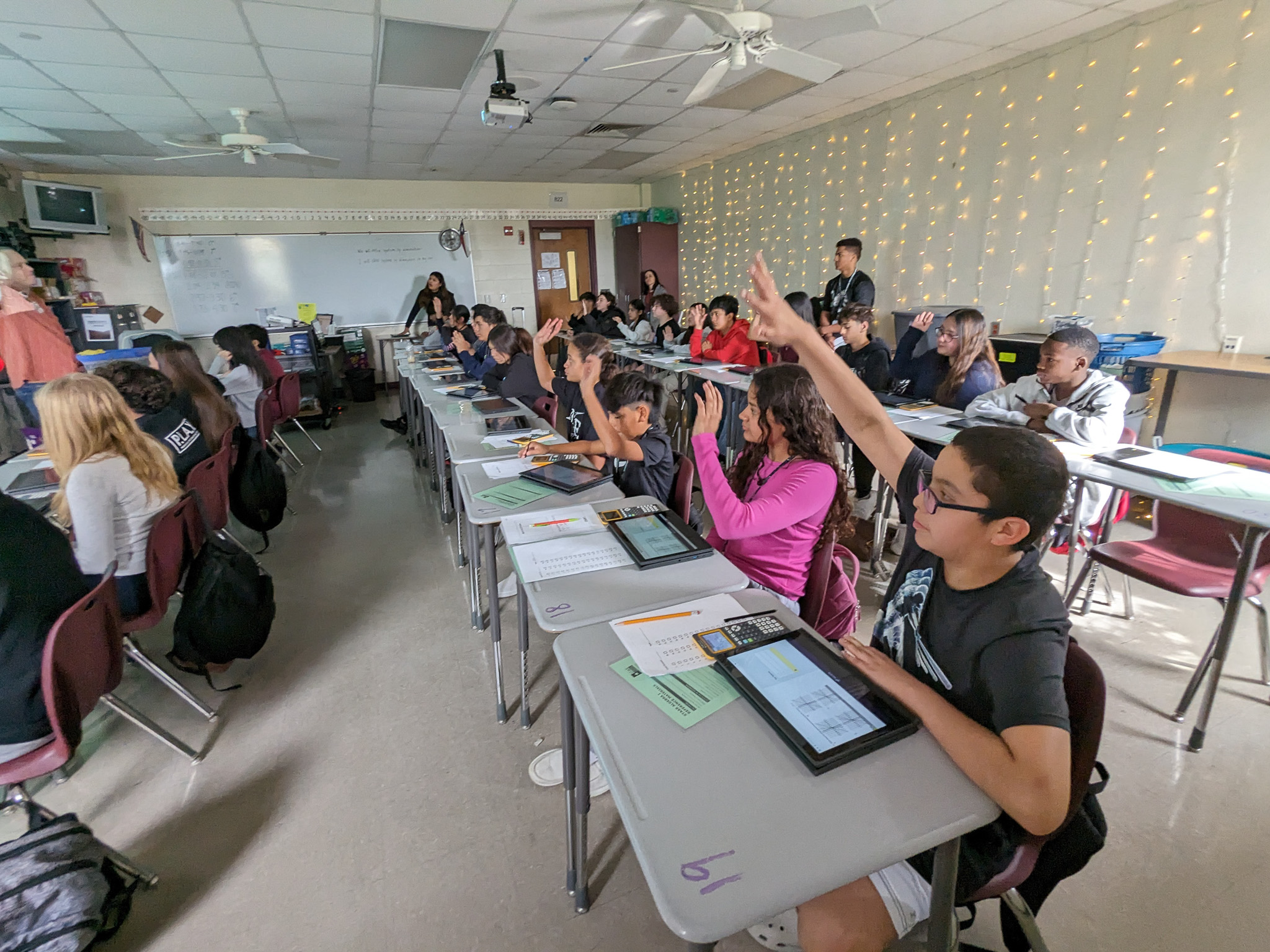
Garland ISD, in northeast Dallas County, has the longest runway. Its system now runs from sixth grade through twelfth. “We’ve really pushed towards our vision of having as many students in Algebra 1 in 8th grade as possible. The continued work is going to be making sure that they’re successful as they pursue through high school on college entrance exams,” Coleman said.
Commit’s part in that next phase, he said, is helping the district see obstacles coming. “Having a sustained partnership like [Commit] helps you project those speed bumps and be able to move past them in a fast way.”
Richard said advanced math builds skills that carry into any field. “Middle grade advanced math prepares students for post-secondary work and their careers later on…Advanced math prepares you for STEM work. It prepares you for communications and marketing. It prepares you for research and allows you to really take very abstract ideas and concepts and know how to calculate and turn them into practical steps,” he said.
Commit describes its policy work as resting on a statewide coalition that includes other StriveTogether Network members, E3 among them. A partner like E3, which understands its regional context and operates as a backbone, helps the two organizations pool resources and approach state policy collectively. Being part of the StriveTogether Network also connected Commit to peers in other regions facing similar challenges.
Texas is one state, but the stakes are national. E3 Alliance and The Commit Partnership used local data to show which students were being missed, worked with other statewide partners to turn that evidence into SB 2124 and then with districts to carry it out.
The work is evidence that place-based partnerships can move from local pilot to statewide change by building the Nested Civic Infrastructure™ that lets districts, partners and the state work from the same data. Other states are asking the same question, and what E3 and Commit built gives others a foundation that starts with local data, steady partners and a clear placement rule. Each time a community finds a student who was being missed and changes the system that missed them, the path to economic mobility widens for the next one.
Additional Stories

From Local Results to Texas Law: E3 Alliance and The Commit Partnership Widen Access to Advanced Math