StriveTogether and Data: A Commitment to Better Outcomes

Data is one of the most powerful tools a community has for improving outcomes for children and families. It reveals which young people are falling behind, shows which strategies are making a difference and helps partners make decisions based on evidence rather than assumption. When communities collect, share and act on data together, they move faster and produce better results.
But data only creates change when communities actually use it. Without the infrastructure, commitment and culture to turn information into action, even the best data sits unused. The gap between collecting data and acting on it is where progress stalls and where too many youth are missed.
At StriveTogether, evidence-based decision making is a core pillar of how communities are supported to improve outcomes across the cradle-to-career journey. StriveTogether’s goal of 4 million more futures by 2030 is what that commitment is working toward. It is a shared commitment that runs through everything StriveTogether does and everything it asks of the communities in its Cradle to Career Network.
What StriveTogether measures and why it matters
StriveTogether’s commitment to data begins at the very start of a community’s journey. Data sharing is a condition of membership in the Cradle to Career Network, established before a community officially joins and carried through every year of the partnership. Data transparency is how trust gets built in cradle-to-career work.
Every year network members submit outcomes data tracking progress on seven cradle-to-career milestones: kindergarten readiness, early grade reading, middle grade math, high school graduation, postsecondary enrollment, postsecondary completion and employment. These are research-backed measurement points proven to predict whether a young person will reach economic mobility. Tracking the same milestones across communities in different states creates a consistent shared language for what progress looks like and makes it possible to learn from what is working anywhere in the network.
Outcomes are disaggregated by race, ethnicity, gender, income, language and special education status. Aggregate data can show a community that things are improving on average and completely hide the fact that certain groups of young people are falling further behind. Behind every data point is a range of experiences. Disaggregation brings those experiences into focus, showing exactly which groups are making progress and which are still being left behind.

Data serves as a flashlight for cradle-to-career work. Without it gaps stay hidden, embedded in averages and assumptions. Disaggregation is what brings them into the open, finding what is working and revealing where more resources should be deployed. That transparency builds the trust between grassroots organizations and institutional partners that makes genuine collaboration possible.
Understanding what is happening to young people requires looking at more than one level of data. StriveTogether network members track population-level data to see how all young people in a community are doing overall and strategy-level data to understand what is working inside specific programs and interventions. StriveTogether supports that work with playbooks comprised of evidence-based practices that help communities measure what matters and act on what they find and help communities measure what matters and act on what they find.
But submitting data is only the starting point. Members are expected to use it actively with their communities, bringing it to partner meetings, presenting it publicly and letting it shape how resources and strategies get directed. The communities making the most progress have put real resources behind that commitment, building dedicated data teams because they have learned that a strong data practice accelerates everything else.
The impact of making data accessible and actionable is clear.
Across the Network, 494,633 additional youth are meeting or on track to meet key milestones. In every outcome area at least 50% of the Network has shown growth since 2022.
How StriveTogether puts data to work
Since its founding, StriveTogether has grounded its work in evidence-based decision making, holding itself to the same standard it expects of the Network. StriveTogether tracks outcome trends continuously and asks hard questions: did outcomes move up or down over time in a given community? How did that community perform relative to its peers and the state? How are economically disadvantaged populations faring within those trends? The answers shape which practices get lifted up, which supports get built and how advising evolves. StriveTogether also engages in external evaluation as a demonstration of its commitment to transparency and continuous improvement.
The quantitative work runs alongside it. StriveTogether’s team combs through narratives, field data and what members share to identify what is actually moving outcomes in communities. Those practices get shared across the Network. What works in one community can inform what happens in another. That is the value of belonging to a network that takes learning seriously.
When StriveTogether supports a network member, data is always on the table as a shared starting point for problem solving. What do the outcomes show? Where are the gaps? What does the community’s own data suggest about where to focus next? That is how evidence-based decision making becomes a living practice.
At StriveTogether, data is a tool for illumination and improvement. It surfaces what is working, guides communities toward what comes next and keeps the focus on outcomes for youth and families. Every piece of data collected is tied to a clear purpose:
- Accelerating network member results
- Supporting internal continuous improvement
- Showcasing impact across the field
- Informing decisions across StriveTogether, the Network and the broader field
Data is connected across sources, tools and teams to build a holistic picture of what is happening in communities. Feedback from network members continuously shapes how those systems and practices evolve.
Practices That Move Communities
StriveTogether’s network-wide goal is 4 million more futures on a path to economic mobility by 2030, measured by milestones met or on track to be met. A goal that size only means something when every community can see itself in it. StriveTogether has long celebrated the power of naming specific goals for each community as a step toward the collective vision, and Know Your Number is how that belief becomes practice. Each community examines its own historical outcome trends and arrives at a concrete contribution it can own, communicate and be held to.
A specific number does things a vague goal simply cannot. It motivates community members who want to see progress they can point to. It aligns partners including schools, nonprofits, government agencies and funders around a shared target where everyone understands their contribution. It creates an investable plan where partners can see exactly what they are supporting and what results it connects to. As of 2025 every network member has identified their number, translating a shared vision into a local commitment.
That work becomes visible through StriveTogether’s two public dashboards. The Network Dashboard shows how the Cradle to Career Network is moving as a whole. The Community Dashboard lets anyone drill down into outcomes data for individual communities and links to local dashboards where available. The network-level view shows the scale of the work. The community-level view shows the specificity that drives local action.
Those dashboards also change what happens when people come together. When advisors, funders and community leaders meet, the data is not a backdrop. It is the starting point. What do the numbers show? What has moved? Who still is not being reached? Conversations grounded in shared data produce different decisions than conversations grounded in assumption. Public reporting creates shared accountability and when outcomes are visible, partners cannot defer to a different dataset or claim they did not know. Making data usable and accessible is what makes it actionable, turning information into better strategies and better outcomes for young people.
Across the network, communities are building the kind of data infrastructure that turns information into action. Baltimore’s Promise maintains a public Youth Data Scorecard tracking over 20 indicators from birth through early career, designed to help the community hold decision makers accountable and improve services for Baltimore’s children. Learn to Earn Dayton offers a data dashboard that lets users explore cradle-to-career milestones across all 611 Ohio school districts, disaggregated by population, to surface bright spots worthy of scale. For communities like these, data is a feedback loop. They test a strategy, observe what moves, adjust and try again. That cycle done consistently over time builds a culture of learning, one where data drives what comes next.
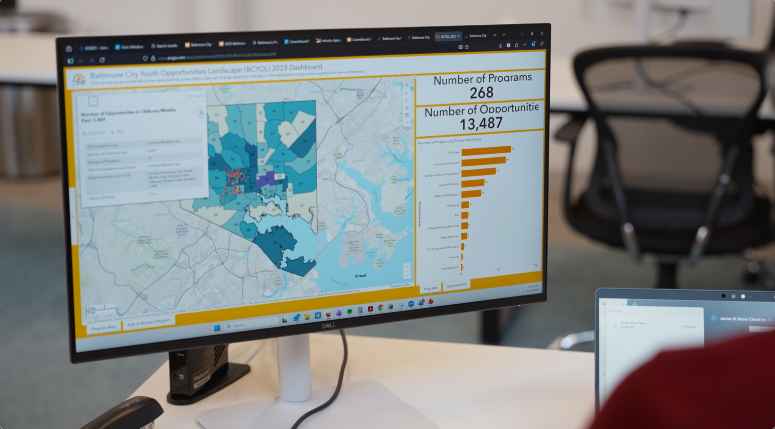
For data to truly shift behavior it has to reach people at two levels. Quantitative data speaks to the mind, showing scale, trend and disparity with a clarity that is hard to argue with. Qualitative data speaks to the heart, adding the stories, voices and lived experiences that make the stakes real and the work personal. Together they move a community from knowing about a problem to feeling compelled to solve it.
StriveTogether’s approach offers principles that any community can put to work.
Setting a concrete goal, making data publicly visible and pairing quantitative trends with qualitative stories are not just things StriveTogether does, they are practices that change how communities move. A specific number motivates partners and creates an investable plan. Public dashboards shift conversations from assumption to evidence. And quantitative data paired with the stories behind it moves communities from knowing about a problem to feeling compelled to solve it.
To explore StriveTogether’s data and learn more about building your community’s practice, visit Member Data Dashboards.