Aligning Education and Industry to Expand Workforce Pathways in Central Texas
Overview
E3 Alliance is connecting education, workforce and industry partners across Central Texas to expand pathways into high-demand careers.
As a place-based partnership in the StriveTogether Cradle to Career Network, E3 Alliance uses data and collaboration to align K-12 schools, colleges and employers around a shared goal: ensuring every student and adult has access to the skills and credentials needed to enter the workforce and build long-term economic mobility.
-
Education and industry align for impact
School districts, nonprofits, philanthropy, businesses and community members are coordinating approaches for stronger impact.
-
Hands-on pathways open doors to careers
Partners supported students to overcome obstacles beyond academics and increased access to tutoring, extracurriculars and mentorship.
-
Growing enrollment shows what’s possible
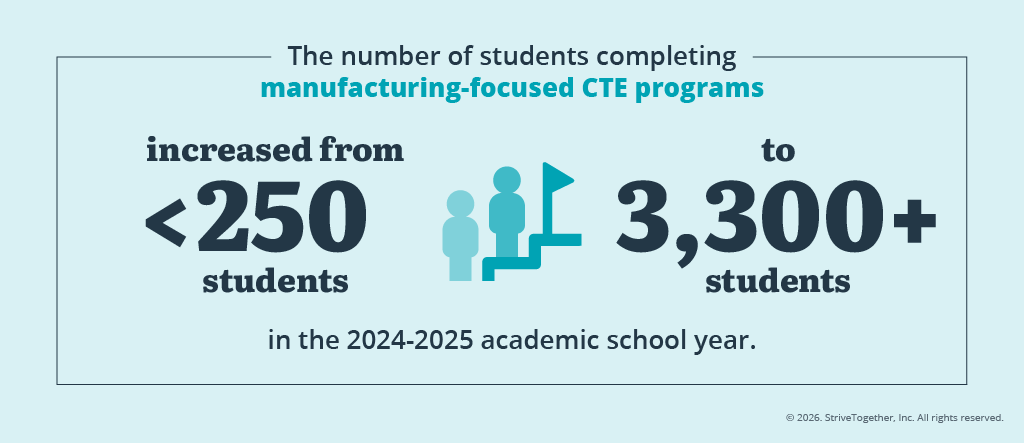
Students completing manufacturing-focused CTE programs grew from fewer than 250 to more than 3,300 in a single year.
National Background
Access to quality employment can change the trajectory of a young person’s future. Jobs that offer strong wages and opportunities for advancement allow families to build stability, invest in education and create long-term economic mobility.
National research from a Georgetown University study found that since 2010 the U.S. economy added 6.6 million jobs, including 2.9 million “good jobs” that pay wages in the top third of occupations.
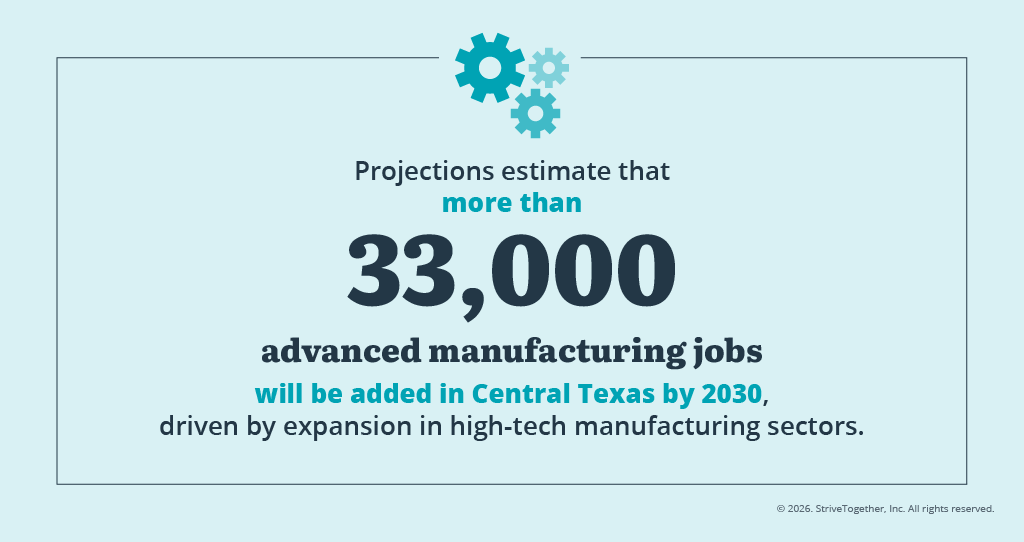
In Central Texas, that opportunity is growing rapidly. Projections estimate that more than 33,000 advanced manufacturing jobs will be added in the region by 2030, driven by expansion in high-tech manufacturing sectors, creating an urgent need to connect more students and workers to these pathways.
When someone doesn’t have access to quality jobs and living wage work, they’re just focused on survival. So it really becomes a systemic issue, not just an individual one.
Sara Saleem, director of career pathways and workforce attainment at E3 Alliance
Austin, Texas
Local Context
E3 Alliance, a member of the StriveTogether Cradle to Career Network, brings together education, workforce and industry partners to expand pathways into high-demand careers, such as advanced manufacturing. As a place-based partnership, E3 Alliance works at the community level to connect the people and organizations best positioned to improve outcomes for students and families.
As industries grow and technologies evolve, the new workforce landscape is creating new opportunities for workers while also showing the gaps in the education and training pipeline. E3 Alliance analysis of regional education data found that only 284 Central Texas high school seniors completed a sequence of manufacturing courses in 2022, while workforce projections estimate the region will need to fill approximately 20,000 advanced manufacturing jobs within the next five years.
For Sara Saleem, director of career pathways and workforce attainment at E3 Alliance, this gap highlights the importance of connecting education and workforce systems.
“Access to quality employment is the critical factor in long term success for families and individuals,” Sara said. “When someone doesn’t have access to quality jobs and living wage work, they’re just focused on survival. So it really becomes a systemic issue, not just an individual one.”
Richard Tagle, president and executive director of E3 Alliance, says strengthening workforce pathways is also critical to the long-term health of the region.
“Workforce attainment is important for everybody to be able to contribute back to the community and keep the economic development and viability of the region sustainable,” Richard said. “When people have access to careers that pay a living wage, they can pursue opportunities they care about while also contributing to the growth and vitality of their community.”
Through data-driven collaboration and regional partnerships, E3 Alliance works to strengthen the workforce pipeline while expanding access to high-demand careers. The partnership’s workforce initiative prioritizes students and adults from low-income households, who often face barriers to accessing education and career opportunities.
To address these challenges, E3 Alliance and its partners launched a regional effort to strengthen advanced manufacturing career pathways and expand access to training programs that connect learners to high-demand jobs.
Bringing Systems Together
E3 Alliance brings together partners across K-12 education, postsecondary institutions and industry to strengthen the region’s workforce pipeline. By convening school districts, colleges, workforce organizations and employers, the partnership helps ensure that education and training programs prepare students for the skills needed in today’s labor market.
Workforce attainment is important for everybody to be able to contribute back to the community and keep the economic development and viability of the region sustainable. When people have access to careers that pay a living wage, they can pursue opportunities they care about while also contributing to the growth and vitality of their community.
Richard Tagle, president and executive director of E3 Alliance
Austin, TX
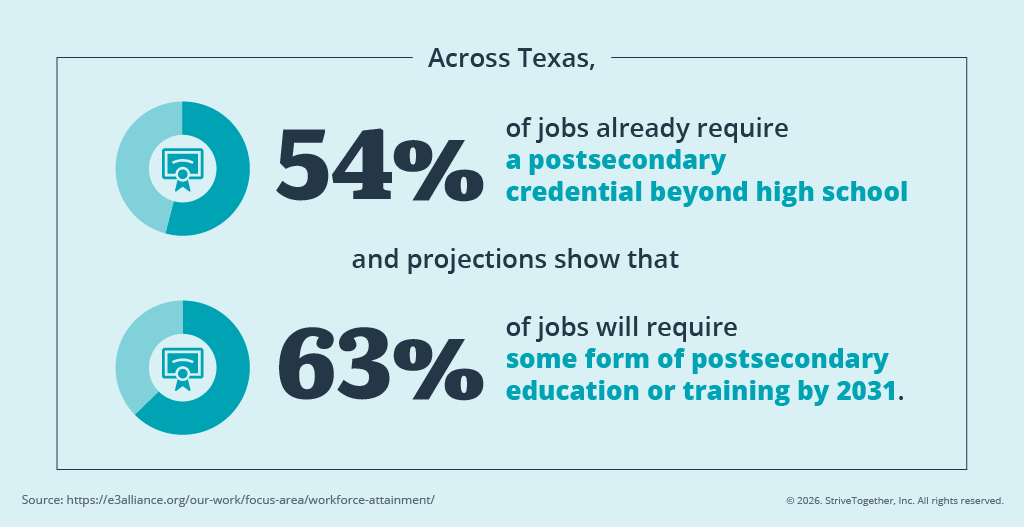
This coordination is increasingly important as workforce demands continue to evolve. Across Texas, 54% of jobs already require a postsecondary credential beyond high school and projections show that 63% will require some form of postsecondary education or training by 2031. Aligning education pathways with these workforce needs helps ensure students are prepared for careers available in their communities.
But historically, education and workforce systems have not always worked together. “In this region, the challenge has always been that education, training and employer needs operate in silos,” Richard said. “The role of E3 Alliance is to bring those sectors together so that the pathway from cradle to career becomes clear and navigable.”
Preparing students for these opportunities also begins earlier in the education pipeline. “Research has shown a direct link between middle school advanced math pathways, postsecondary readiness and workforce success,” said Priscilla Flores, senior director of policy at E3 Alliance.
E3 Alliance works with regional partners to use data to guide decisions about career pathways and workforce preparation. School districts, colleges and employers collaborate to identify the skills students need and ensure programs reflect real workforce opportunities.
Through this collaboration, the partnership is helping create clearer pathways for students to move from school into postsecondary training and high-demand careers.
Strategy and Impact
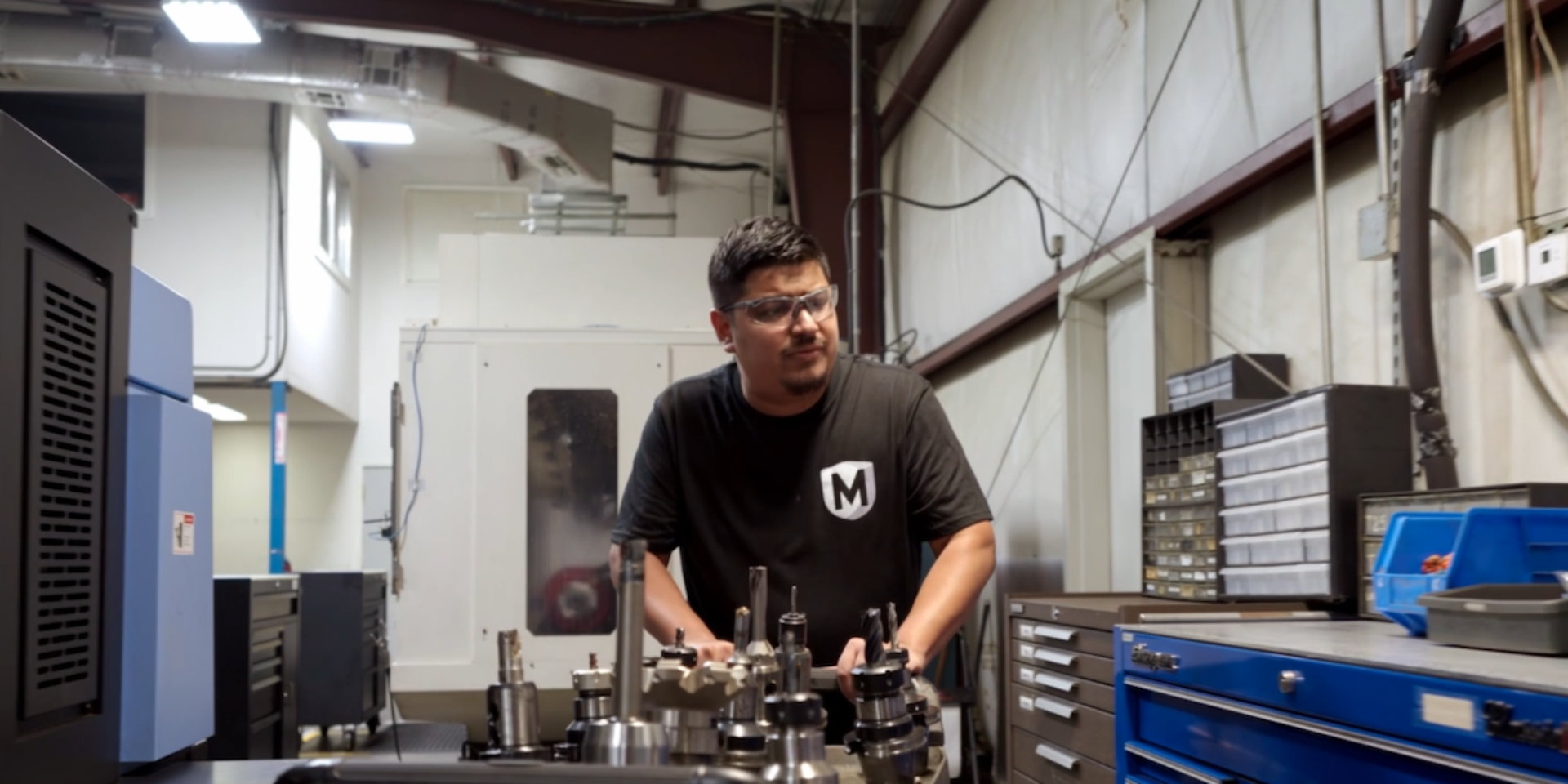
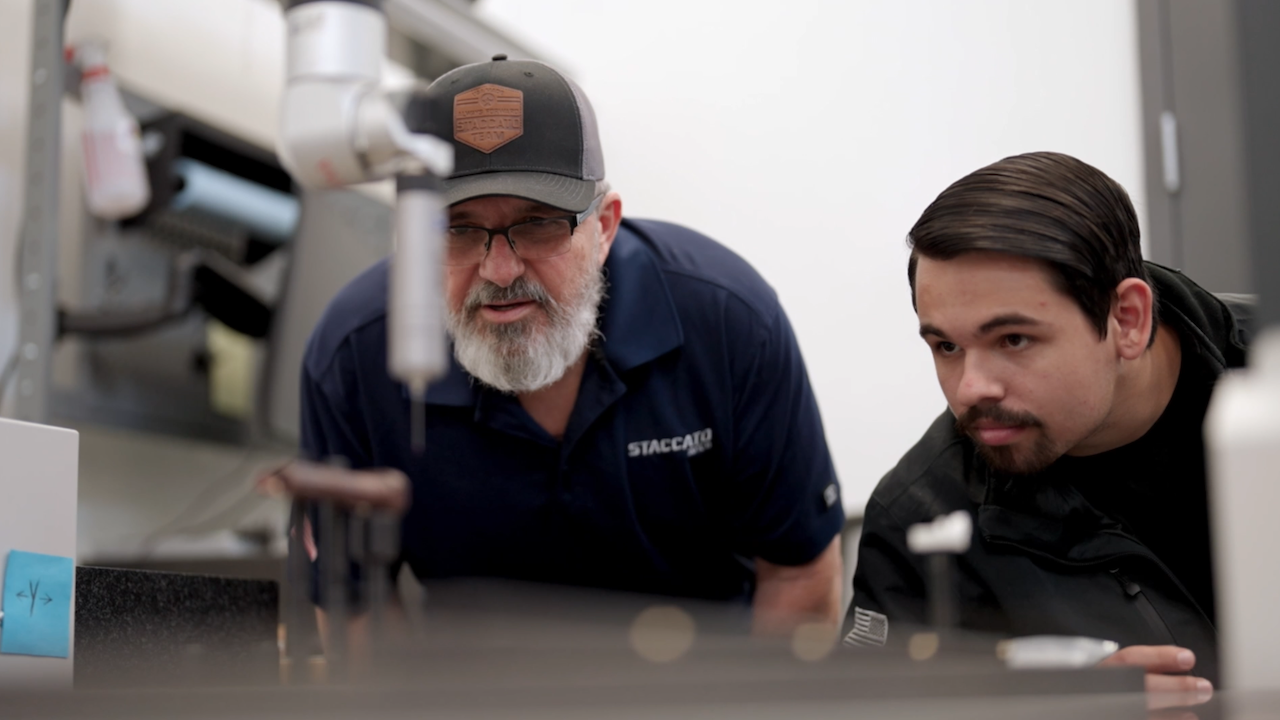
Advanced manufacturing is one of Central Texas’s fastest-growing industries and one of its most misunderstood. Many students and families still picture outdated factory work, unaware of the high-tech, high-demand careers that exist today. E3 Alliance is working to change that.
Through a regional approach that connects industry, education and community, E3 Alliance is building a workforce pipeline that works for everyone, helping employers find the talent they need while opening doors for students and adults seeking meaningful, well-paying careers.
They’re coming in on their days off, on school holidays, asking to work more. They’re excited because they’re starting to see what a career trajectory could look like for them.
Alexis Flores, director of workforce development at Austin Regional Manufacturers Association
Austin, TX
Early Momentum Across the Region
Early results from E3 Alliance’s workforce strategy show promising growth in the region’s manufacturing pipeline. By working with schools, colleges and employers to formalize career pathways and expand awareness of manufacturing careers, more students are beginning to enter these programs.
In recent years, participation in advanced manufacturing pathways has grown significantly. The number of students completing manufacturing-focused CTE programs increased from fewer than 250 students to more than 3,300 students in the most recent academic year. This growth reflects stronger alignment between education partners and employers across the region.
Regional data also shows progress in connecting students to employment and postsecondary pathways. In the 2022–2023 school year, about 66% of students in the region were employed six years after their expected graduation date. This outcome has also improved over time, increasing from about 64% in 2020–2021 to 66% in 2021–2022, and is remaining steady.
Additional regional data shows similar trends in the early workforce pipeline. For the class of 2022, about 63% of Central Texas graduates were employed one year after high school, either while enrolled in college or working full time. These indicators help regional leaders understand how education and workforce strategies are supporting students as they transition into careers.
The work has also revealed important insights about how students engage with workforce pathways. When students can see a clear connection between their education and real career opportunities, their interest and motivation increase.
Hands-on experiences such as internships, apprenticeships and workplace exposure help students better understand what careers in advanced manufacturing look like and how they can grow in the field. These experiences allow students to explore potential career paths while building relationships with employers.
These insights are helping E3 Alliance and its partners refine their approach as they continue expanding workforce pathways across Central Texas.
Future Vision
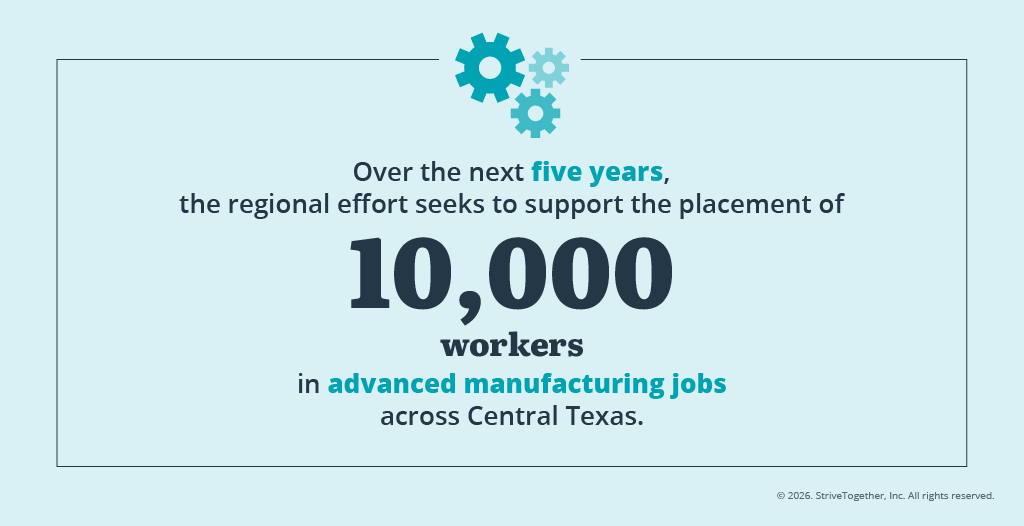
E3 Alliance and its partners are continuing to expand these workforce pathways. The partnership aims to enroll 1,750 new students and reskilling adults in advanced manufacturing pathways. Over the next five years, the regional effort seeks to support the placement of 10,000 workers in advanced manufacturing jobs across Central Texas.
The partnership is also working to develop a scalable workforce pipeline framework that aligns K-12 education, postsecondary training and employer needs. By strengthening these connections, E3 Alliance hopes to expand successful strategies to other sectors and regions.
As part of the StriveTogether Cradle to Career Network, E3 Alliance also benefits from opportunities to learn from other communities working to improve outcomes across the cradle-to-career continuum.
“Being part of the StriveTogether Cradle to Career Network has strengthened E3 Alliance tremendously,” Richard said. “We learn from other partnerships about how they approach opportunities and challenges, and we’ve been able to adopt best practices that strengthen our own work.”
For Richard, the Cradle to Career Network also provides valuable opportunities for leadership development and problem solving.
“As a leader, I’m able to connect with other leaders in the Network and tap into their insights about how they approach both community challenges and organizational development,” Richard said. “The training and knowledge sharing that StriveTogether provides has been immeasurable.”
These connections help partnerships like E3 Alliance refine their strategies, strengthen collaboration across sectors and scale solutions that improve education and workforce outcomes for communities.
Through continued collaboration and data-driven decision-making, E3 Alliance and its partners are helping build a workforce pipeline that supports both economic mobility for individuals and long-term economic growth across Central Texas.
Being part of the StriveTogether Cradle to Career Network has strengthened E3 Alliance tremendously. We learn from other partnerships about how they approach opportunities and challenges, and we’ve been able to adopt best practices that strengthen our own work.
Richard Tagle, president and executive director of E3 Alliance
Austin, TX
More Stories of Impact
Stronger Future Spotlight: Erika Graham in Baltimore