Chattanooga 2.0 Is Using Data to Drive Community Change
Every year, decisions about where to invest, which programs to fund and which students need more support get made without a full picture of what is actually happening to children and families. When data is scattered across agencies, averaged into numbers that hide who is struggling most or simply never collected, the result is resources that miss the mark and gaps that quietly widen for years. Without good data, those questions get answered by assumption, habit or whoever is loudest in the room. With it, communities can see clearly, act precisely and measure whether anything is changing. The decision to build shared data infrastructure is one of the most powerful choices a community can make for its children.
In Hamilton County, Tennessee, Chattanooga 2.0 has committed to that work, building data systems that track where children stand at every stage of their journey and ensuring that information reaches the people making decisions about their futures. Founded in 2015, Chattanooga 2.0 is a nonprofit backbone organization working to improve economic opportunity and quality of life through system change, with education as the foundation. As a member of the StriveTogether Cradle to Career Network, it connects families, schools, employers and community partners around shared goals and shared information.
Chattanooga 2.0 holds data at the forefront of all its birth-to-career strategies, believing that information should be easily accessible and widely shared so that community leaders, officials and residents can make evidence-based decisions together. That means collecting data the county did not have before, disaggregating it so no group stays invisible and making it public so every sector is held accountable.
Building the data infrastructure
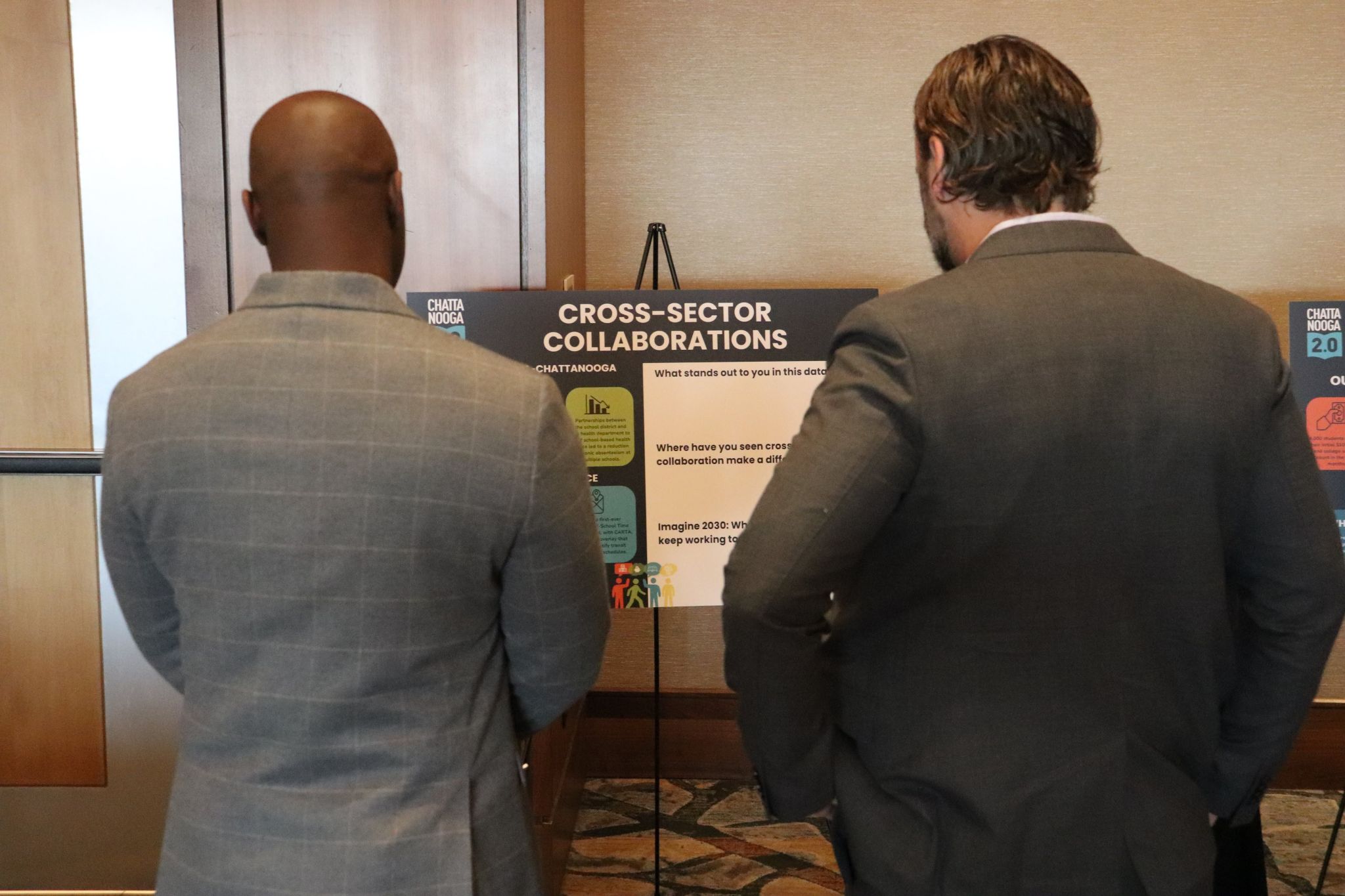
Without shared data systems, well-intentioned efforts operate in silos and problems go undetected until they become crises. Chattanooga 2.0 addresses that by structuring its data strategy around three pillars: goals and program evaluation, data accessibility and sharing, and youth and community engagement. The Chattanooga 2.0 Data Council coordinates that work, providing aligned data collection and reporting across early childhood, K-20 education and youth services so every partner works from the same information.
That approach has evolved over time. In the early years, the focus was on building trust, both in the quality of the data and in how it would be used. That foundation has since allowed Chattanooga 2.0 to become a trusted data source in the community. Today the emphasis has shifted toward actively sharing data to inform decision-making and reveal insights, with the next phase centered on connecting data systems across sectors to enable stronger, more coordinated strategies.
Some of the most important data the organization has produced is information the county simply did not have before. A fiscal map revealed that Hamilton County received $333 million in federal relief funding from FY2020 to FY2024, with $142 million going directly to Hamilton County Schools. Without that analysis, leaders could not identify which services were most at risk as relief dollars ended.
A first-ever child care seat count found the real available seat count was 8,700 short of the 11,000 seats estimated to be available if fully staffed and well below the reported licensed capacity of 14,000. Low wages were described as a key reason behind those shortages. A Child Care Cost study conducted the following year revealed the average wage of local child care teachers to be just $15.31 per hour.
Since 2022, Chattanooga 2.0 has also built four new dashboards tracking youth mental well-being, public relief funding, fiscal funding for children and youth and enrollment in the Special Supplemental Nutrition Program for Women, Infants, and Children (WIC). Each one surfaces information that would have remained scattered or invisible.
Data collected without community voice can miss what matters most. Through the third pillar, youth and community engagement, students at Brainerd and Howard high schools conducted participatory action research. They identified financial anxiety and uncertainty about life after high school as top concerns, needs no standardized test would capture. That insight now directly informs how Chattanooga 2.0 designs pathway supports.
Building on that work, Chattanooga 2.0 is now expanding youth engagement through a youth advisory council, ensuring young people have an ongoing role in shaping the data and decisions that affect their lives.
Connecting data to action
In the 2023-2024 school year, Chattanooga 2.0 piloted two tutoring models simultaneously at different elementary schools to evaluate which approach worked best. At East Side Elementary, students in the Literacy First model showed 50% more progress on decoding, the skill of sounding out words that unlocks independent reading. Kindergarten students gained 1.7 additional months of learning, and first-grade students gained 3.5 months.
The second model, piloted at a different school, did not produce the same results. Rather than continue an approach that was not working, Chattanooga 2.0 and Hamilton County Schools made the decision together to transition away from it That willingness to honestly evaluate both models and act on what the data showed, even when it meant ending a program, built trust with partners across the community that the data would always be used to serve children rather than protect appearances. Because Literacy First proved it was working, it scaled to 750 students across 14 campuses.
Program evaluation is built into every strategy. A review of the out-of-school time K-2 literacy toolkit found the initial training was too short, leading directly to a revised model with longer preparation and ongoing coaching. Through the Family Reads initiative, 83% of families reported more literacy-centered conversations at home, and the toolkit reached 406 students across six afterschool sites. That same commitment to evidence carried into workforce training, where Chattanooga 2.0 partnered with Vanderbilt University graduate students to formally evaluate the linework career pathway.
On thriving wages, labor market data and National Student Clearinghouse analysis identified the eight high schools with the lowest postsecondary attainment rates and shaped career pathways around what employers need. Only 18% of Black residents ages 25 to 34 earn more than $50,000 a year, compared to 35% of white residents. Five active pathways in linework, welding and dental assisting are on track to reach 10 by 2027, with a projected $13-15 million in economic impact. The share of young adults earning a thriving wage has grown from 24% in 2021 to 31% in 2023.
Data has also shaped how Hamilton County’s cross-sector leadership focuses its efforts. The Hamilton County-Chattanooga Children’s Cabinet, co-chaired by the mayors of Chattanooga and Hamilton County and the Hamilton County Schools superintendent, reviews data at every meeting to create shared understanding and drive action. What began as a focus on youth violence has, through regular data review, evolved into a focus on youth homelessness after the Cabinet identified housing instability as a key factor contributing to both chronic absenteeism and violence. That shift led to the End School Homelessness Pilot, where partners use monthly data huddles and Plan-Do-Study-Act cycles to improve coordination and housing outcomes for students. Early cycles have already refined referral criteria, streamlined data sharing and strengthened communication among agencies.
What the data shows
In late 2024, all of that data infrastructure came together in a single public tool. Chattanooga 2.0 launched its 2030 Goals Dashboard, a publicly available tool tracking five outcomes across Hamilton County: kindergarten readiness, third- through fifth-grade literacy, college and career readiness, postsecondary completion and the number of 25- to 34-year-olds earning a thriving wage of $50,000 or more per year. The dashboard does not soften what the data shows, because transparency is what holds the whole community accountable.
As of 2025, 40.9% of third- through fifth-grade students are reading and writing on grade level, up from 34.3% in 2018, against a goal of 70% by 2030. That same year, 55.6% of students graduated ready for college or a career, up from 37.2% in 2019, against a target of 70%. The most recent postsecondary completion data, tracking the class of 2019, shows 34.7% completed a degree or credential within six years, while the goal is 60%. And according to 2023 American Community Survey estimates, 16,509 young adults ages 25 to 34 are earning a thriving wage, compared to the goal of 20,000.
Every outcome is also broken down by race, economic status and English language learner status, so partners can see how students are doing overall and who is being left behind. On literacy, economically disadvantaged students score 35 percentage points below their peers on the 2025 state assessment. English language learner students have grown their proficiency rate from 10.4% in 2018 to 16.2% in 2025, a meaningful gain that still leaves them far behind the 44.4% rate for non-English language learner students.
On postsecondary completion, six-year graduation rates for Black students have held flat at around 22.9% while rates for white students have grown, a disparity the dashboard makes impossible to ignore. According to the 2024 Census Reporter, 25.3% of children under 18 in Hamilton County live below the federal poverty line, a rate that rises to nearly 40% within the city of Chattanooga itself. More than 33% of students attend high-poverty schools. Without disaggregated data, these disparities stay buried in the averages. within the city of Chattanooga itself. More than 33% of students attend high-poverty schools. Without disaggregated data, these disparities stay buried in the averages.
Rachel Kramer, Chattanooga 2.0’s director of data strategy and impact, described the purpose plainly when the dashboard launched. “The dashboard is designed to both hold Chattanooga 2.0 accountable to our goals and to help community organizations and local leaders inform and strengthen their work,” she wrote.
Data as a community resource
Data use is not a technical exercise. It is a commitment to honesty about where a community stands and a shared obligation to act on what is found. When data is disaggregated, it names who is being left behind. When it is made public, it holds every sector accountable. When it drives program decisions, it ensures resources reach the children and families who need them most. Chattanooga 2.0 has built all three into how it works, using shared data to pilot and scale what works, retire what does not and keep Hamilton County’s cradle-to-career goals in front of every partner. And that work is not standing still.
Looking ahead, Chattanooga 2.0 plans to review its contributing and contextual indicators in partnership with the Data Council and action teams to ensure they still fully capture what is happening for children and youth as conditions in Hamilton County shift. The organization also plans to build out a robust data system for the out-of-school time space, collect nutrition data for the county and continue growing data capacity for partners across sectors.
The 2030 Goals Dashboard is where that commitment becomes a community resource. It is a shared scoreboard for what Hamilton County is working toward together, putting the same honest picture in front of every sector at once. “The data is meant to shine a light on opportunities for change and highlight where we are making strides and where there is still work to be done,” Rachel said. The numbers are public, the goals are shared and the evidence from communities across the country is clear that when partners commit to using data together, outcomes for children improve.
More Stories of Impact
“Baltimore’s Promise, Maryland’s Partner”: How the ENOUGH Act Took a City’s Model Statewide