How Learn to Earn Dayton Turned a Community Model into Permanent Ohio Infrastructure Through Policy
Overview
In Montgomery County, Ohio, a student’s zip code once determined what opportunities they could access. Learn to Earn Dayton spent more than a decade building the community-level proof that changed that and then convinced a skeptical legislature to make it the law of the land for every region in Ohio.
-
From One Region to Every Region
SB 208 made Ohio the first state to mandate and fund regional cradle-to-career partnerships in all eight of its economic development regions.
-
The Data That Moved a Legislature
A statewide dashboard gave every Ohio legislator a view of how students in their districts were performing, creating a statewide policy case.
-
A Coalition That Made the Difference
L2ED turned a Dayton success story into an Ohio movement, with organizations across the state working to get SB 208 over the finish line.
National Context
State policy is a powerful lever for improving outcomes at scale. When policy changes, it changes for every student in every district, carries dedicated funding that survives individual budget cycles and creates accountability structures that outlast any single administration or philanthropic priority. When it does not, even the strongest local partnerships operate against a ceiling they cannot break through alone.
Across the United States, that ceiling is visible in the data. Only 31% of fourth graders scored at or above proficiency in reading on the National Assessment of Educational Progress (NAEP) in 2024, down from 33% in 2022 and the lowest rate since before the pandemic. Nearly 40% scored below the most basic reading benchmark, the largest share since 2002.
Those early gaps have consequences that follow students through every stage that comes next. On average, high school graduates earn at least $10,000 more annually then those who did not complete high school. When students fall behind in the early grades, the path to a diploma becomes harder and the path beyond it harder still. Georgetown University’s Center on Education and the Workforce projects a shortfall of 5.25 million workers with postsecondary credentials by 2032, as retirements outpace the pipeline of younger workers entering the labor market. Behind every one of those numbers is a system that policy has the power to change.
Community partnerships take years to build trust, align partners and produce results. Competitive grant cycles run on two- and three-year windows, and the communities that need coordination most are rarely the ones that win them. Without a policy mandate, participation is voluntary. Partners join when it is convenient and step back when priorities shift. Policy is what makes the table permanent, the accountability real, and the funding available to every region regardless of its capacity to compete for it.
Ohio looked at what its strongest communities had built and decided every region deserved the same infrastructure. One community in particular showed the state what was possible. Learn to Earn Dayton in Ohio spent more than a decade building and running the kind of regional partnership that SB 208 now requires everywhere in Ohio. They are a backbone organization that brings together schools, employers, higher education institutions, government and community organizations around shared data and shared accountability for student outcomes. That model, proven in Montgomery County, has convinced the Ohio legislature that the model was worth making permanent.
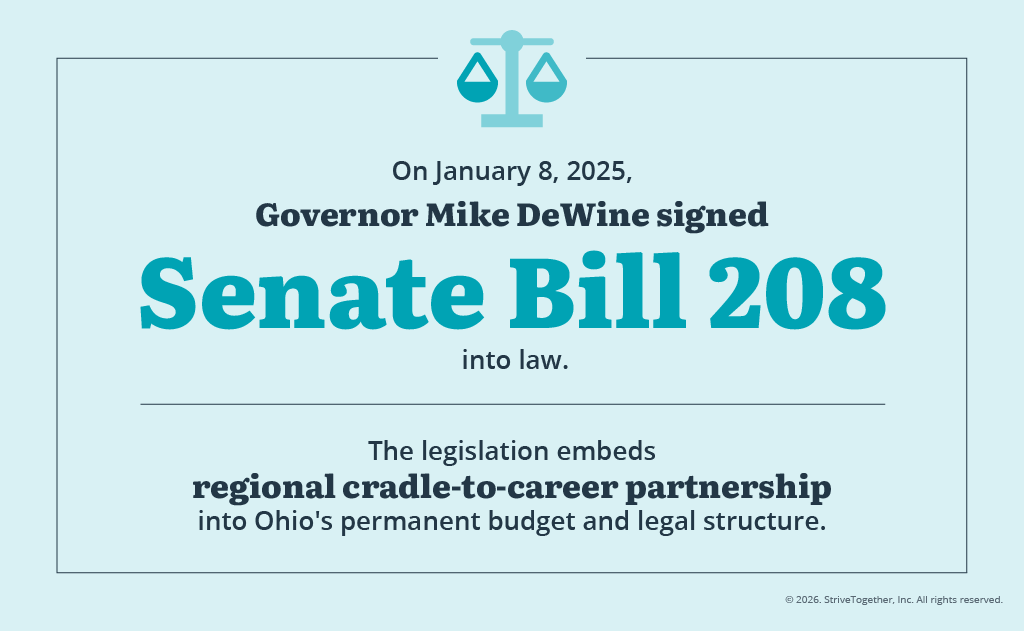
On January 8, 2025, Governor Mike DeWine signed Senate Bill 208 into law. The legislation embeds regional partnerships into Ohio’s permanent revised code structure. Those partnerships are organized around the state’s seven Jobs Ohio economic development regions and are accountable to the Ohio Department of Education and Workforce. SB 208 makes cross-sector regional partnerships a permanent part of how Ohio invests in children and workforce development, for every student and in every region, regardless of what outside funding is available in any given year. It is the most significant state commitment to sustaining place-based civic infrastructure enacted anywhere in the country.
Local Context
What Learn to Earn Dayton Built
The Dayton area was once home to several Fortune 500 companies. Over the years, companies left, in part, because they could not find the workers they needed. Learn to Earn Dayton (L2ED), a member of the StriveTogether Cradle to Career Network, was created in direct response to that reality. It does that by bringing together schools, colleges, employers, nonprofits and local government to align resources around the shared goal of making sure every student reaches the milestones that lead to economic independence.
L2ED’s north star is that 60% of working-age adults in Montgomery County will hold a degree or credential that gives them access to a high-growth, high-wage, high-demand career. Reaching that goal requires reading proficiency in the early grades, career awareness in middle school, credential attainment through postsecondary and employer connections that turn credentials into careers.
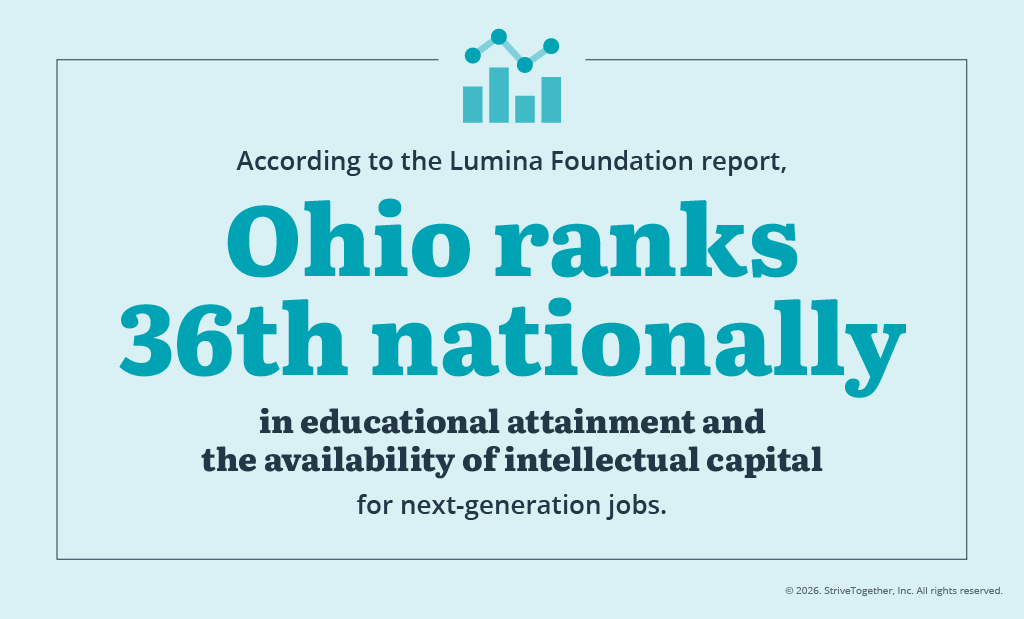
Tom Lasley, director of policy and advocacy at the Montgomery County Educational Service Center and founder of Learn to Earn Dayton, said the loss of those companies made the problem impossible to ignore. “One of the reasons those companies left was because they felt we did not have the workforce they needed. So, we knew we needed to address that problem.” According to the Lumina Foundation report, Ohio ranks 36th nationally in educational attainment and the availability of intellectual capital for next-generation jobs. The region needed a different approach and Learn to Earn Dayton was built to be it.
That work also made the case for something bigger. SB 208 requires every one of Ohio’s seven Jobs Ohio economic development regions to have at least one regional partnership, supported by the Ohio Department of Education and Workforce. Those partnerships are responsible for connecting state education priorities to local practice, including career-connected learning, Science of Reading implementation and FAFSA completion. Before SB 208, access to that kind of coordinated support depended on where a student happened to live. “Where a student lived dictated what opportunities might be provided,” Tom said. “We’re trying to move beyond that to uniform practices that allow all students, regardless of where they live, rural, urban or suburban, to be successful.”
Learn to Earn Dayton is the kind of organization SB 208 now requires everywhere in Ohio. Stacy Schweikhart, CEO of Learn to Earn Dayton, described how the work begins. “Learn to Earn Dayton starts with the data,” Stacy said. “We look at the data for outcomes for our students, but also for enabling conditions and contributing factors that may create barriers to academic achievement. We take that data and bring cross-sector partners together to say what assets do we have that we might align differently to create a system where all students can succeed.”
Learn to Earn Dayton starts with the data. We look at the data for outcomes for our students, but also for enabling conditions and contributing factors that may create barriers to academic achievement.
Stacy Schweikhart, CEO of Learn to Earn Dayton
Dayton, Ohio
Learn to Earn Dayton tracks student outcomes down to the census-tract level. They also built a publicly accessible and user-friendly statewide data dashboard showing how students in every school district, county, JobsOhio territory, and legislative district in Ohio are performing across every cradle-to-career milestone. That dashboard became one of the most powerful tools in the SB 208 campaign. It showed legislators not just what was possible in Montgomery County but exactly how far students in their own districts were from reaching critical milestones.
The partnership’s work on early grade reading shows how the model operates in practice. Third grade reading proficiency in Montgomery County sits at approximately 60%, below Ohio’s statewide average of 65%. In high-poverty districts, rates fall to between 30% and 40% (Ohio Department of Education). Rather than treating that as a school problem alone, L2ED looked at the full picture of a child’s day. Of the roughly 8,900 hours in a year, Ohio law requires about 1,001 to be spent in school, leaving nearly 4,900 hours while students are awake when reading either gets reinforced or does not. Through its summer and after-school learning collaborative, L2ED connects out-of-school-time providers to the same evidence-based literacy practices used in classrooms, extending learning into the hours schools cannot reach.
“Doing it in one region of the state allowed us to show how you could scale it throughout the state,” said Tom. SB 208 takes what Montgomery County built and makes it the standard for every region in Ohio, so that no student’s future is shaped by their zip code.
Strategy and ImpactStrategy and Impact
Building the Policy Case
The move from community impact to state policy required relationships that data alone cannot build. Learn to Earn Dayton spent years working alongside local legislators as ongoing partners, sharing data on student outcomes in their districts and helping them understand what the evidence showed. That sustained engagement meant that when the moment came to move a bill, the relationships and the credibility were already in place.
Those relationships were put to work directly in the Science of Reading campaign. Working alongside Representatives Andrea White, Phil Plummer and Tom Young, both from the Dayton region, L2ED helped advocate for the inclusion of Science of Reading requirements in both K-12 curricula and higher education teacher preparation programs in Ohio. The result was House Bill 33, passed in 2023 as part of Ohio’s state budget, securing $168 million for evidence-based literacy instruction: $86 million for educator training, $64 million for high-quality instructional materials and $18 million for literacy coaching. More than 300 educators in Montgomery County have since been coached in Science of Reading practices through the Montgomery County Educational Service Center.
Early results from that investment point in the right direction. Third grade reading proficiency in Ohio rose from 66% to 68% between 2022 and 2024. Dayton Public Schools, starting from a harder baseline of 38%, gained two points over the same period. These are first-cohort results, with more than 300 newly trained educators now carrying structured literacy practices into every grade behind them.
That track record became the foundation for the next push. HB 33 showed what was possible when a place-based partnership worked alongside legislators to turn community evidence into state policy. SB 208 took that lesson and applied it at scale, creating the permanent regional infrastructure that makes that kind of policy translation possible across every region of Ohio, for every education priority the state sets.
Getting SB 208 Passed
The legislative path required strategy as well as advocacy. The language that would become SB 208 was originally introduced as House Bill 312 by Representatives Andrea White and Tom Young in the 135th General Assembly. Recognizing that a standalone bill would move more slowly, the partners worked with legislative leadership to fold the HB 312 language into Senate Bill 208, in the final weeks of the session. Governor DeWine signed it on January 8, 2025.
[Learn to Earn Dayton] gave me the light bulb that we need to take this [legislation] not only from a funding standpoint statewide, but to institutionalize this within the Department of Education and Workforce so that it was sustainable long term.
Andrea White, Ohio House of Representatives
Montgomery County, Ohio
Representative Andrea White, who sponsored the original House Bill 312, said L2ED’s decade of work in Montgomery County was what made the legislation possible. “Frankly, there would be no legislation without Learn to Earn Dayton,” Andrea said. “They showed me the way. They showed me how it could work, and they basically role modeled for so many others in the state what it takes. It gave me the light bulb that we need to take this not only from a funding standpoint statewide, but to institutionalize this within the Department of Education and Workforce so that it was sustainable long term.”
Representative White said the goal was permanence, not just funding. “We passed legislation to institutionalize regional education partnerships so that it doesn’t matter who’s sitting in the legislature or who’s sitting at the Department of Education and Workforce,” Andrea said. “We have a commitment as a state to ensuring regional education partnerships are built and sustained throughout Ohio, targeted at the most in-demand jobs and the credentials and educational needs of our students, so that we have the workforce we need for the future and, above all, healthy thriving individuals who can support themselves and their families and help build their communities so that Ohio continues to thrive.”
For L2ED, the passage of SB 208 was the direct result of doing the work first and then making the case for it. “When our local initiatives with partners result in stronger outcomes for students, then the next part of the work is to connect with our state legislators to get policy passed that makes those opportunities and resources possible for all students in Ohio,” Stacy said.
Building the Coalition
L2ED also understood early that a bill championed by one community would face limits in a legislature representing 88 counties. The work needed to be an Ohio story. L2ED convened and led the Ohio Regional Partnerships Coalition, a statewide collaborative that advances policies contributing to better outcomes for children and young people. Coalition members include Summit Education Initiative and other StriveTogether network members across the state including Summit County, Toledo Tomorrow and Enterprise Muskingum. Each organization worked its own local legislative relationships while reinforcing a shared message that every region of Ohio deserves this infrastructure.
For David James, executive director of Summit Education Initiative, the collective approach was the only way to get it done. “When we have statewide coalitions around policy, we can actually influence what happens in our state capital in Columbus,” David said. “They can use their influence with their local legislator and then collectively as we all come together influence what happens in Columbus at the state legislature. There is definitely strength in numbers.”
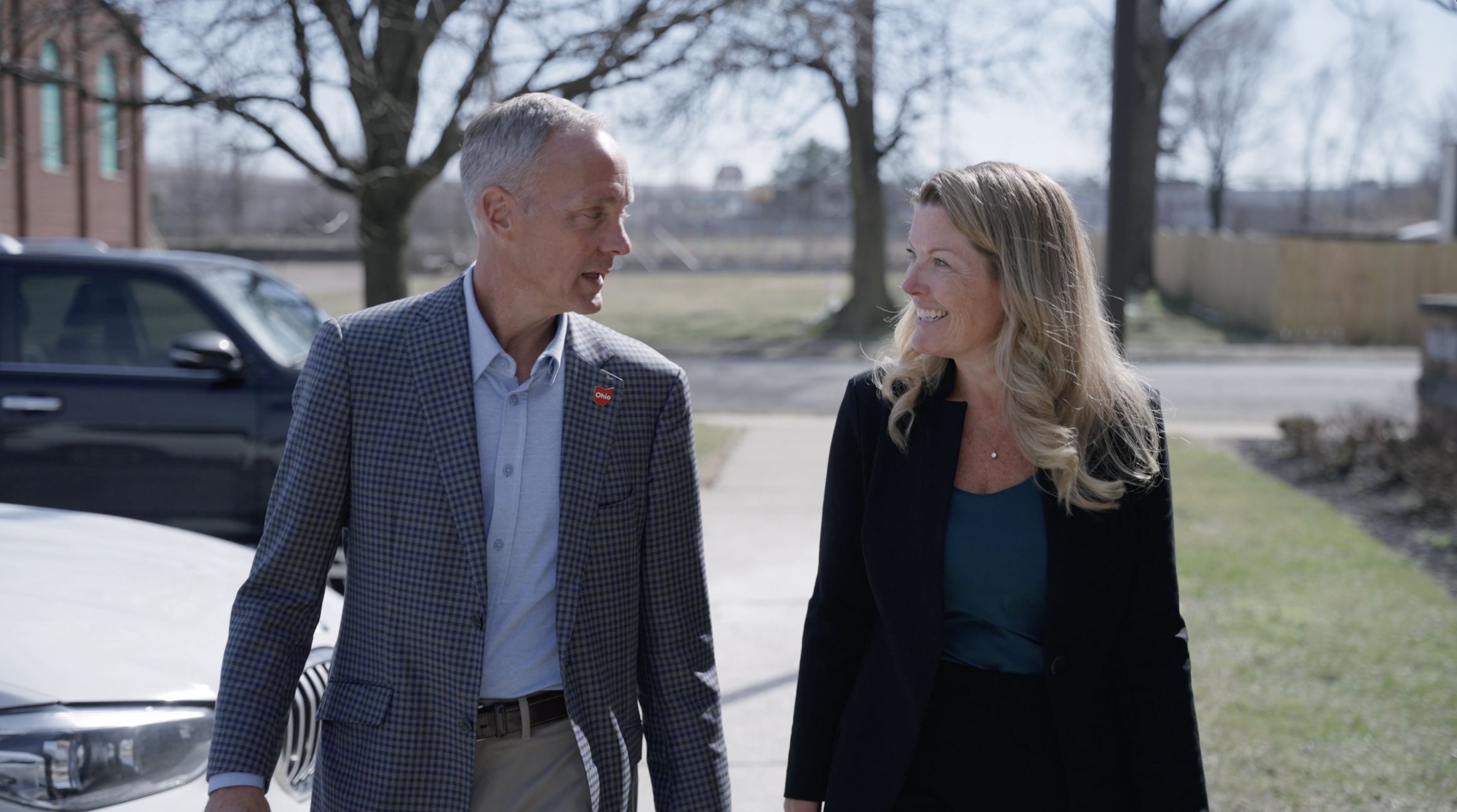
Coalition members provided direct testimony in support of HB 312, joined by StriveTogether Chief Advancement Officer Colin Groth, connecting local results to national evidence across the StriveTogether Network. That national connection mattered. “Being a part of StriveTogether has allowed us to show that a national organization is advocating for something that really is supportive of what we’re trying to do locally,” Tom said. “You need the national advocacy, you need the national presence in order for the local efforts to be successful.”
From Community Proof to Statewide Change
“Two things have really changed since Senate Bill 208 was passed,” Tom said. “First, we now have a legislative mandate to create regional partnerships. Second, and more importantly, we have leaders throughout the state who are embracing what we’re trying to do. And without that leadership, you simply cannot accomplish some of the outcomes that are essential.”
The passage of SB 208 marked a turning point not just for Ohio but for the national cradle-to-career movement. Learn to Earn Dayton is fielding inquiries from peer states looking to replicate the legislative strategy. StriveTogether is documenting the approach as a model for other network members. The core insight driving all of it is the argument Learn to Earn Dayton has been making for more than a decade: community-level proof, sustained over time and translated into permanent state infrastructure, is the only durable path to population-level change.
As one of the Pathways Impact Fund at StriveTogether’s inaugural grantees, Learn to Earn Dayton is deepening its work with school districts in Montgomery County and scaling into two adjacent counties, adding more than 2,500 students to career-connected learning pathways. John Garcia, executive director of the Pathways Impact Fund at StriveTogether, said the investment reflects a broader bet on what organizations like Learn to Earn Dayton can do. “Learn to Earn Dayton is expanding their pathways programming across the state in partnership with their State Department of Education and Workforce,” John said. “We’re making big bets on intermediaries. We believe they have the experience, the knowledge and the relationships to create transformation at scale.”
Representative Andrea White said the significance of what Ohio has done is still coming into focus. “When this takes hold across the nation, you’re going to see even more young people of all socioeconomic backgrounds coming together and saying, ‘I’ve got access to opportunity. I’ve got a future.’ We’re going to see more young people who truly realize their dreams and see that people care and are invested in their future.”
Future VisionFuture Vision
With SB 208 signed into law, Learn to Earn Dayton is moving from advocate to architect. The partnership is working with the Ohio Department of Education and Workforce and aligned organizations across the state to build the statewide network the legislation calls for. That network has a shared mission: engaging community partners to improve academic milestones for all Ohio students in every region.
Being part of the StriveTogether Cradle to Career Network remains central to how Learn to Earn Dayton grows and adapts. “Being part of the StriveTogether Cradle to Career Network has given us access to our colleagues doing this work across the country,” Stacy said. “We learn so much from our peers. Even though communities are different, we all hold the same passion, the same commitment and we’re working towards the same goals. When we learn from our colleagues across the Cradle to Career Network, approaches that they’ve taken in their communities to get stronger results, we’re able to bring those ideas back to our community and pull together our partners and find a way to rebuild our systems so that those opportunities can be extended here in our community as well.”
Stacy said the policy work is far from finished. “We found that some of the policy challenges in Ohio are not just about getting legislation passed that will lead to more opportunities for every student but actually preventing policies that are harmful for all students reaching those outcomes.”
Through sustained advocacy, cross-sector partnership and a commitment to data-driven systems change, Learn to Earn Dayton and its partners are helping build the civic infrastructure Ohio needs so that every student in every region of the state has access to the opportunities that make a cradle-to-career pathway possible.
More Stories of Impact
Stronger Future Spotlight: Crayons and Culture in Baltimore