Why Policy Matters
Shaping policies is one of the most powerful ways to create lasting change for young people. When policy is done well, it shifts the rules of the systems that create opportunity. It can expand access to early childhood education, change how schools are funded, connect young people to career pathways and remove barriers to economic mobility. When it’s done poorly — without data, community voice or attention to implementation — it can deepen the disparities it was meant to address.
Policy change is hard for one single organization to create. It requires data, relationships, community trust, knowledge of the political landscape and the capacity to stay engaged across years. Place-based partnerships, which are community partnerships that bring together youth and families, nonprofits, employers, schools and more, are uniquely positioned to advance critical policies that improve cradle-to-career outcomes.
Whether working at the local, regional, or state level, place-based partnerships in the StriveTogether Network develop the cross-sector relationships that policy work depends on. They identify the barriers preventing young people from reaching economic mobility, use data and community voice to test strategies and build the proof points needed to show what actually moves the needle for students. And because no partner carries the work alone, a coalition can involve different organizations in different roles: some contributing data expertise, others activating grassroots networks, others opening doors with decision-makers.
The result is policy change built on community insight, tested strategies and real outcomes data. That is what shifts systems in ways designed to improve outcomes for every student. And when place-based partnerships lead policy engagement, the relationships, data and community trust needed to make that happen are already there and ready to be activated.
How Policy Changes Systems
Individual programs can improve outcomes for the children and families they serve, but without policy change, those improvements rarely reach the scale needed to shift outcomes across an entire community.
Policy operates at every level of government — local, state and federal — and takes many forms. Some policies are formal laws, legislation and regulations, like state literacy laws, federal funding formulas or city budget ordinances. Other policies are the institutional rules and practices that shape day-to-day decisions within organizations and agencies, like a district’s grading policy, a grantmaker’s eligibility criteria or an agency’s intake process. Better outcomes usually require change in both categories.
Policies create rules, funding structures and accountability practices that determine how systems work. A policy that requires high-quality literacy instruction in every school reaches all students, including those whose families cannot access a specific program. A policy that links funding to student need changes what resources are available and where.
Research from the National Academies of Sciences, Engineering and Medicine refers to evidence that certain policy choices, like establishing early childhood education as a right, can improve outcomes for children. Data from What Works Cities, launched in 2015 by Bloomberg Philanthropies, shows that when city leaders use data to drive policy and operational decisions, it results in better services, more efficient use of public funding and stronger civic engagement. These kinds of structural shifts are what it takes to get to population-level outcomes.
Outcomes for kids are shaped by policy choices.
The Annie E. Casey Foundation’s 2026 KIDS COUNT Data Book reinforces that outcomes for children are shaped by policy choices, public investments and community conditions.
This kind of impact is why StriveTogether’s approach emphasizes the connection between changing direct service practice and shifting policy. Communities that pursue both together are more likely to produce lasting change.
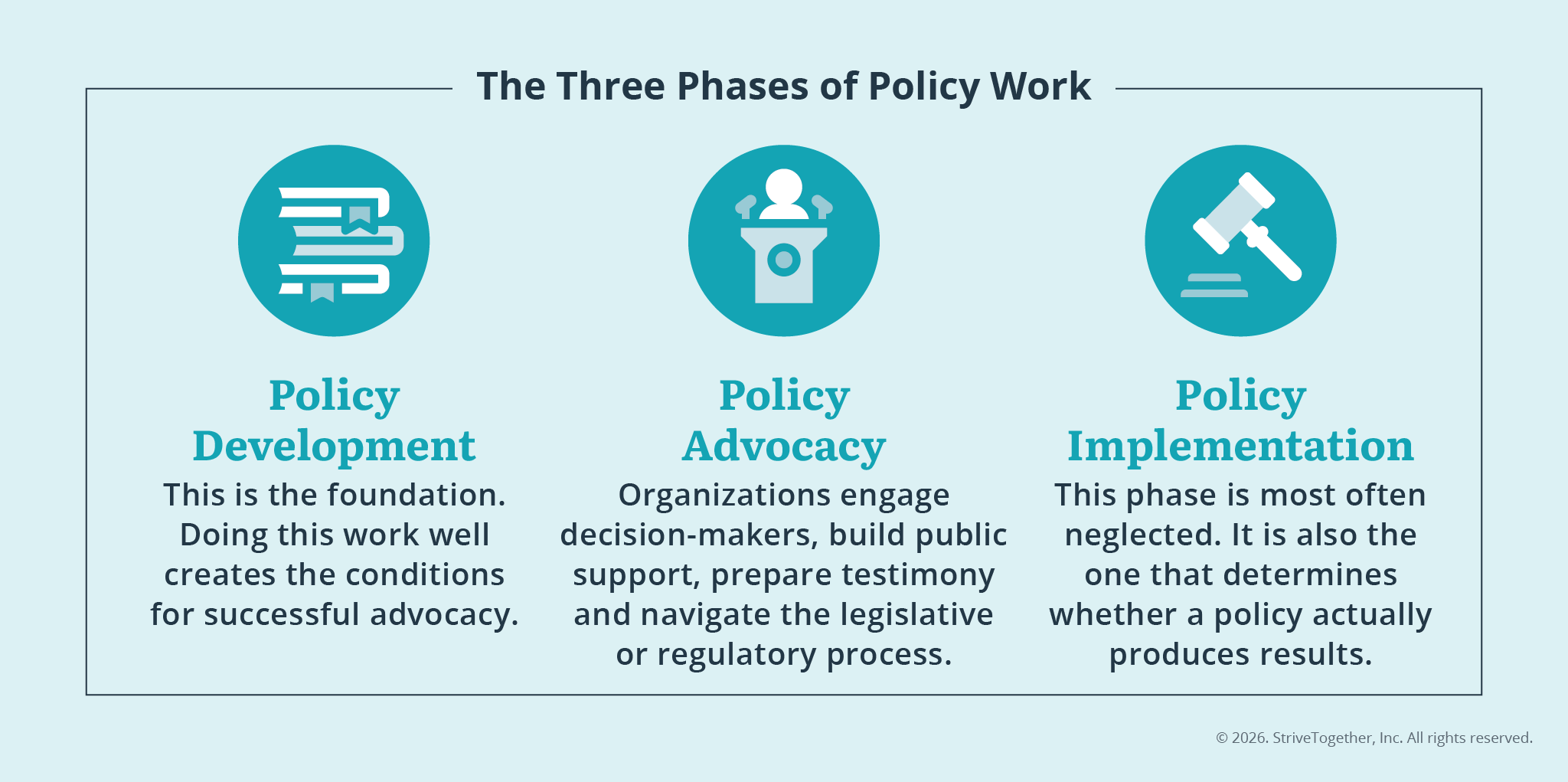
The Three Phases of Policy Work
The journey from problem identification to lasting policy change involves three interconnected phases, each building on the last. Before starting policy work, communities should make sure they understand the policy-related activities that are allowed for 501(c)(3) and 501(c)(4) organizations and the relevant IRS regulations.
Policy Work and Cradle-to-Career Outcomes
StriveTogether network communities work to improve seven outcomes across the cradle-to-career journey: kindergarten readiness, early grade reading, middle grade math, high school graduation, postsecondary enrollment, postsecondary completion and employment. At each of these milestones, policy shapes what is possible.

What children experience before kindergarten is shaped by child care licensing standards, subsidy policies and early intervention funding. Whether students read on grade level by third grade is influenced by state literacy laws, curriculum requirements and how assessment results are communicated to families. Whether a student graduates high school connected to a career pathway depends on dual enrollment, work-based learning and college advising policies at the state and local level.
No single organization can change all of these policies at once. Communities that develop the capacity to engage strategically in policy work, with data and community voice at the center, are better positioned to make progress on the outcomes that matter most and to sustain that progress over time.
What Strategic Policy Work Produces
When communities approach policy work with rigor, the results extend beyond any single policy win. Coalitions grow stronger. Community members develop lasting knowledge and confidence to engage in civic life. Relationships with decision-makers deepen. And the infrastructure built through one policy campaign becomes the foundation for the next.
This cumulative capacity is what makes systems change sustainable. It allows a community to move from reacting to conditions to actively shaping them.
Policy work is not easy, and the path from proposal to lasting impact is rarely linear. But for communities committed to ensuring every child has a path to economic opportunity, it is essential.
To go deeper, explore the StriveTogether and PolicyLink Policy Toolkit, which includes tools, worksheets, case studies and community stories for all three phases of the policy cycle.
Additional Resources
AI Resource Library
For Members
Why Postsecondary Completion Matters