UP Partnership Is Aligning a City Around Dual Credit and Postsecondary Success in San Antonio
Overview
UP Partnership is the place-based partnership behind the Future Ready Bexar County Plan, uniting more than 100 organizations across education, youth development, philanthropy, business and government around the goal of expanding postsecondary access for Bexar County students.
Students from low-income households remain underrepresented in dual credit nationally and locally, even as enrollment has climbed 14 points since 2020, reaching 64% years ahead of projections in Bexar County.
-
Expanding Access to Dual Credit
Alamo Colleges enrolled 21,851 dual credit students in fall 2025, up 31% and now nearly 25% of total enrollment: a major step toward earlier access.
-
Extending Advising Beyond the Counselor’s Office
Advise Me 210 trains trusted youth workers alongside counselors to guide students through college and career pathways. 83% request a second session.
-
Building District Capacity for Postsecondary Success
One district went from ad hoc advice to dedicated advisors, increasing credentials of value from 300 toward 400 students.
National background
Postsecondary enrollment is still pivotal for economic mobility
Postsecondary enrollment remains one of the clearest levers for economic mobility.
Enrollment in a public four-year institution alone is linked to a roughly 20% boost in household income by age 30.
Yet progress has stalled nationally. Immediate college enrollment for the classes of 2023 and 2024 held at around 60%, down from 68% a decade earlier, according to National Student Clearinghouse and National Center for Education Statistics. The Alliance for Excellent Education estimates that closing the college-going gap between underrepresented students and their peers could add $231 billion in GDP and $80 billion in tax revenue nationally. The unemployment gap tells the same story. The Bureau of Labor Statistics put the April 2026 rate at 2.8% for workers with a bachelor’s degree versus 6.4% for those without a diploma.
A four-year degree isn’t the only route to that payoff. Registered apprenticeships enrolled about 940,000 people nationally in fiscal year 2024, and completers earned average first-year wages of about $80,000, more than associate degree holders, based on a Government Accountability Office analysis of Department of Labor data. Apprentices still make up only about 0.3% of the U.S. working-age population, compared with 2% to 3% in Germany and the U.K.
One strategy for encouraging more students toward postsecondary enrollment is dual credit, coursework that lets high schoolers earn college credit before they graduate. According to the Collaborative for Higher Education Research and Policy, dual enrollment has broad, well-documented positive impacts on college enrollment and completion, and it’s why dual credit has become a go-to strategy for districts and colleges nationwide.
Columbia’s Community College Research Center finds dual credit narrows gaps only when paired with targeted outreach, strong pathway alignment, structured advising and high-quality instruction; without those elements, it can widen the very gap it’s meant to close.
National data show that economic disparities in postsecondary outcomes extend well beyond college enrollment. According to the National Student Clearinghouse Research Center, students graduating from high schools with greater concentrations of low-income students experience lower rates of college persistence and completion.
Among the Class of 2018, more than half of graduates from low-poverty high schools earned an associate degree or higher within six years, compared with just one in four graduates from high-poverty high schools. The disparity is also evident in persistence: for the Class of 2022, 74.4% of graduates from high-poverty high schools who enrolled in college persisted from their first to second year.
Local ContextLocal Context
Texas has watched that national pattern play out, with dual credit access split sharply along district and income lines. State leaders leaned on dual credit specifically as the lever to close it. In 2019, House Bill 3 created the College, Career or Military Readiness, or, CCMR Outcomes Bonus, an annual payment that rewards districts based on the share of graduates who complete dual credit, enroll in postsecondary education, or otherwise demonstrate college, career or military readiness, giving districts a direct financial reason to build dual credit pathways.
Bexar County is beating that national pattern. When Alamo Colleges District launched AlamoPROMISE in 2020, the goal was to raise the county’s college-going rate, counting students enrolled both in and out of Texas, from less than 50% to more than 70% within a decade. At the same time, Bexar County’s postsecondary enrollment rate has risen 14 percentage points since 2020 to 64%. UP Partnership’s own data dashboard, that measures in-state enrollment, tells a similar story using a narrower measure, only Texas colleges and universities. For over a decade, from 2011 to 2020, enrollment stayed between 46% and 51% every year. It dropped to 47% in 2021. Then it rose to 52% in 2022 and 56% in 2023, the highest point in more than ten years.
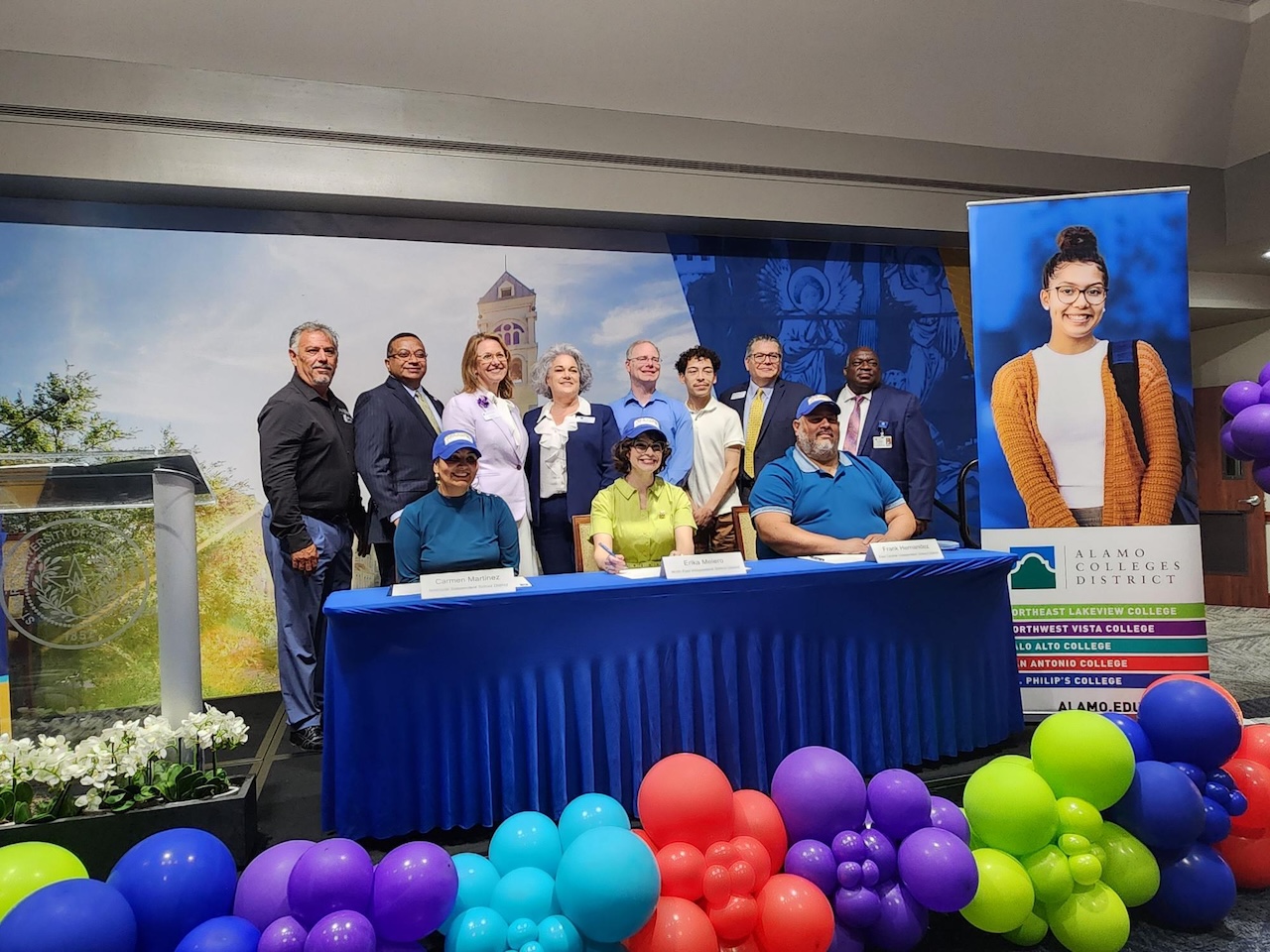
In San Antonio, UP Partnership, a StriveTogether Cradle to Career Network member and lead convener of the Future Ready Bexar County Plan, has aligned more than 100 organizations across education, youth development, philanthropy, business and government around the goal of closing the distance between a high school diploma and a postsecondary credential, and keeping that momentum going.
But a countywide average hides how unevenly that progress has landed. Nearly nine in ten students in one Bexar County district come from low-income households. That’s on par with the county’s other most economically disadvantaged districts, according to state data.
Alamo Colleges District, the region’s two-year college system and a key Future Ready Bexar County Plan partner, is where most of the region’s dual credit work happens.
For many students in Bexar County, especially first-generation college students, college can feel financially and academically out of reach. Dual credit helps make college feel attainable.
Dr. Cathy Jones, CEO, UP Partnership
San Antonio, Texas

Sara Mann, the district’s chief high school programs officer, regularly brings a chart into UP Partnership’s leadership meetings that tracks dual credit participation against low-income enrollment across 13 San Antonio-area high schools for 2022-23, with school names stripped out. At the highest-poverty school, 89% of students qualified as low-income and just 6% took dual credit. At the lowest-poverty school, only 34% qualified as low-income, and 37% took dual credit, more than six times the rate.
“It is a really tough chart to look at,” said Dr. Briana Hagelgans, managing director of educational pathways and opportunity at UP Partnership. “The access to those opportunities, I mean, it’s clear as day. It’s not good or bad. But we’ve got to do something about it.”
That uneven access is exactly what stands between Bexar County and the rest of the climb toward 70%. Closing it is the work UP Partnership, its member districts and Alamo Colleges have built their strategy around.
StrategiesStrategies
That data revealed a gap, and UP Partnership points to closing it as the reason the work started. That work has meant training more community advisors where counselors are stretched too thin, making college a reality by eliminating financial barriers, credentialing more teachers to teach dual credit, and making the region’s goals visible enough that students and families can track them too.
Once I saw myself succeeding in a pathway built for me, I stopped seeing myself as behind and started seeing myself as capable
Kendra, student
San Antonio, Texas
Impact
Countywide and regional gains
The clearest measure of what this system produces is the one UP Partnership tracks against its North Star. Bexar County’s Class of 2023 enrolled in postsecondary education at 56% when counting only public two-year and four-year. National Student Clearinghouse data provides a more comprehensive view of where students enroll, to include public and private intuitions and in-state and out-of-state institutions, revealing 62% postsecondary enrollment in class of 2023.
The Class of 2024 reached 64%. In 2020, when Alamo Colleges District launched AlamoPROMISE with a goal of reaching 70% within a decade, that same measure sat under 50%. Five years in, the county has already closed 14 of those 20 points.
Reaching that number sooner than modeled matters less to Dr. Cathy than what sits behind it. “We’ve seen students receive direct admissions offers and realize for the first time that college is within reach,” she said. “We’ve seen students complete dual credit courses and gain confidence in their ability to succeed in a college environment.”
Alamo Colleges District’s own fall 2025 enrollment shows the same momentum, with 87,757 students across its five colleges, a 12% increase. Dual credit and Early College High School enrollment reached 21,851 students, and more than 12,000 AlamoPROMISE scholars attended tuition-free. For students who start with dual credit, that momentum doesn’t have to stop at an associate degree. UT San Antonio and Texas A&M-San Antonio have built their own “Promise to Promise” pathways that extend Alamo Promise’s tuition-free model, covering tuition and fees for eligible students who transfer in to complete their four-year degree, turning what dual credit started in high school into a continuous, affordable route all the way to a bachelor’s.
Momentum is already growing
Dual credit and Early College High School enrollment hit 21,851 students for fall 2025, a 31% jump over the previous year — putting the 2029 goal of 29,000 students within reach ahead of schedule.
One District’s Success
Inside the district, the advising overhaul is already showing up in completion numbers. Across its P-TECH and early college campuses, about 300 students earned a “credential of value,” a Level 1 certificate or associate degree, during the 2024-25 school year. That number is expected to climb toward roughly 400 in 2026.
At one of the district’s most high-poverty campuses, which went from zero to five advanced academic and dual credit sections in a single year, a sophomore class completed a dual credit algebra course with high success the coordinator wasn’t sure which course to place them in next. That campus is now the first ensuring every campus offers at least one Level 1 certificate aligned to a local college program, ahead of a 2030 shift in Texas’s accountability rules that will count those certificates as an advanced college-readiness indicator without requiring the placement exam first.
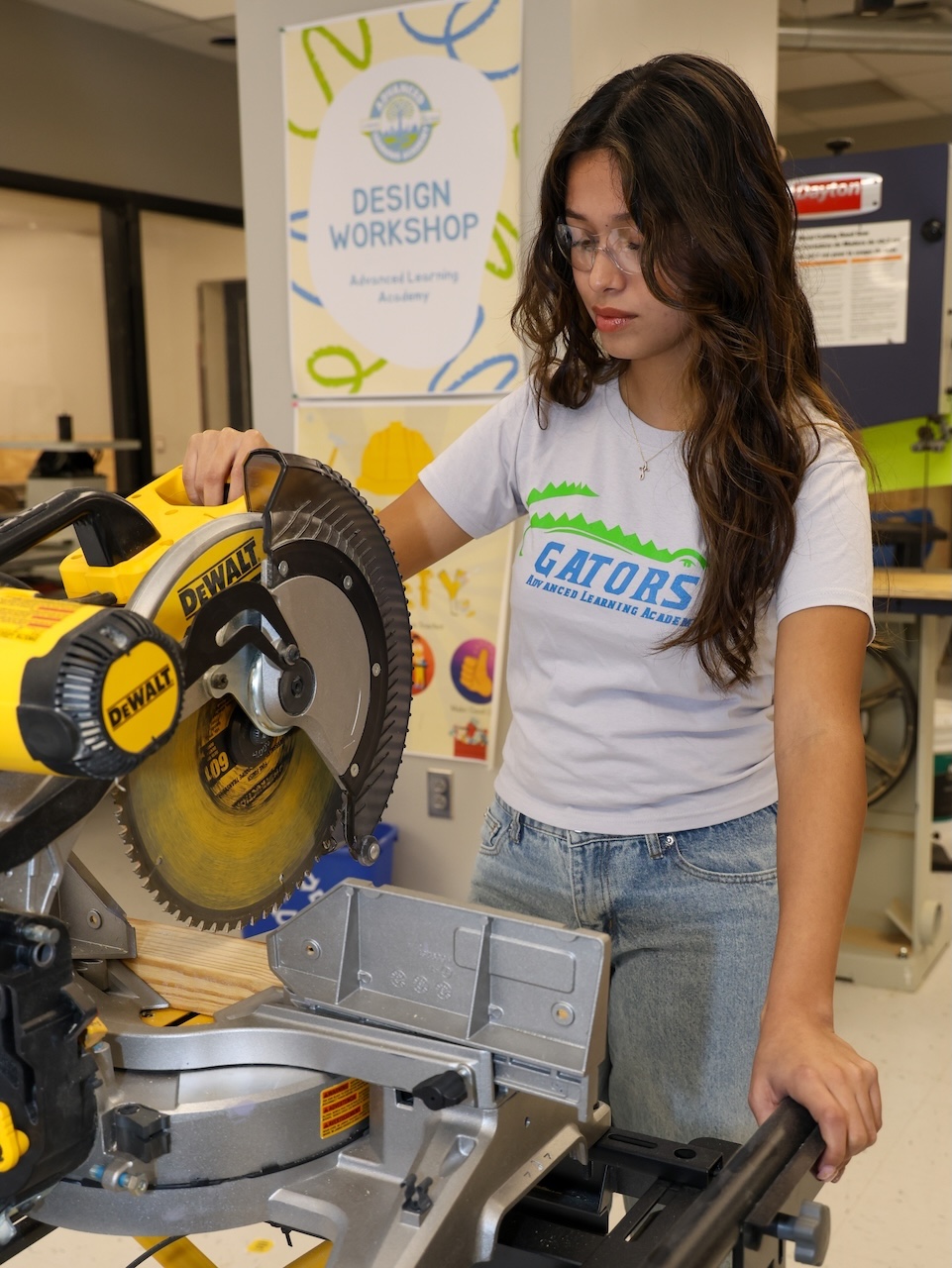
What ties Advise Me 210, the direct-admissions pilot, the faculty credentialing partnership and the district’s advising overhaul together is a shared discipline, not a single program. “UP Partnership’s role is to keep the data and the conversations honest enough that partners stay pointed at the same gap,” Dr. Brianna said. “Everybody has opinions on the way things should be, but looking at the numbers, who’s getting access to opportunities, who’s not, that only happens when all of us come together.”
For many of these students, the credential of value is only the midpoint. Industry partners have created jobs for students before they leave for college, letting them work while finishing their credentials, and some go on to nursing school and other in-demand programs. The lesson the region draws from these cases is what happens when a system stops treating a student’s file, a 504 plan, a district transfer or an unconventional path as a mark against them and instead builds advising, dual credit and employer partnerships sturdy enough to catch students wherever they land.
The network effect
UP Partnership isn’t building this model alone, or from scratch. It’s one of dozens of place-based partnerships across the country doing similar work as part of the StriveTogether Cradle to Career Network, and that partnership shapes how the work gets done locally. “Being part of the StriveTogether Cradle to Career Network has had a significant impact on both our work at UP Partnership and our broader community,” said Dr. Cathy. “The network has provided us with a proven framework for driving community-wide systems change and has strengthened our role as the lead convener of the Future Ready Bexar County Plan.” Rather than organizations working independently toward similar goals, the framework helps align partners around a common vision and a shared set of results.
In Bexar County, that has helped move the region from isolated efforts to coordinated action across education, youth development, philanthropy, business and local government. Today, nearly 100 partners are aligned around that shared North Star, and StriveTogether’s emphasis on data has helped UP Partnership identify disparities, track where progress is happening and focus resources on the strategies making the greatest difference for students and families. The network has also connected UP Partnership to communities nationwide tackling similar challenges, giving the partnership access to national best practices and proven strategies that have accelerated its own work, and reinforced how much good data analysis matters to making sure all young people, especially those who have been historically underserved, have access to opportunity.
“On a personal level, as a CEO, being part of the StriveTogether network has provided me with an incredible cohort of leaders who are deeply committed to solving these challenges in their own communities,” Dr. Cathy said. “The camaraderie, support, and insights I’ve gained from those relationships have been invaluable, particularly as a relatively new leader in this space.”
StriveTogether has also strengthened the partnership’s internal capacity through “tools, coaching, and accountability structures” that keep it focused on outcomes rather than activities alone, reinforcing what she calls a lesson seen every day in Bexar County: that “meaningful and lasting progress happens when institutions commit to shared accountability, long-term collaboration, and a common vision for young people’s success.”
The Cradle to Career Network has provided us with a proven framework for driving community-wide systems change and has strengthened our role as the lead convener of the Future Ready Bexar County Plan.
Dr. Cathy Jones, CEO of UP Partnership
San Antonio
Future Vision
UP Partnership and its partners are not finished with the work that chart started: of closing the wide, uneven gap in dual credit access between the county’s affluent and low-income schools. The partnership has set explicit goals for the districts furthest behind on dual credit access, directing additional advising their way. Its My Brother’s Keeper San Antonio network, recognized by the Obama Foundation as an accelerator program, is expanding its focus on boys and young men of color in underserved neighborhoods. Alamo Promise is reaching earlier into students’ lives too, with a Blue Meridian Partners investment funding work into the middle grades.
Other pieces of the work are still being built. UP Partnership and its member districts have kicked off a needs assessment on high school completion, with partners selecting shared indicators through a formal agreement process. “We are deepening our work through the Future Ready Bexar County Institutional Agreement process,” Dr. Cathy said. “Through these agreements, organizations are making formal commitments to shared outcomes and aligning their efforts around our collective goal of increasing postsecondary enrollment.” A separate assessment is mapping the region’s work-based learning landscape.
One gap remains open, and that is pushing the city’s largest employers to track new hires by high school and career pathway, data that would show whether graduates land in the careers the pathways were built for.
Dr. Cathy frames that gap as the network’s next horizon. “It is not enough to help students get to college,” she said. “We want to ensure they earn credentials with labor market value, complete their programs and enter careers that provide long-term economic opportunity and financial stability.”
Through dedicated advising, expanded dual credit access and a shared commitment to data-driven systems change, UP Partnership and its partners are helping build the civic infrastructure Bexar County needs so that every student, not just the ones born into opportunity, gets to redefine what’s possible for their own life.
Additional Stories
Stronger Future Spotlight: Erika Graham in Baltimore