Stronger Future Spotlight: Erika Graham in Baltimore
Growing up, Erika Graham thought her path led toward marine biology. Then, during her junior year, CareerBound recruiters from Urban Alliance came to Green Street Academy with an offer that made her reconsider that path. They told her about a new program, one that went beyond standard Certified Nurse Assistant (CNA) training.
“I didn’t know what I was walking into, to be honest,” Erika said. “I really wasn’t sure. I was just like, this seems like a cool opportunity to look good on my resume, I’m going to give it a try.”
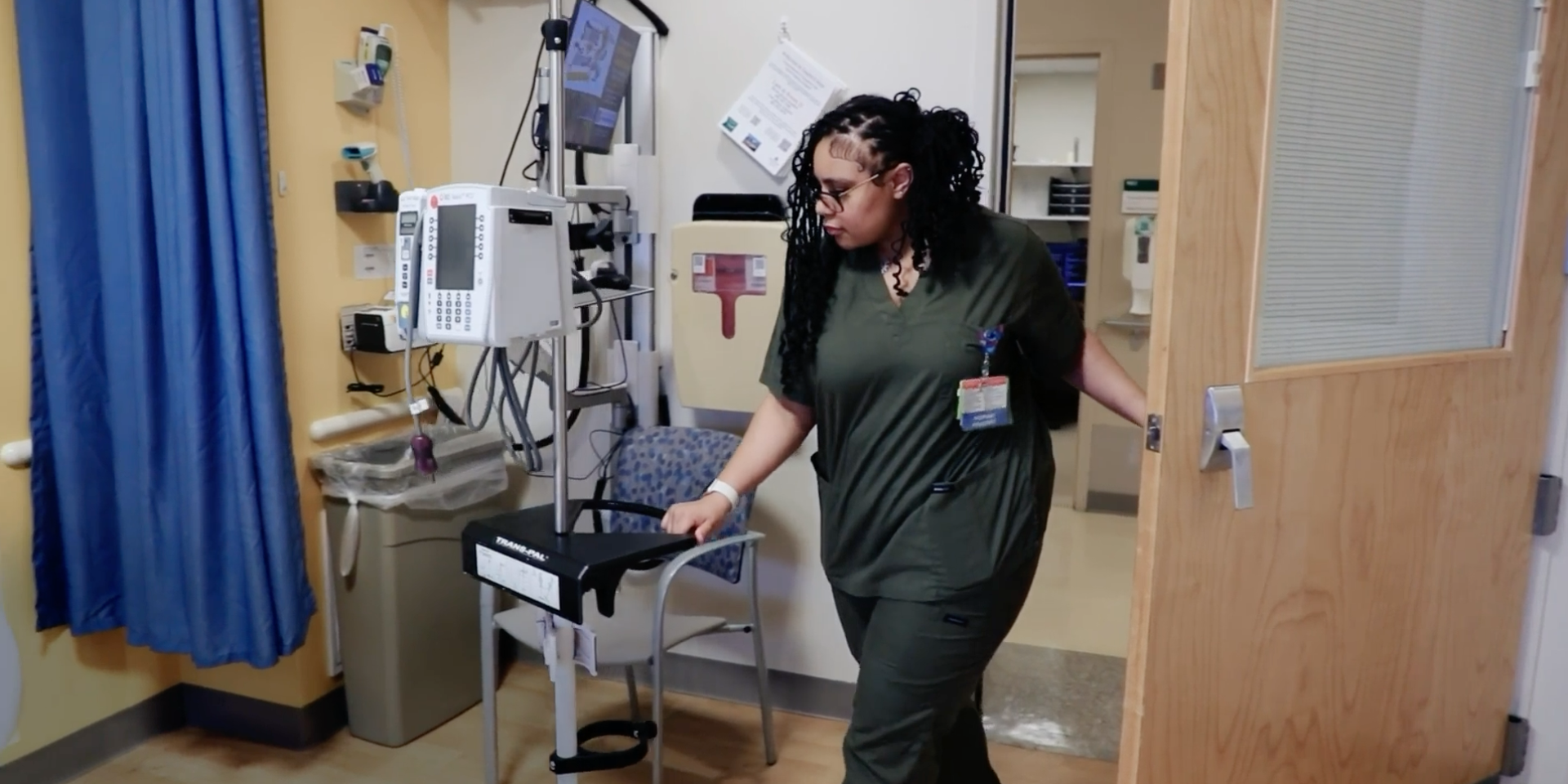
As a senior at Green Street Academy, a high school in Baltimore City, Erika worked as a certified nursing assistant on the comprehensive transplant unit at Johns Hopkins Hospital, helping patients through some of the most vulnerable moments of their lives. The CNA credential was just her first step toward a nursing career, not the destination, and every college application she has filled out listed the same intended major: pre-nursing.
“It made me finally decide what I wanted to do,” she said.
A Pathway Built Over Time
What made Erika’s apprenticeship possible was years of groundwork happening behind the scenes. Baltimore’s Promise, a StriveTogether Cradle to Career Network Member, had spent years building a partnership with Baltimore City Public Schools and the Mayor’s Office of Employment Development called CareerBound. This system is designed to do exactly what happened to Erika: place students with real employers, like Johns Hopkins Hospital, and pay them to learn a field before they have to commit to it.
The goal, said Julia Baez, chief executive officer of Baltimore’s Promise, is to replace assumption with lived experience. “Sometimes you want to be a nurse, but you show up in a hospital and you hate to see blood,” Julia said. “We need to make sure that kids have a chance to try those things out, so that as they’re crafting their pathway and they’re thinking about their future, it’s not just informed by what they’ve heard, but it’s actually informed by their own personal experiences.”
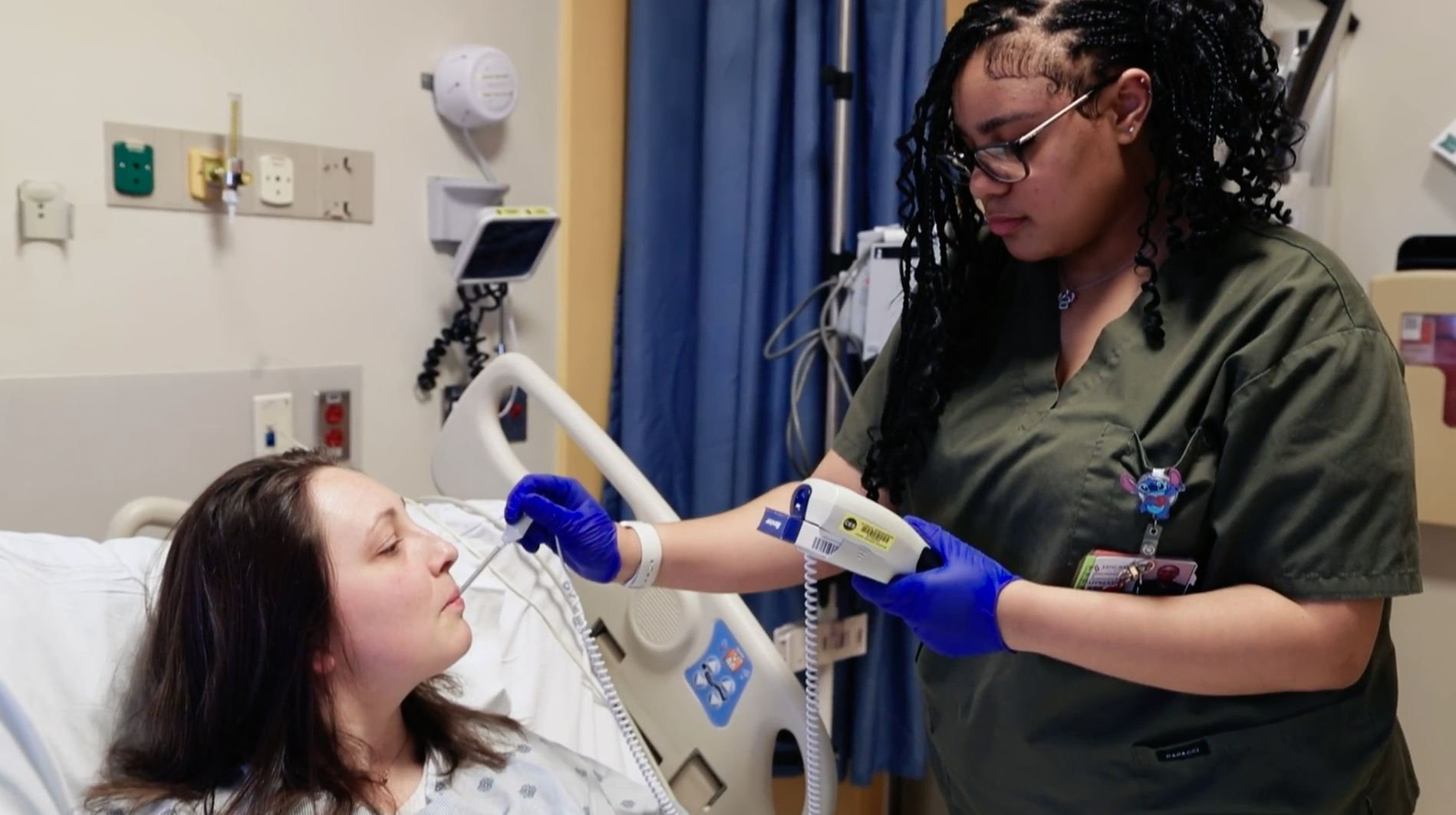
According to Eric Jefferson, executive director of secondary success and innovation for Baltimore City Public Schools, students choose a pathway as early as eighth grade, then move through a built-in sequence: a related course freshman year, industry-recognized credentials sophomore year, an internship junior year and a paid apprenticeship senior year, with the hope that graduation leads straight into full-time work.
The number of students in apprenticeships districtwide has grown quickly, from two in 2023 — when Jefferson took over the role — to 189 this year, spanning fields from healthcare to skilled trades to automotive work. This growth has been driven in part by the Blueprint for Maryland’s Future, which requires 45% of Maryland high school graduates to earn an industry-recognized credential or complete the high school component of a registered apprenticeship program by 2031.
The healthcare apprenticeship pilot Erika joined gave 106 students real-world experience in roles like certified nursing assistant and surgical technician, working toward a credential through up to 450 hours of hands-on learning inside hospital systems like Johns Hopkins, chosen in part to help address a well-documented healthcare staffing shortage in the city.
The goal is entry into a career pathway that leads to a livable wage, whatever point along that pathway a student chooses to build a life from. Nationally, nearly four in ten students who enroll in a postsecondary program never complete it, and Baltimore’s Promise co-designed this opportunity so that students who want to keep going have a clear way to do it, with each credential designed to connect to the next. For Erika, that shows up as a CNA license that doubles as a running start toward the nursing degree she now plans to pursue in college.
A Connection That Found Her
When Erika’s school first introduced the program, it wasn’t just CNA training — students could also explore paths like phlebotomy. She talked it over with her mom and picked CNA because it was something she had never tried.
Her junior year built toward supporting that choice with coursework in what Erika calls “adulting” (saving money, setting goals), a summer youth employment program with her first debit card, a month of classroom coursework and quizzes she had to pass before moving on. She then had a week of hands-on clinicals — taking vitals, checking blood pressure, making beds and other tasks of the role. Passing that clinical week is what let her move into the matching process that placed her at Johns Hopkins.
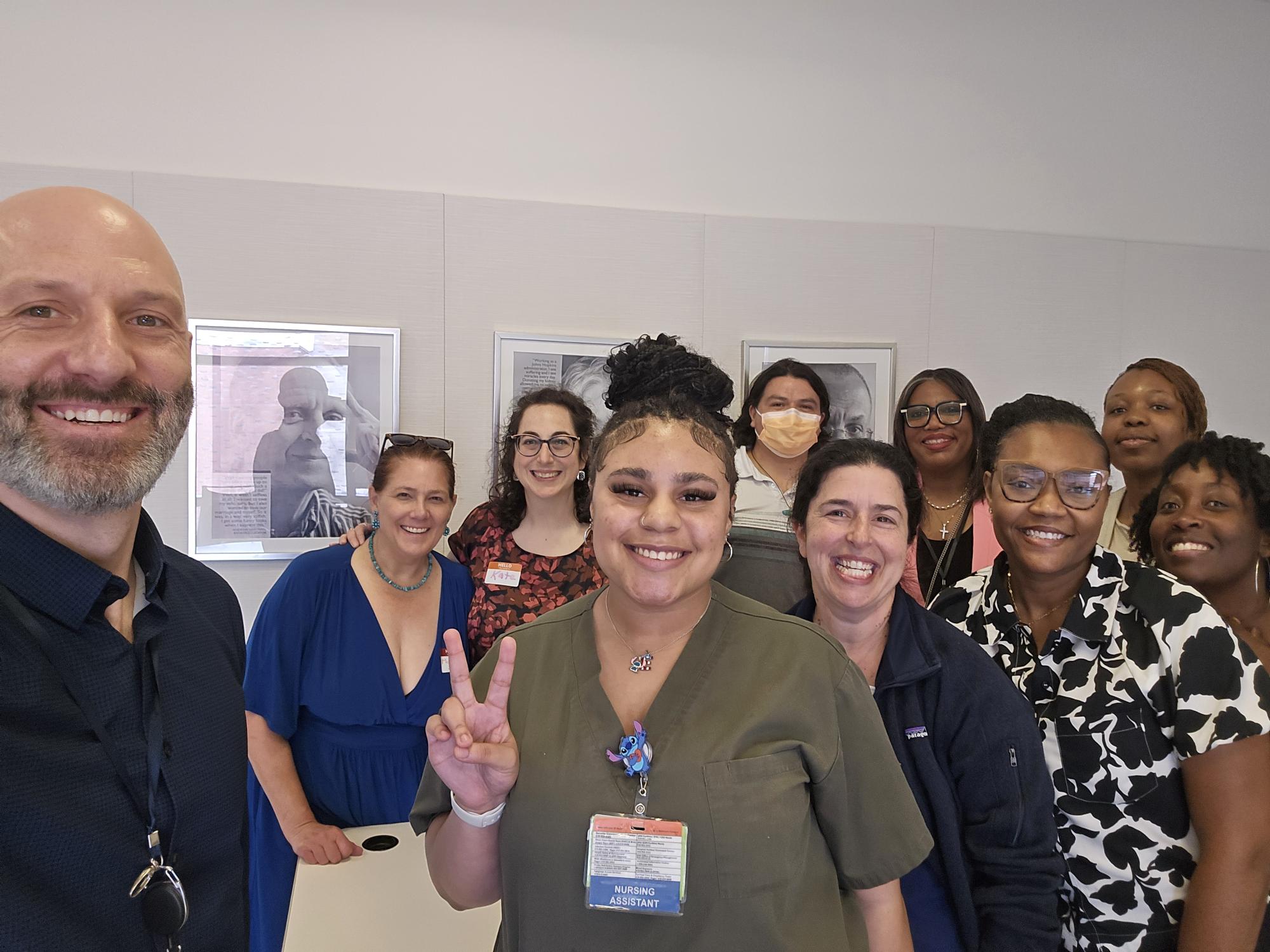
That placement closed a loop Erika didn’t expect. She landed in the comprehensive transplant unit, the same floor where her grandmother received a kidney transplant in 2015. Before that, her grandmother had worked in dialysis herself.
“She used to do dialysis here, but she used to work there before she became a patient,” Erika said. “She’s the one who first taught me all the small stuff in the hospital that I needed to know before I came on this floor.”
Erika calls her grandmother her best friend and her whole world. Now Erika cares for patients going through the same transplant process her grandmother once did. “I get to take care of other patients that are going through the same thing,” she said. “Having this connection of her being on this floor, and me being able to help patients just like her, is what makes me, me.”
That connection became concrete the first time Erika watched a kidney transplant in the operating room. “Getting to see what [her grandmother] got was very meaningful for me,” she said. It’s also part of what made nursing feel like the right path to put on her college applications.
A Mentorship Built Around Her Curiosity
Erika’s mentor is Jen Glovitch, the nurse manager who oversees the transplant unit and has spent more than two decades in nursing. Jen said she matched Erika to the unit based on her personality and aspirations. Part of her role during Erika’s apprenticeship was making sure she saw beyond the immediate opportunities of her program.
“We try to make sure that Erika has the autonomy to set up opportunities that she’s interested in,” Jen said. “I want her to see the unit and understand the unit, but then there’s also things outside of the unit that I feel would interest her as well.”
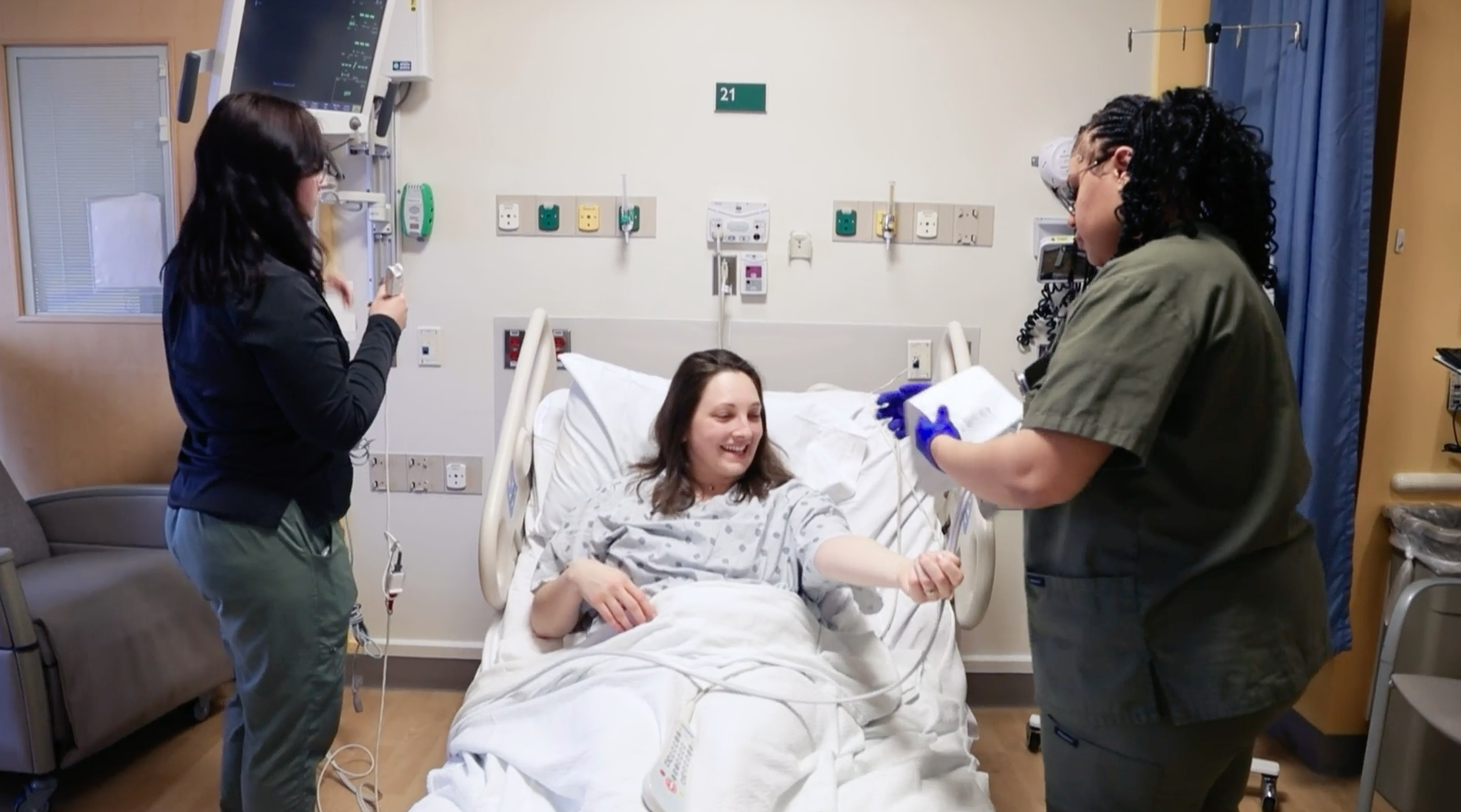
When Erika mentioned wanting to explore psychiatry, Jen set up time for her on a psychiatric unit. She has also sent Erika to the operating room five times, where she’s watched a kidney transplant, a liver transplant, an emergency C-section and spinal surgery.
One of those operating room visits stood out to Jen, too. “I’ll never forget the day that Erika came back from the operating room because she had such a great experience,” Jen said. “Her eyes were lighting up, and she couldn’t wait to go back, so much so that she set up another opportunity independently with the operating room and went back another day to see another experience.”
Not everything came easily. Jen said Erika has had to navigate scheduling conflicts between school and the unit, and the learning curve of professionalism in a new setting. “I helped her with continued guidance and reinforcement of good behaviors, and reminders when things weren’t meeting her professional requirements,” Jen said.
“We try to make sure that Erika has the autonomy to set up opportunities that she’s interested in. I want her to see the unit and understand the unit, but then there’s also things outside of the unit that I feel would interest her as well.”
Jen Glovitch, nurse manager at Johns Hopkins
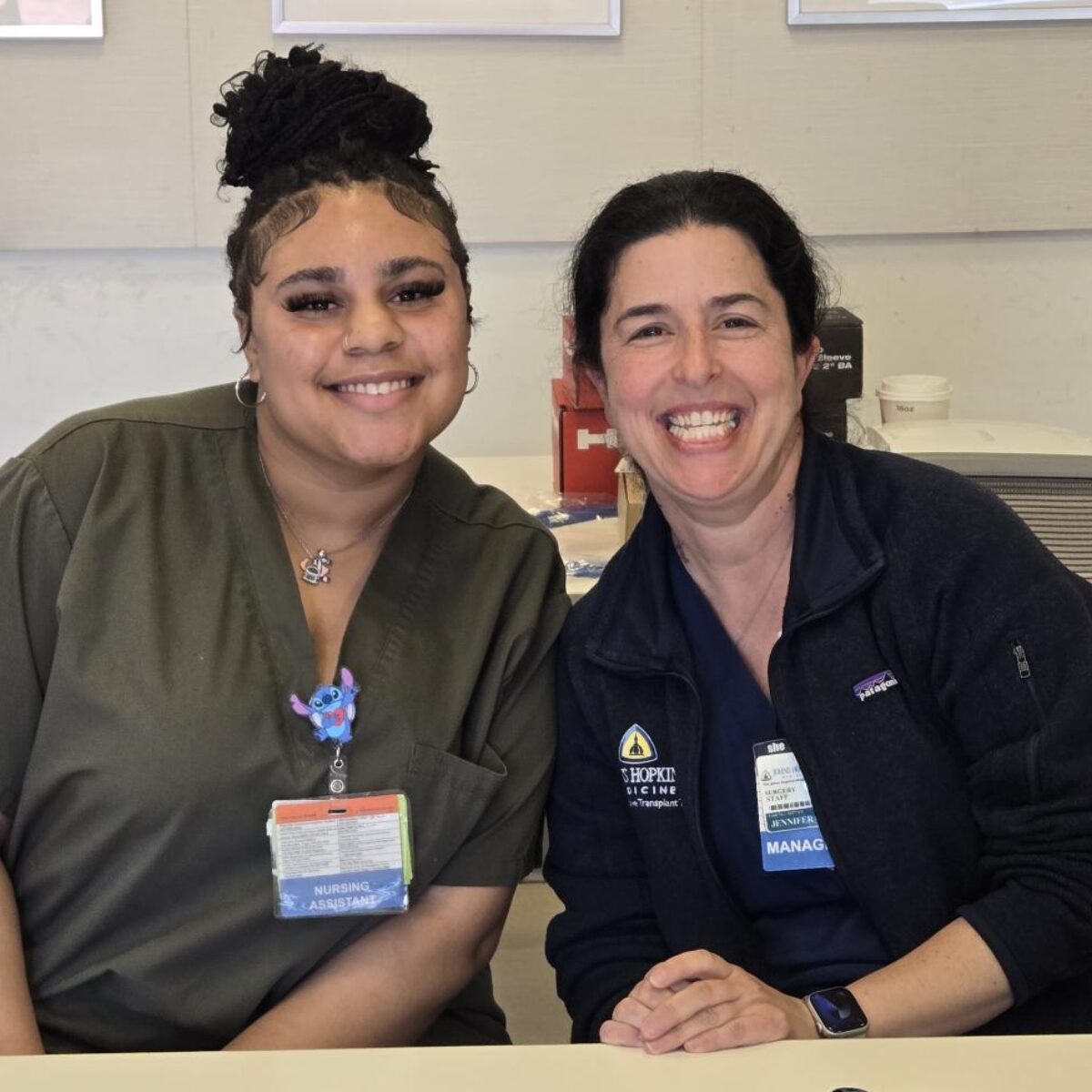
What didn’t needed much reinforcement, Jen added, was how Erika related to people while on the floor. “She has developed lots of friendships on the unit, lots of connections,” Jen said. “She also connects with the patients really well … She really understands what it’s like to have a sick relative or be a sick patient.” Jen said she was also struck by how Erika built that network on her own. “She’s really found her own mentors on the unit, and she did that on her own,” Jen said.
That connection runs deeper on a transplant unit than it might elsewhere, Jen said, because patients often stay for weeks rather than days. “She’s afforded the opportunity to really get to know patients and see them week to week and see their progress,” Jen said. “Our patient population is very vulnerable, and it’s especially nice to have Erica because she has the extra time in her day to sit with the patients, or take them outside if they want to, or bring them a snack — little things.”
Day to day, that showed up in small things: helping patients with vitals and meals, a walk down the hall, a cup of cranberry juice, a little encouragement on days patients can’t get out of bed. “You’ve got to give them a little bit of sunshine,” Erika said. She has also learned to prioritize care in real time, like recognizing when a patient’s dropping blood sugar takes precedence over routine vitals. The most rewarding part wasn’t any single moment, she said, but hearing that she made a difference.
“Sometimes I discharge them, and they say it was nice seeing me and thank you for all your help,” she said. “That shows that I made a difference. Maybe a small one, but it’s still a difference.”
A System Built to Scale
Before the program, Erika said she felt unsure of herself and her future. Now, she’s confident enough to talk about her future in specifics: pre-nursing, with an interest in psychiatric care, and maybe travel nursing before she settles down anywhere long term. “I feel a lot more confident,” she said “I’m proud of myself. I’m proud of my career.”
Jen sees that growth as the point of pairing a credential with a paycheck. “It’s very powerful that the youth apprentice is able to have their credentials and also earn a paycheck, because it affords them the time and the opportunity to make learning a priority,” Jen said. “The youth apprentice really understands that this is real life — it makes it a priority and a focus as well.”
Baltimore’s Promise, Baltimore City Public Schools and the Mayor’s Office of Employment Development each describe the apprenticeship system as an ecosystem, one where no single organization owns the outcome. “It wasn’t just City Schools. It wasn’t isolated to the Mayor’s Office of Employment Development. It wasn’t just Baltimore’s Promise’s movement,” Eric said. “It was all three entities moving seamlessly together to get the best outcomes for students.”
The healthcare pilot Erika went through is meant to be a model the district can repeat, first in skilled trades, then in business fields like entrepreneurship and hospitality. “This launch is actually a playbook for how we do it in all of our pathways,” Eric said.
Kumasi Vines, deputy director and chief of staff for the Mayor’s Office of Employment Development, said aligning the workforce and education systems around real labor-market data is what makes the pathway work. “A very strong pipeline from education to the workforce is really about economic justice,” Kumasi said.
Jen, who started at Johns Hopkins at 22 and has stayed almost 24 years, said she sees the stakes in personal terms. “Clear career pathways matter because we have a shortage of good talent here,” she said. “If we’re able to show young people different career pathways and then retain them within the Baltimore area, it’s only going to help our hospital setting and our community.”
Julia sees the same stakes on a citywide scale. “Our hope is Baltimore is a city where young people can stay, live and thrive,” she said. It’s a vision Baltimore’s Promise keeps returning to: that young people like Erika shouldn’t have to leave the city to build a future, and that the systems built to train them should be strong enough to keep them here, too.
For Erika, that citywide infrastructure came down to one conversation and one match, a head start built to carry her and many others in Baltimore all the way through a finished credential.
Additional Stories
Stronger Future Spotlight: Erika Graham in Baltimore