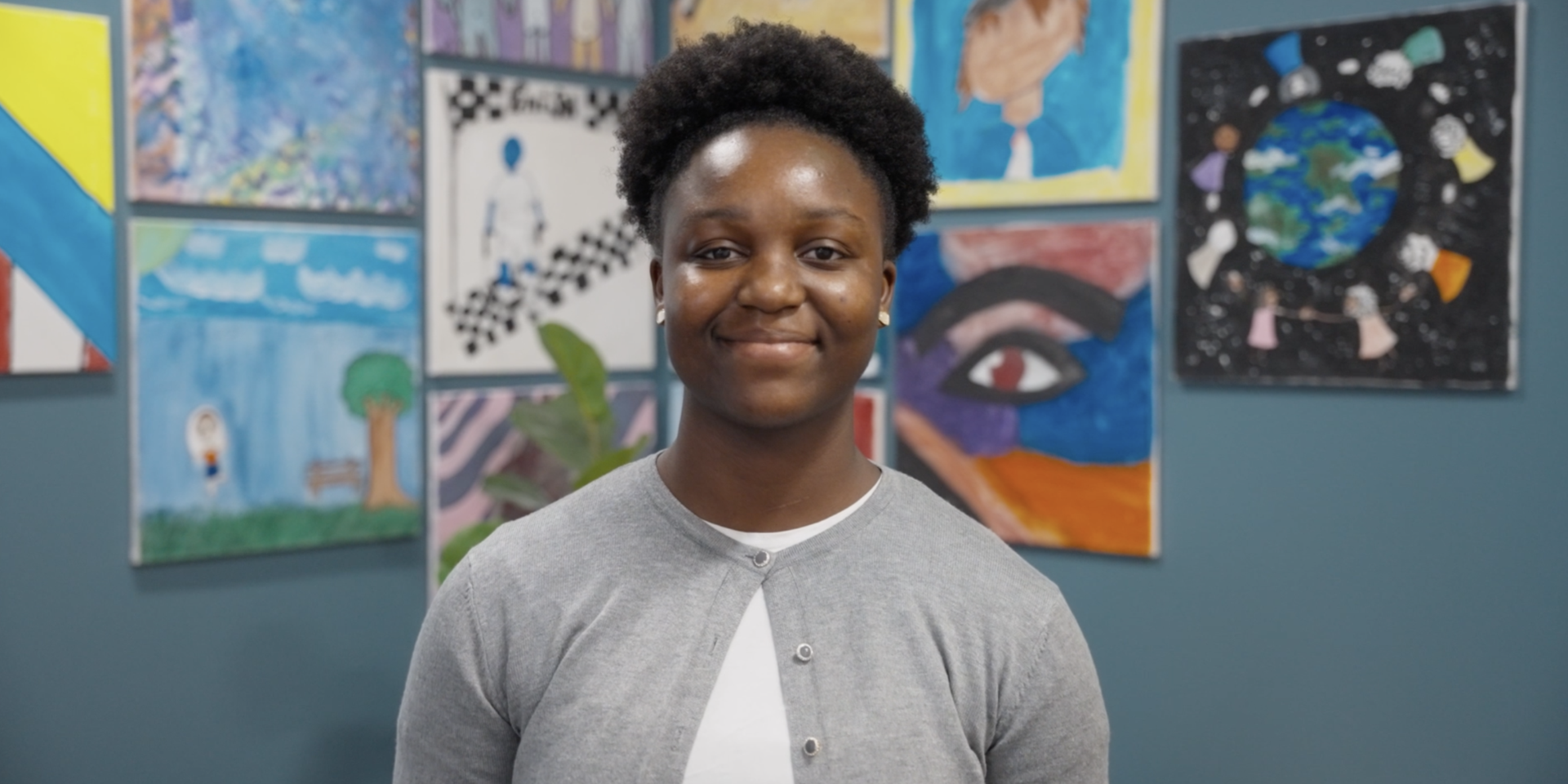
Stronger Future Spotlight: Wahomina in Garland
Wahomina has loved math since she was a child. She still can’t quite explain why. “It just makes me feel happy, like just solving math problems, just adding things,” she said. “It just makes me excited in this way, and I don’t know how to explain it, but I really love math.”
Wahomina is a student in the Math, Science and Technology program at Garland Independent School District (ISD) in Dallas County, Texas. She took geometry as a freshman and planned to move on to Algebra II, if not pre-calculus, the following year. The step that made that possible was Algebra I in eighth grade.
For many Texas students, getting into Algebra I that early used to depend on which district they attended and whether a teacher recommended them. Garland ISD changed how it placed students. Two StriveTogether Cradle to Career Network members, The Commit Partnership in Dallas County and E3 Alliance in Central Texas, later helped turn a similar approach into state law.
Algebra I in Eighth Grade
Wahomina was placed in honors math in sixth grade. “I was just really proud of myself and I was motivated to just keep on going and do better,” she said. In seventh grade, she skipped ahead to eighth grade math and took the eighth grade State of Texas Assessments of Academic Readiness (STAAR) test. She took Algebra I the next year. “It helped me see that I could go and have more advanced classes in my future years,” she said.
Garland ISD serves more than 50,000 students in northeast Dallas County. It was one of the first Texas districts to automatically place students who were proficient in fifth grade math on a pathway to Algebra I. Families could opt out.
“In Garland ISD, we were early adopters of the Algebra I policy to ensure that students did not have a gatekeeper anymore as they entered into high school,” said Coleman Bruman, the district’s executive director of secondary teaching and learning.
I was just really proud of myself and I was motivated to just keep on going and do better. It helped me see that I could go and have more advanced classes in my future years.
Wahomina, student at Garland Independent School District (ISD)
Dallas County, Texas
Wahomina’s teacher helped her keep up. When something didn’t make sense, she went to tutorials. “My teacher would sometimes go through the assignments with me and explain step by to step my questions,” she said. “My teacher was amazing, and I loved the students and my class.”
That kind of help is part of Garland’s approach. As the district opened Algebra I to more middle schoolers, it added tutoring, high-quality instructional materials and an Algebra I instructional facilitator. Algebra I teachers also get four planning days a year to prepare.
She sees the class as a way to get ahead. “It made me feel like I was leveling up,” she said. She knows some students face academic challenges and don’t get into advanced classes.
For her, finishing Algebra I early opened up her schedule for classes tied to a future career. She’s still deciding what that career will be. “That’s why I really like the fact that I got into Algebra I and got that out of the way,” she said. “It helped me create more space to figure out what I want to do for my future.”
She saw the benefit in geometry. “Some of the things we’re learning requires basic algebra knowledge,” she said. “Some students, because they didn’t get to take Algebra I in their eighth-grade year, they have to go back and take Algebra I. But for me it’s a different story and I get to go straight into geometry.”
Garland tested Algebra I for all students at one middle school for three years before expanding. This school year, all 12 of its middle schools are part of it. From 2021 to 2025, the share of Garland students meeting grade level on the Algebra I end-of-course exam rose from about 30% to more than 52%.
From Local Proof to Texas Law
Garland’s results caught the attention of The Commit Partnership, a StriveTogether Cradle to Career Network member in Dallas County. In Central Texas, fellow network member E3 Alliance had spent years studying who was being left out of advanced math. E3 tracked Central Texas fifth graders who scored in the top 20% in math in 2014. Only 33% of Black students and 46% of Latine students in that group completed Algebra I by the end of eighth grade.
“Prior to the passage of Senate Bill 2124, access to advanced math was really based on values-based decision-making … it was the perception of teachers as to who was ready,” said Richard Tagle, president and executive director of E3 Alliance.
The two partnerships took their evidence to the Texas Capitol. E3 coordinated a statewide coalition and supplied the research. Commit brought the Dallas County proof point. Bridget Worley, Commit’s chief state impact officer, said that local evidence was essential. “Texas is a fiscally conservative state, and in that kind of environment, it’s critically important when you’re advocating to bring data and real examples of success from school systems,” she said.
It also meant speaking up for the people with the most at stake. “Students don’t have paid lobbyists. They don’t actually have a vote,” Bridget said. “And so, it’s really critically important that there are people at the Capitol who are thinking about how policies impact students.”
In 2023, Senate Bill (SB) 2124 passed unanimously. It requires every Texas district to automatically enroll sixth graders in advanced math if they score in the top 40% on their fifth grade math assessment, or on a local measure. Families can opt out.
After the bill passed, Commit helped Dallas County districts identify qualifying students, notify families and plan for enough certified Algebra I teachers. E3 built a needs assessment to help districts get ready. Both partnerships draw on a statewide coalition that includes other network members. They also learn from peers across the Network who face similar challenges.
A Stronger Future
For Wahomina, the experience changed how she sees school. “Being in an advanced class really helped me see that I could do more and I could be greater,” she said.
She’s interested in the medical field and engineering. “After I graduate, I want to get into a very good college, maybe on a scholarship if I can,” she said.
School is about more than coursework for her. “I love the community at school and the clubs and how school brings a lot of people together,” she said. In her free time, she crochets and makes small crafts. She lights up talking about her teachers. “My biology teacher, she’s so sweet and she loves to talk to her students,” she said. “I also love geometry because my teacher is funny.”
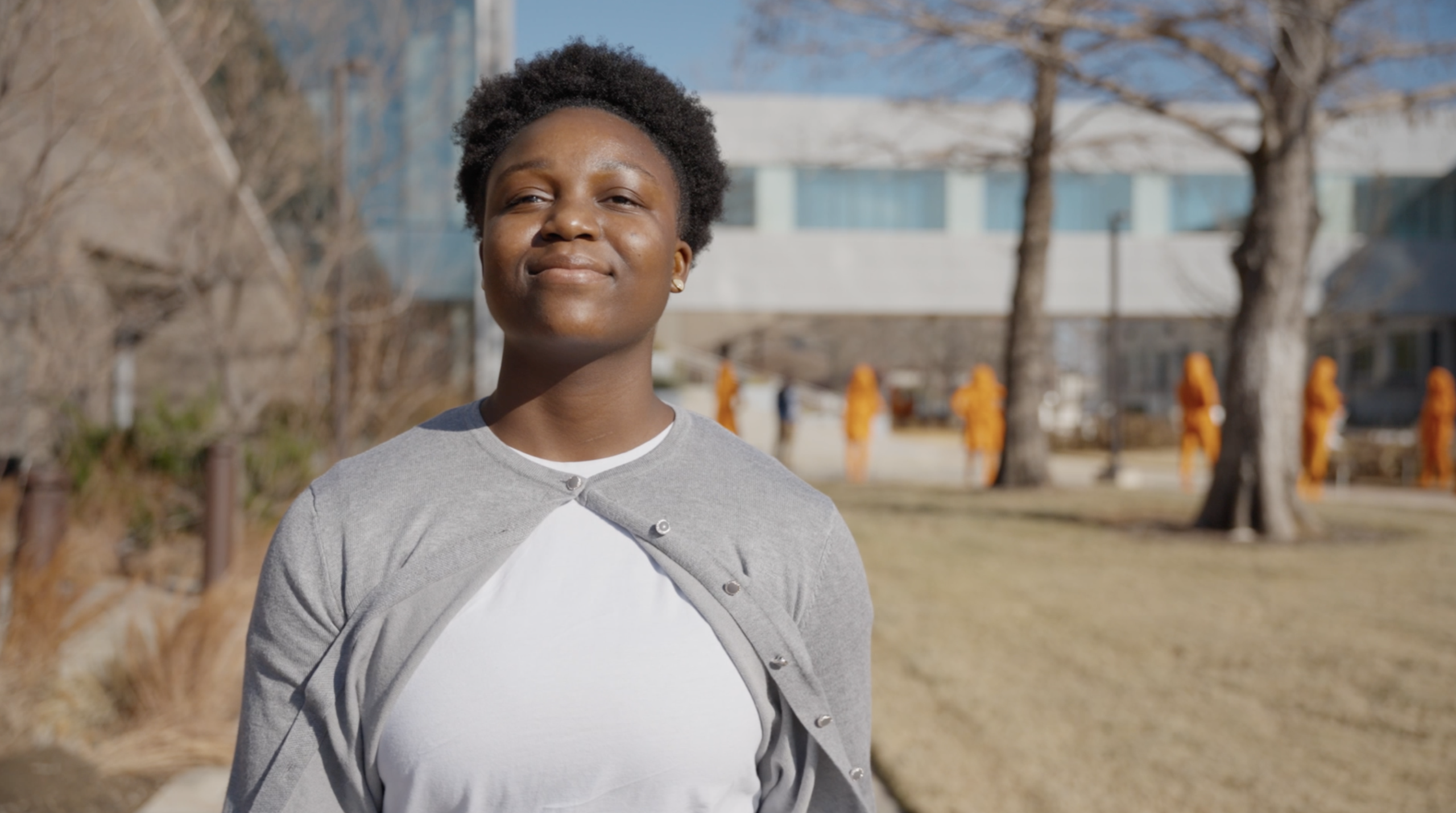
When school gets hard, she leans on her family and her faith. “It helps me ground myself whenever I’m feeling down,” she said. “It helps me realize that I could keep going and I got this.”
Garland is already focused on what comes next. “The continued work is going to be making sure that they’re successful as they pursue through high school on college entrance exams,” Coleman said.
Wahomina knows what she’d tell a student facing the same choice. “If a student is considering taking Algebra I in eighth grade, I would highly recommend them to do so because it would really set them up for their future,” she said.
Not long ago, a student like her might have needed someone to notice her before she could reach Algebra I. Now, across Texas, what students show they can do opens that door. Because of a district, two partnerships and a unanimous legislature, more young people get the chance Wahomina had to level up.
Additional Stories
Stronger Future Spotlight: Wahomina in Garland