Policy toolkit: A guide to systems transformation through policy change

Changing policies is a powerful way to transform systems of opportunity and put more young people on a path to economic mobility. To help communities navigate this complicated work, StriveTogether partnered with PolicyLink to gather learning from leaders across the country.
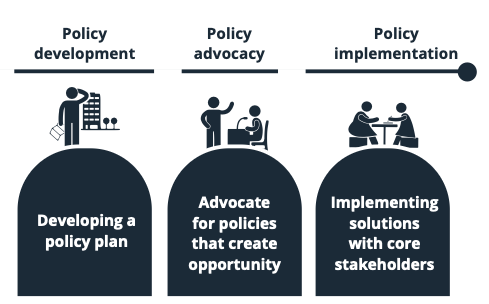
Together, we created a policy toolkit — a comprehensive resource for place-based partnerships and other coalitions embarking on or deepening strategic policy work alongside their communities. It features tools, worksheets and case studies for three policy phases: development, advocacy and implementation.
Our goal is to make policy work accessible for communities of all sizes across the country, using StriveTogether’s approach of accelerating learning to shift practice and move results.
Through a 2018 investment in seven communities focused on policy change, StriveTogether supported communities to try new things, documenting our successes and setbacks through stories and data. We created processes to capture learning and reflections with our partners at PolicyLink. This work resulted in the policy toolkit, an accessible frame of how communities can approach policy change.
Read on for key insights from this work, and download the complete policy toolkit at the link below.
Better policymaking starts with an inclusive process. Putting youth and families at the center of policy requires building relationships with community residents, building their capacity to take up this work, and authentically and intentionally engaging them throughout the entire process.
Policy shifts are sequential but not linear. The toolkit identifies three distinct phases of policy work: development, advocacy and implementation. While each phase builds upon the last, progress through the phases isn’t strictly linear.
Successful policy shifts practices. Policy implementation is often an overlooked step. Successful implementation requires engagement of new players, commitment to ongoing monitoring and evaluation, and adjustments based on learnings.
Policy work is rooted in broader systems work. Policy efforts are most successful when they are developed as a part of an overall community plan for systems transformation, including a mix of both practice and policy shifts. The toolkit shares how communities can think about their policy strategy in the context of their broader plan.
More Resources
Why It Matters: StriveTogether® Collaborative Improvement™

Why Postsecondary Enrollment Matters