Why Middle Grade Math Matters

Middle grade math is the math students learn in sixth, seventh and eighth grades. During these years, students move from arithmetic to ratios, proportional reasoning, early algebra and linear functions. These skills form the foundation for Algebra I and the high school math courses that follow.
The middle grades are a turning point. Math becomes more abstract, and expectations rise quickly. Students who build strong skills now are better prepared for the courses, credentials and careers ahead. Students who struggle without support are more likely to fall further behind each year.
Middle grade math is also one of the clearest early signals of a young person’s future. Researchers at Harvard and Dartmouth linked stronger eighth-grade math achievement to higher adult income. Stronger results also tracked with more education and lower rates of teen parenthood, incarceration and arrest. Johns Hopkins University research found sixth graders in high-poverty schools who fail math have just a 15% to 25% chance of graduating high school.
Recognizing its role in shaping long-term outcomes, StriveTogether includes middle grade math as one of seven shared cradle-to-career outcomes. Communities track it as the percentage of eighth graders scoring proficient or higher on their state math assessment. Across the StriveTogether Cradle to Career Network, partnerships are working together to strengthen math instruction, expand access to advanced coursework and improve this pivotal milestone.
Middle Grade Math and Long-Term Economic Opportunity
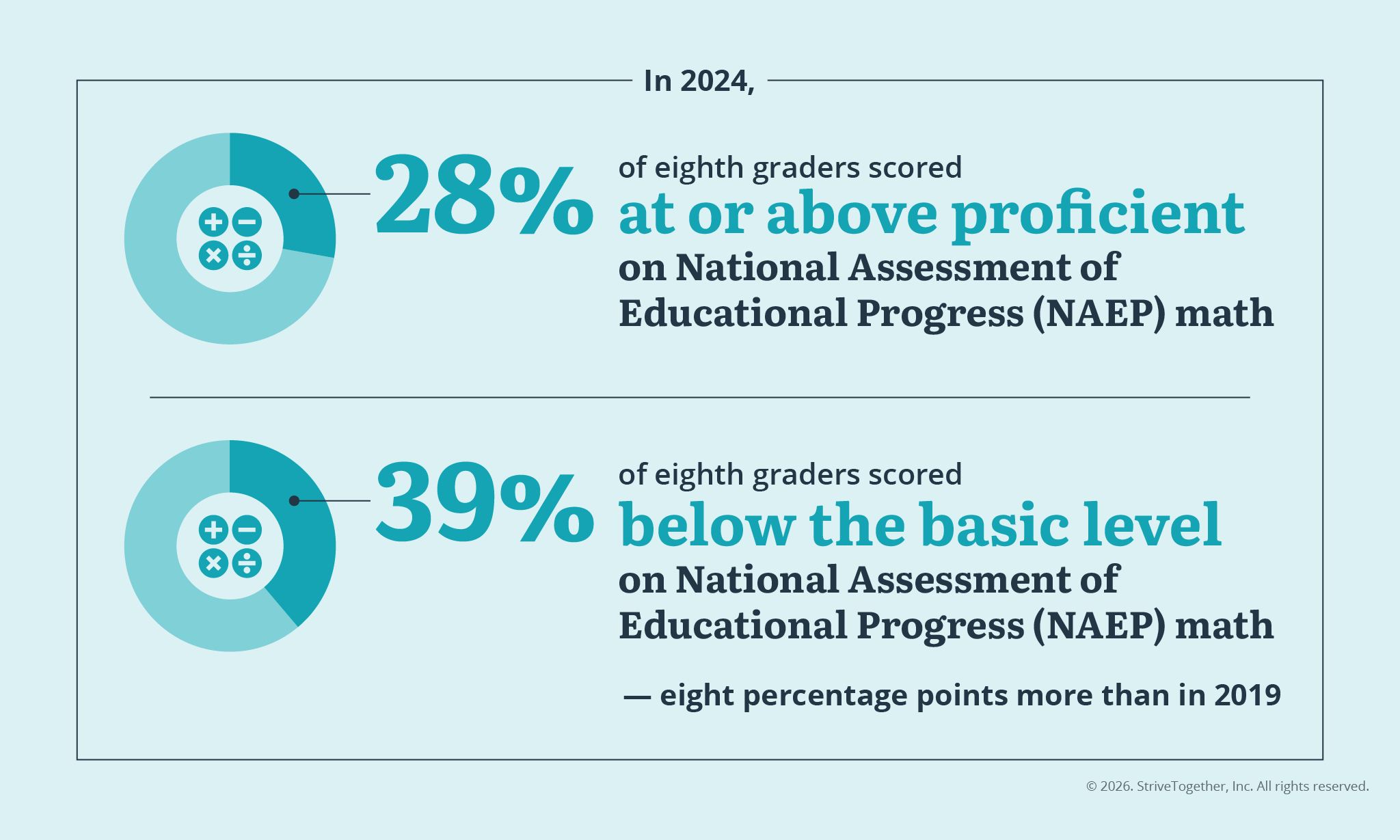
The most widely used national measure of math achievement is the National Assessment of Educational Progress (NAEP), known as the Nation’s Report Card. In 2024, just 28% of eighth graders scored at or above proficient on NAEP math. Nearly four in 10, or 39%, scored below the basic level — eight percentage points more than in 2019. NAEP sets a high bar, and its proficient level is not the same as meeting grade-level standards on a state test. Still, it offers a consistent way to compare progress across states and over time.
Progress has also become more uneven. Between 2022 and 2024, scores rose for the highest-performing eighth graders but fell for the lowest-performing students. Scores also dropped for Hispanic students, students identified as economically disadvantaged, students with disabilities and English learners.
These trends matter because math skills shape earning power. Researchers often measure test score changes in standard deviations, a common unit for comparing the size of a gain. The Harvard and Dartmouth study found that a one standard deviation rise in eighth-grade math achievement was associated with an 8% rise in income.
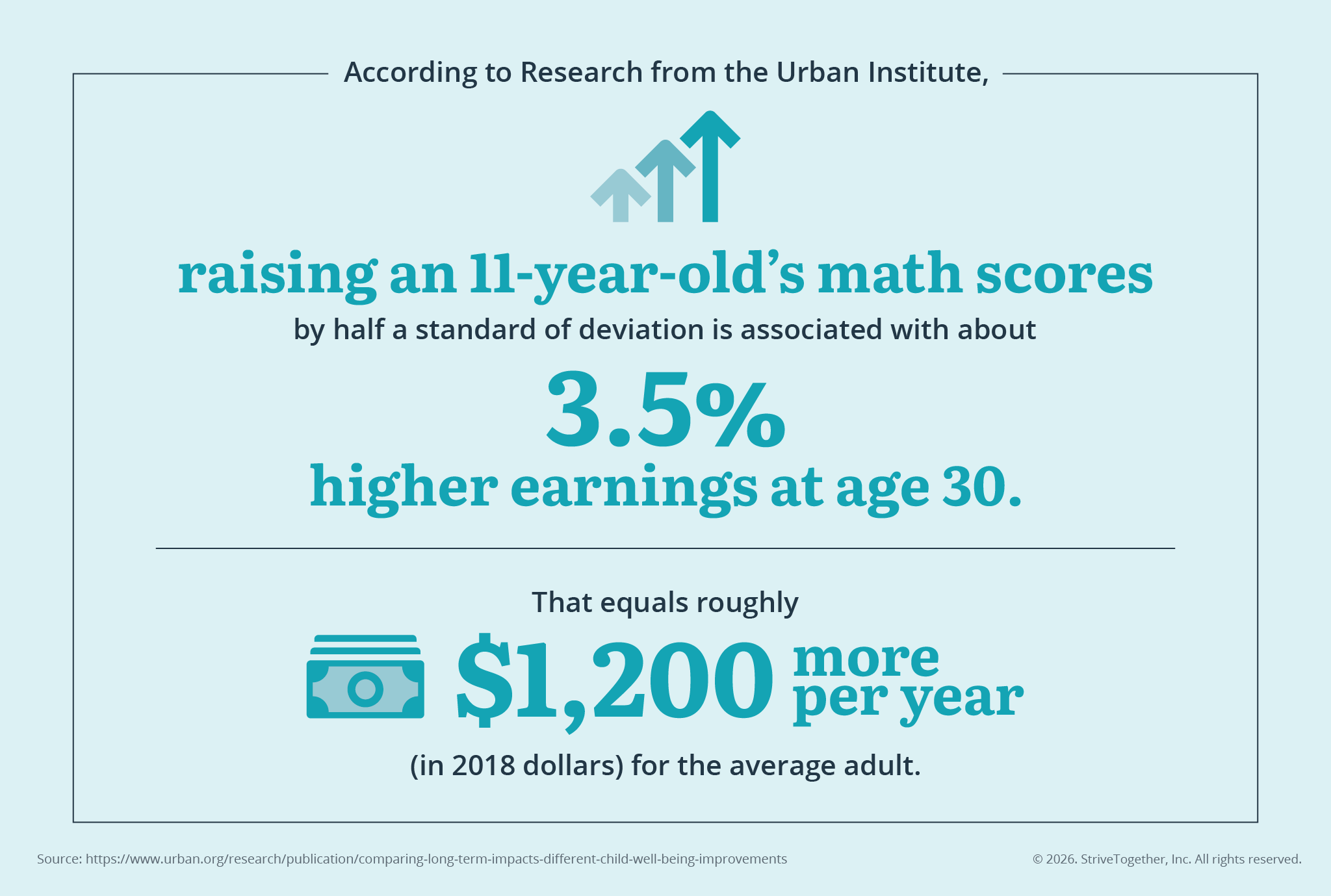
Research from the Urban Institute points to the same conclusion. Raising an 11-year-old’s math scores by half a standard deviation is associated with about 3.5% higher earnings at age 30. That equals roughly $1,200 more per year, in 2018 dollars, for the average adult. Comparable gains in reading had a smaller effect on adult earnings.
Math also opens doors to growing careers. The U.S. Bureau of Labor Statistics projects that jobs in science, technology, engineering and math (STEM) will grow 8.1% from 2024 to 2034, compared with 2.7% for other jobs. The median wage for STEM jobs was $103,580 in 2024, more than twice the $48,000 median for other occupations. Four-year degrees are not the only path where math matters. Many electrical apprenticeship programs require applicants to pass a year of algebra and take an algebra and functions test.
Weak math skills also carry costs for the broader economy. The Harvard and Dartmouth researchers estimated what pandemic-era losses in eighth-grade math could mean if they become permanent. Their estimate: a 1.6% drop in lifetime earnings for the average student, or about $19,400. Across the 48 million students in public schools during the 2020-21 school year, that adds up to $900 billion. The researchers called their figure conservative. Broader estimates that account for slower economic growth run as high as $31 trillion.
Gaps in math achievement and access begin early and widen without intervention. According to the Annie E. Casey Foundation, 90% of Black eighth graders did not reach math proficiency in 2024. The same was true for 88% of American Indian or Alaska Native students and 86% of students identified as Latino. That compares with 63% of white students and 43% of Asian and Pacific Islander students.
Access to advanced math follows a similar pattern. In a 2025 analysis, the testing organization NWEA found that only 46% of the highest-poverty schools in its sample offered Algebra I in eighth grade. Among high-achieving students, 60% of Black students took Algebra I in eighth grade. That compares with 84% of Asian students and 68% of white and Latino students.
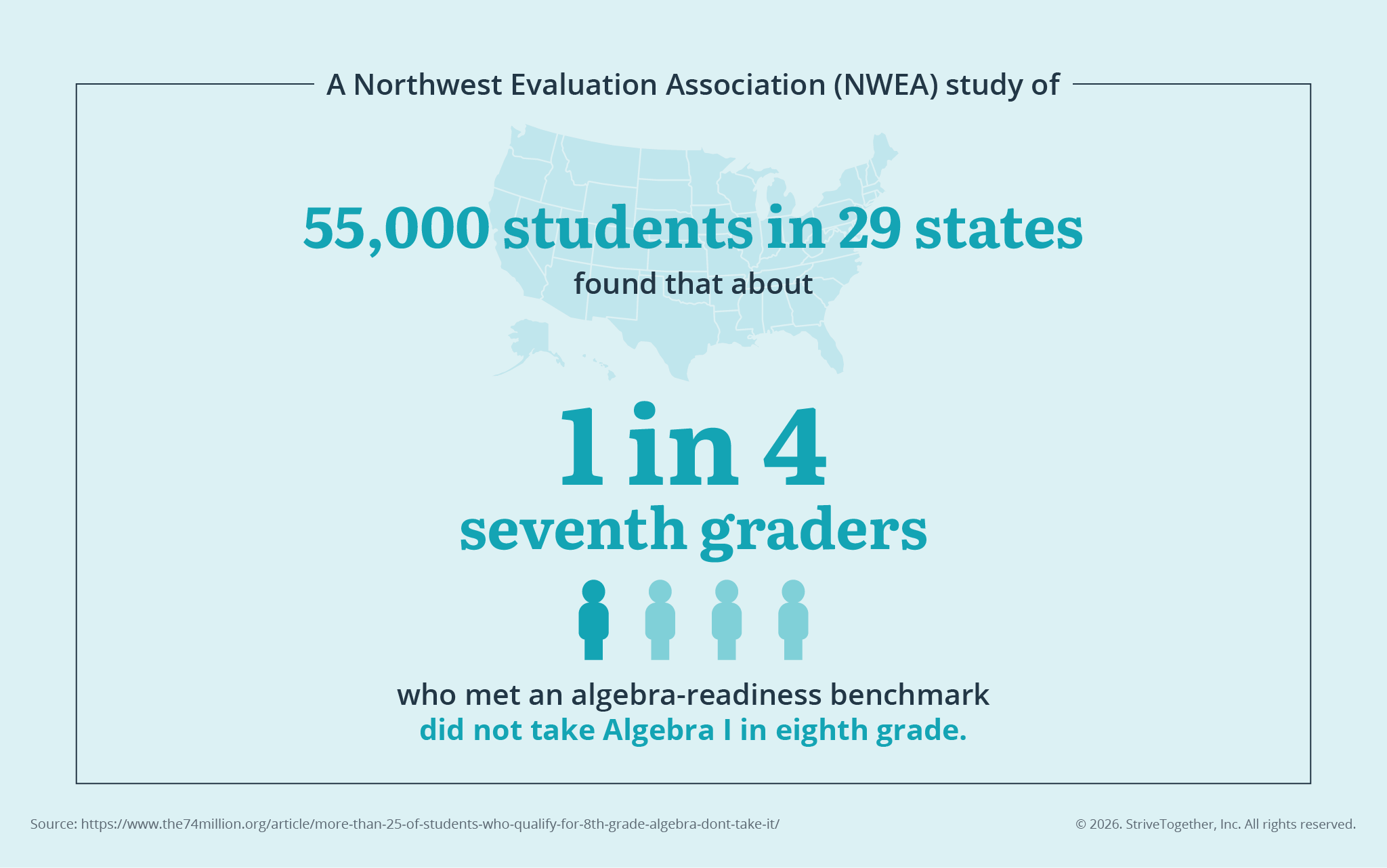
Even when the course is offered, many ready students miss it. A separate NWEA study of 55,000 students in 29 states found that about 1 in 4 seventh graders who met an algebra-readiness benchmark did not take Algebra I in eighth grade. That matters, because ready students performed better in algebra when they took it in eighth grade rather than ninth. In New York, EdTrust-New York estimated that about 20,000 more eighth graders could have taken Algebra I based on their seventh-grade results. These gaps reflect systemic differences in opportunity, not differences in students’ interest or potential.
What Shapes Middle Grade Math Outcomes
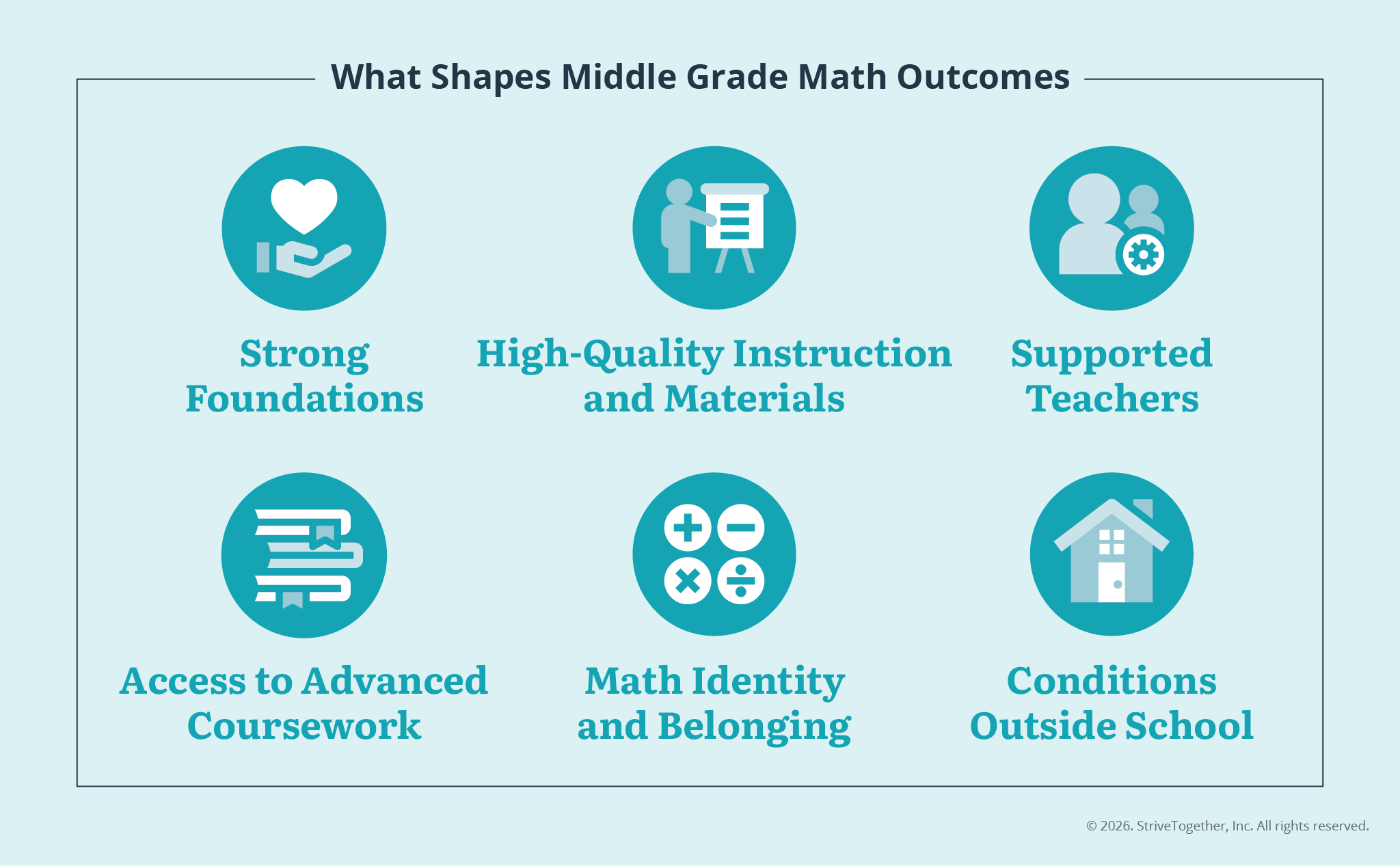
Middle grade math outcomes are shaped by connected conditions inside and outside the classroom. These conditions extend beyond any single program and require coordinated action across systems.
- Strong Foundations: Many students begin middle school without key skills from earlier grades, like fractions and multiplication. Without timely, targeted support, these gaps make grade-level content harder to master.
- High-Quality Instruction and Materials: Students stay on track when lessons focus on grade-level work. Strong instruction builds conceptual understanding, procedural fluency and the ability to apply math to real problems.
- Supported Teachers: Teachers are more effective with ongoing coaching, shared planning time and access to student data. Supported educators are better able to keep students on track.
- Access to Advanced Coursework: Algebra I often acts as a gatekeeper to upper-level math courses. Placement decisions in middle school can shape which students reach calculus or statistics in high school.
- Math Identity and Belonging: Students who believe they can succeed in math are more likely to persist. In one study, 32% of students with the highest math confidence enrolled in calculus, compared with 9% of those with the lowest. Without that confidence, some students who are ready for advanced math count themselves out.
- Conditions Outside School: Regular attendance and access to summer and STEM enrichment support math learning. These opportunities help prevent learning loss and connect students to future careers.
Together, these factors shape whether middle grade math becomes a bridge to opportunity or a barrier to long-term success.
Building Strong Middle Grade Math Systems
Improving middle grade math at scale requires more than isolated programs. It requires aligned systems that connect data, instruction, teacher support and policy from elementary school through Algebra I.
Strong systems start with early identification. Schools and partners use data to spot students who are falling behind, then provide targeted help. Tutoring is one of the best-studied approaches. A review of nearly 100 experiments found tutoring produced large, consistent gains in learning. Math tutoring tended to have bigger effects in later grades, and programs held during the school day outperformed after-school programs.
Strong systems also widen access to advanced math. Instead of relying on teacher recommendations or family requests, some districts automatically enroll students who meet a set benchmark. Students can still opt out. In Dallas, this approach raised the share of students taking Algebra I before high school from 23.6% to 37%. North Carolina, Nevada, Texas and Washington have adopted similar policies.

Automatic enrollment works best when it is paired with strong teaching and academic support. Researchers caution that placing every student in Algebra I regardless of readiness has not raised achievement on average. NWEA also found that students still building their skills need targeted help to succeed in algebra. Waiting until ninth grade alone did little to improve their results. The goal is a seat for every ready student and more students ready each year.
StriveTogether Cradle to Career Network members in Texas show how local results can shape state policy. E3 Alliance of Austin, Texas, worked with Central Texas partners to make advanced math the default for qualifying students. The change cut the gap between Black and white students completing eighth-grade Algebra I by 91%. Building on that progress, E3 Alliance and The Commit Partnership in Dallas, Texas, worked together to help pass Texas Senate Bill 2124, which brought the approach statewide. Both organizations continue to support districts in putting the law into practice.
Middle grade math outcomes improve when schools, districts and community partners work toward shared goals. Using data together, coordinating supports and aligning policies help every effort go further.
Middle Grade Math Strengthens the Cradle-to-Career Pathway
Middle grade math matters because it marks momentum. It shows whether students have the skills and confidence to take on challenging coursework and keep their options open.
This milestone builds on kindergarten readiness and early grade reading. Researchers note that a student’s readiness for algebra at age 13 reflects the math they learned years earlier. Middle grade math also sets the stage for high school graduation, postsecondary enrollment, postsecondary completion and employment. Students who leave eighth grade prepared can choose among college, apprenticeships, technical credentials and careers that rely on math.
No single school or organization can move this outcome alone. Place-based partnerships, which bring together schools, families, employers, nonprofits and more, are well positioned to help. They use disaggregated data, or data broken down by student group, to find where gaps begin. They then align practices and policies so more students get the support they need.
With shared data and shared accountability, communities can ensure more students reach this milestone ready for what comes next.
To learn more about how communities can strengthen middle grade math outcomes, explore the StriveTogether Middle Grade Math Playbook. Supported by the Gates Foundation, it offers 23 essential questions plus indicators, practices and policies communities can use.
Related Resources

Why Middle Grade Math Matters
2025 Outcomes Convenings Learning Summaries
For Members
Automatic Enrollment in Advanced Math: Middle Grade Math Strategy Spotlight
Related Stories
From Local Results to Texas Law: E3 Alliance and The Commit Partnership Widen Access to Advanced Math