Why Postsecondary Completion Matters
Postsecondary completion is where preparation turns into opportunity gained. It means finishing a credential earned after high school: an associate or bachelor’s degree from a community college or university, a technical certificate from a technical college, a completed program at a trade school or vocational institute, or a registered apprenticeship that combines paid work with training. Each path runs on its own timeline: a bachelor’s degree typically takes about four years to finish, an associate degree about two, many technical and vocational certificates less than two, and a registered apprenticeship takes one to six years, depending on the trade.
Completion follows postsecondary enrollment on the cradle-to-career continuum. It is a key milestone on the path to economic mobility, marking the difference between starting toward opportunity and actually reaching it.
Enrolling in college or training is an important step, and completion is what turns that step into a credential young people can use to build a stable career. A young person who enrolls and later leaves without a credential often pays a real cost: lost time, and in many cases, debt, all without the earnings boost that comes with finishing, according to the Federal Reserve Bank of Richmond.
Recognizing its role in shaping long-term outcomes, StriveTogether includes postsecondary completion as one of seven shared outcomes across the cradle-to-career journey. Together, these measures show whether K-12 systems are preparing students to finish what they start, and whether local colleges and training programs are set up to help them do it. Across the StriveTogether Network, partners are working together to strengthen the systems that help students complete a credential after high school.
Postsecondary Completion and Long-term Economic Opportunity
Postsecondary completion is closely tied to economic opportunity, and the payoff grows with every credential a person finishes.
Lifetime earnings rise with each credential completed. A high school diploma alone brings a median of $1.6 million in lifetime earnings, compared with $2 million for an associate degree and $2.8 million for a bachelor’s degree, according to Georgetown University’s Center on Education and the Workforce.
Much of today’s job market strength for workers without a four-year degree is concentrated in skilled trades, where completing an apprenticeship or technical certificate leads directly to work, according to a Burning Glass Institute analysis reported by The Wall Street Journal. Either way, finishing a credential is the step that unlocks economic opportunity.
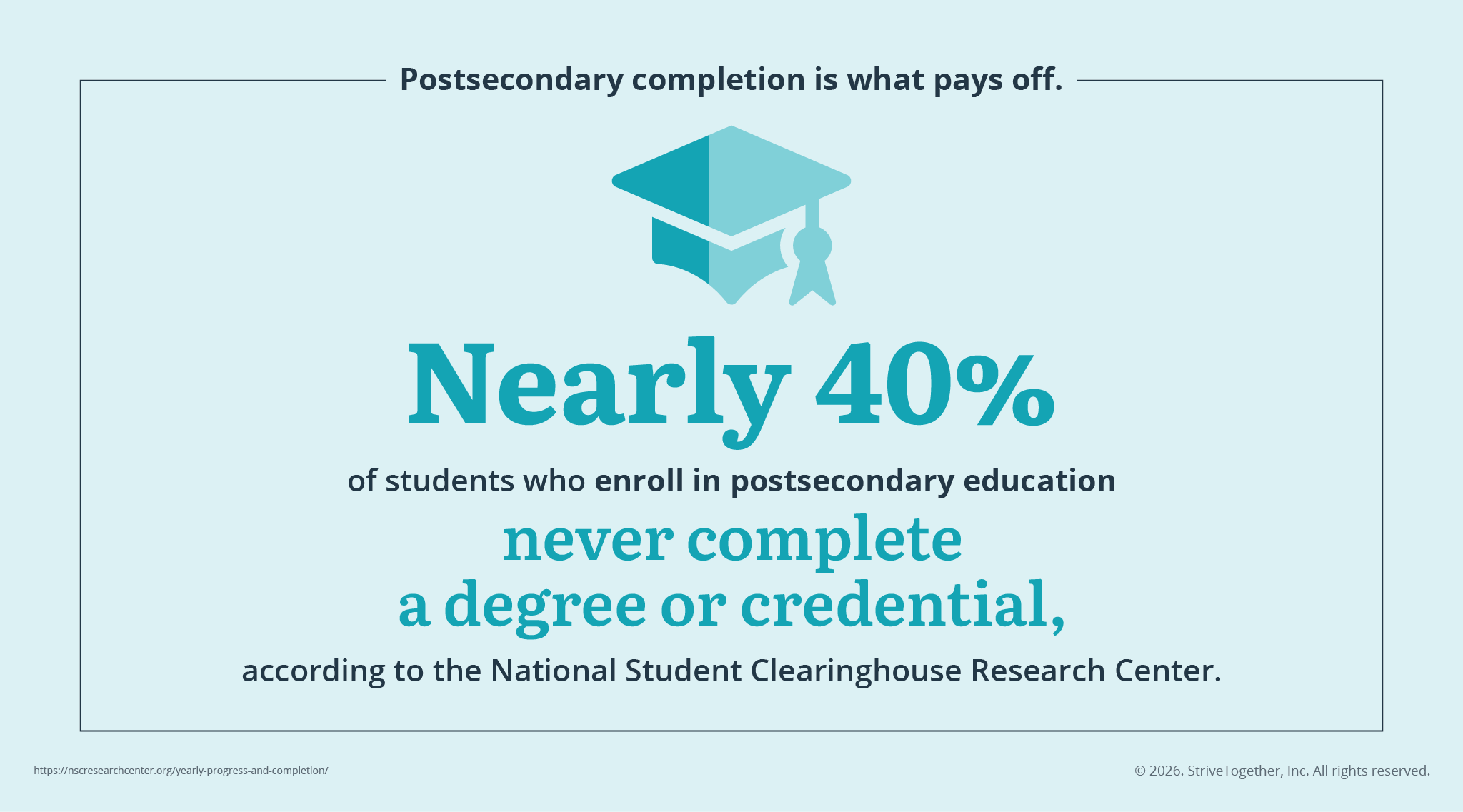
Postsecondary completion is what pays off. Nearly 40% of students who enroll in postsecondary education never complete a degree or credential, according to the National Student Clearinghouse Research Center. An estimated 36.8 million adults carry the debt and lost time of unfinished college without gaining the earnings boost completion brings, according to the Federal Reserve Bank of Richmond.
Apprenticeship completion follows a different pattern than college. Only 46.8% of registered apprentices who started in 2017 completed within six years, well below the 61.1% completion rate for college students who started in fall 2019, according to Social Finance’s analysis of federal data. Apprentices who do finish see strong returns such as a median starting salary of about $86,000 and a 93% employment retention rate.
Completion looks very different depending on a student’s race or income and it holds across institution types, not just four-year colleges. Among students who started college in fall 2019, six-year completion rates ranged from 75.7% for Asian students and 69.0% for white students down to 59.5% for students of two or more races, 50.5% for Hispanic students, 45.2% for Native American students, 44.5% for Native Hawaiian and Pacific Islander students and 44.0% for Black students, according to the National Student Clearinghouse Research Center.
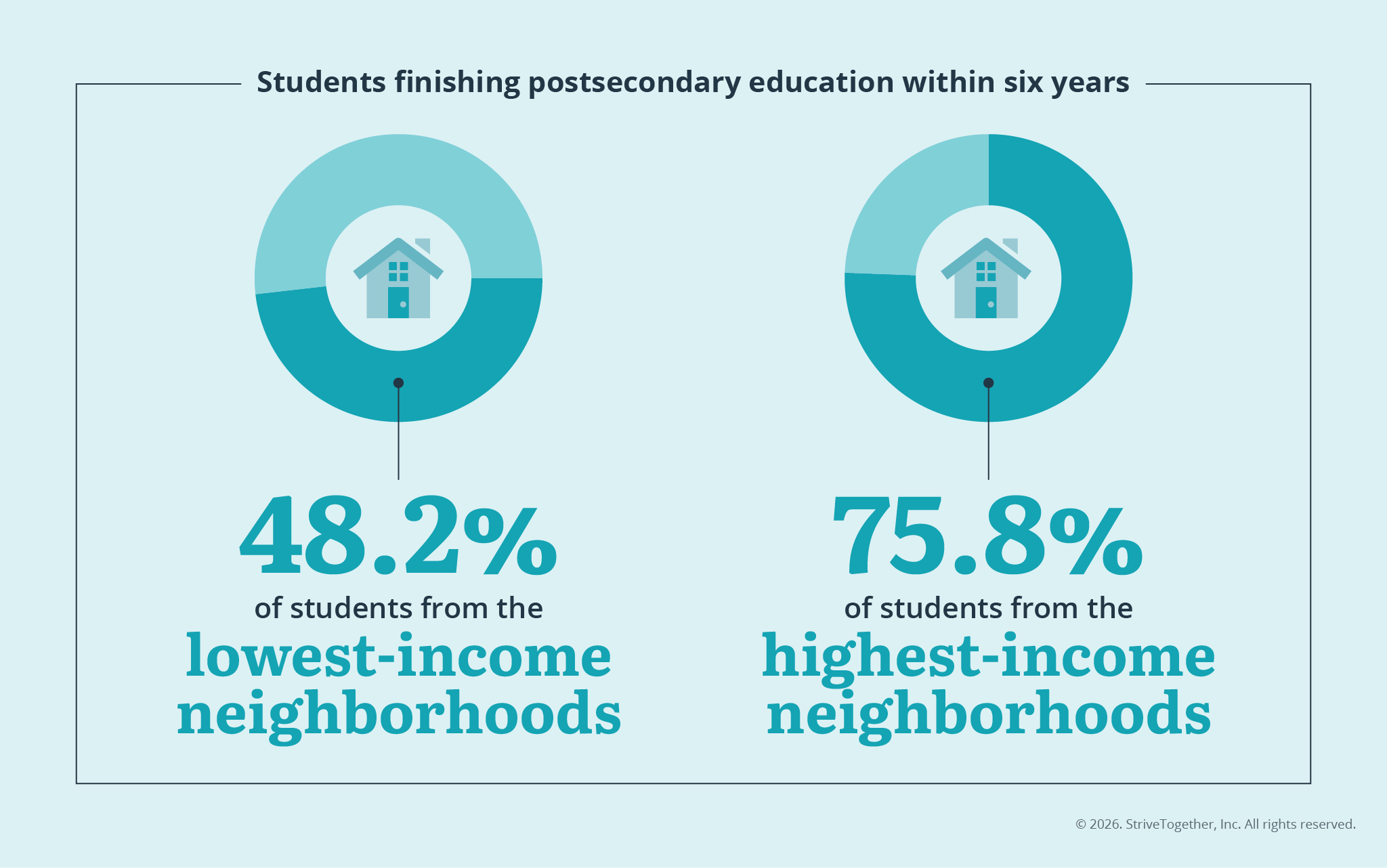
Income tells a similar story with 48.2% of students from the lowest-income neighborhoods finished within six years, compared with 75.8% from the higher-income neighborhoods, a gap that has narrowed from 30 points since 2010. The students facing the biggest barriers to enrolling also face the steepest odds against finishing.
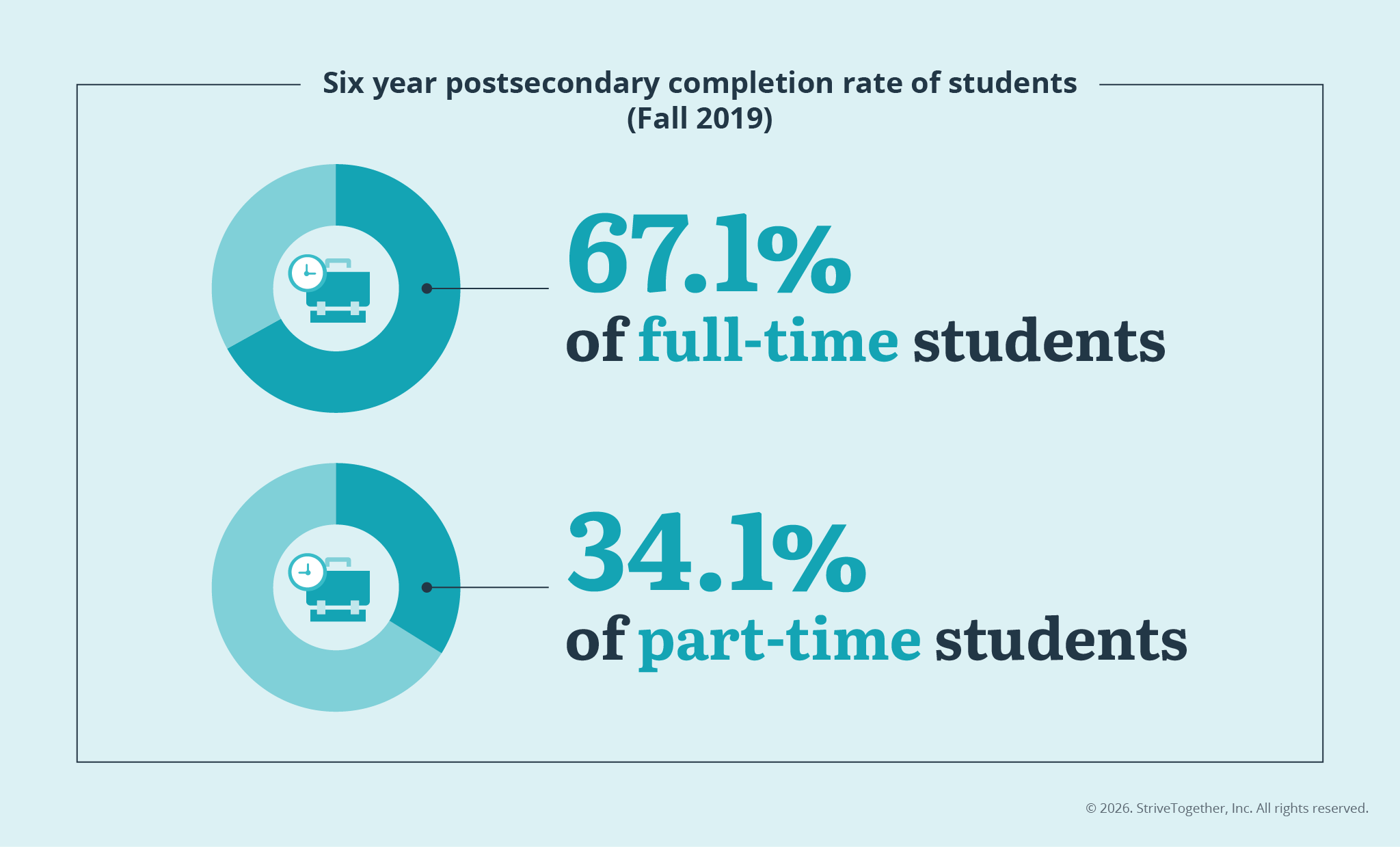
Additionally, how students enroll also shapes their odds of finishing. Full-time students who started college in fall 2019 completed at a rate of 67.1% within six years, compared with 34.1% for part-time students, according to the National Student Clearinghouse Research Center’s Yearly Progress and Completion report.
Communities that invest in strong postsecondary completion systems are already closing the distance between who starts and who finishes.
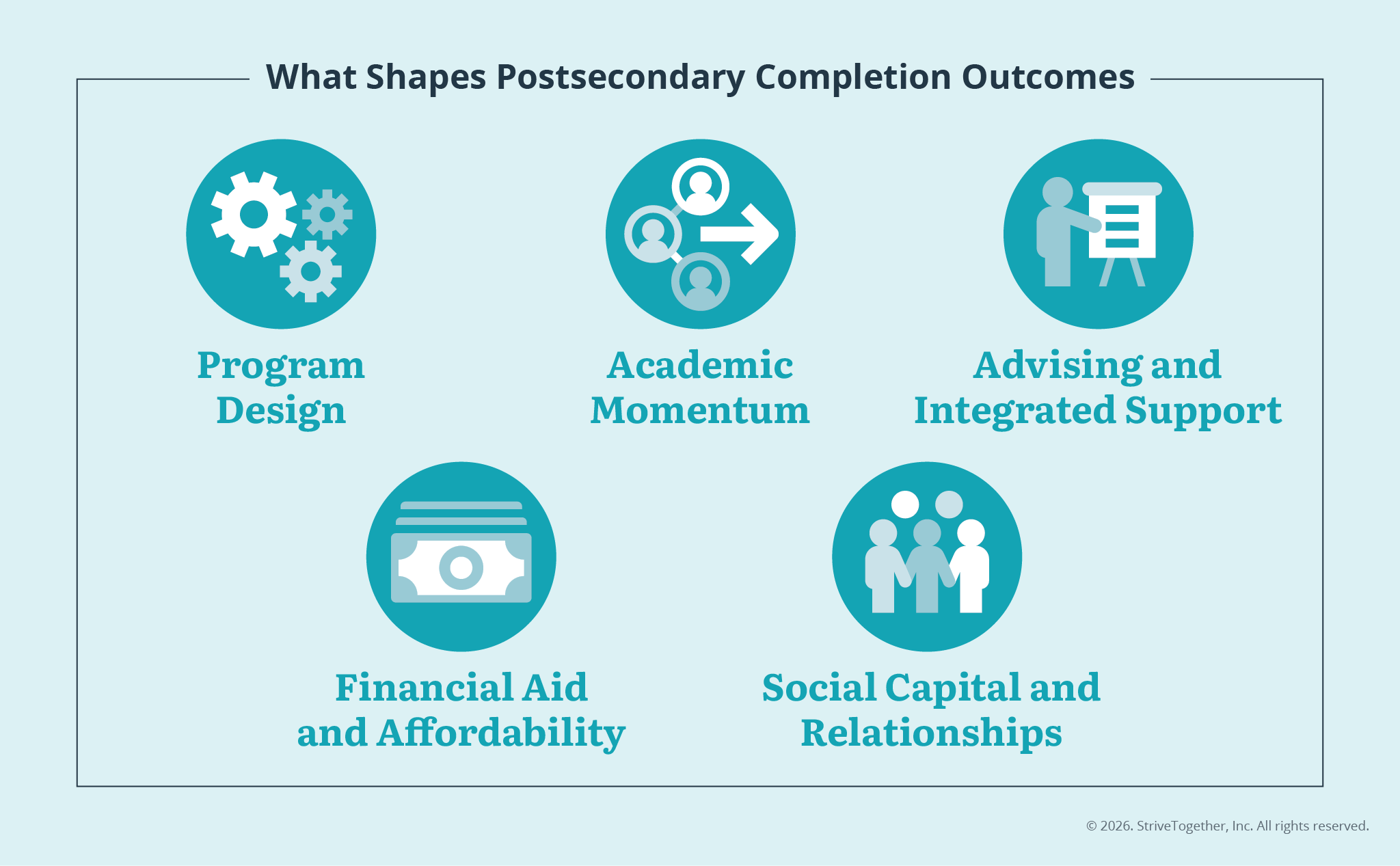
What Shapes Postsecondary Completion Outcomes
Several conditions shape whether a student completes a credential. These begin well before a student’s first day of college and continue all the way through graduation.
- Program Design: Students are more likely to finish when they follow a clear, structured program with a defined path to a credential, instead of navigating a maze of course options largely on their own.
- Academic Momentum: Early progress matters. Students who finish college-level math and English in their first year tend to stay on track. Students who spend a long time in remedial coursework are more likely to fall behind. Students who earn fewer than 20 to 30 college-level credits in their first year are also less likely to finish, making first-year credit accumulation one of the clearest early warning signs.
- Advising and Integrated Support: Students persist and finish at higher rates when advising, tutoring and career services are built into daily college life, instead of offered separately as something students have to seek out on their own.
- Financial Aid and Affordability: Affordability often decides whether a student finishes. Adult students spend an average of $30,000 a year on caregiving costs on top of tuition, more than financial aid typically covers. Apprentices face a similar squeeze: many drop out in the first six months, when wages are lowest, according to the U.S. Government Accountability Office.
- Social Capital and Relationships: Students with strong ties to professors, mentors and peers are more likely to stay motivated. So are students with access to internships and other real-world work experience.
Together, these conditions decide the outcome. Postsecondary opportunities can become a credential a young person uses for years, or an unfinished chapter that comes with a cost.
Building Strong Postsecondary Completion Systems
Improving postsecondary completion rates takes more than helping students walk through the door. It takes systems that support them the whole way to a credential.
Strong systems track early momentum. They use measures like credit accumulation and first-year course completion to flag students who are falling off track before they stop out entirely. Some colleges redesign their programs into clear, structured pathways, sometimes called guided pathways. This helps students skip unnecessary courses and stay focused on a defined route to completion.
Integrated student supports also matter. When advising, financial coaching, tutoring and career services are woven into daily college life, students are more likely to push through setbacks that might otherwise cause them to leave. Communities are also working to reconnect with adults who have some college experience and no credential. Many of them are only a few courses away from finishing.
Finally, strong systems connect postsecondary institutions to the workforce. When employers, industry partners and colleges align around in-demand career paths, a finished credential leads more directly to a stable job.

Postsecondary Completion Strengthens the Cradle-to-Career Pathway
A finished credential opens the door to higher earnings, workforce success and long-term stability. It shows that a young person has gained the skills and support needed to turn an education or training opportunity into a finished credential.
When students complete a credential, they are better positioned to secure stable employment, earn family-sustaining wages and reach economic mobility. Communities that strengthen completion systems raise completion rates and build pathways that support lifelong learning and economic mobility.
Improving completion rates requires coordinated action across K-12, postsecondary and workforce systems. When communities share data and hold each other accountable, more students can cross the finish line ready for what comes next.
To learn more about how communities can strengthen postsecondary completion outcomes, explore the StriveTogether Cradle-to-Career Playbook: Postsecondary Completion for research, indicators and evidence-based practices from across the Cradle to Career Network.
Additional Resources
AI Resource Library
For Members
Why Postsecondary Completion Matters