Why Postsecondary Enrollment Matters

Postsecondary enrollment refers to the path students take after high school that leads to further education, training or employment. It includes enrolling in a two-year or four-year college, taking part in a career and technical education program that leads to an industry-recognized certification, entering a registered apprenticeship, joining the skilled trades or enlisting in the military.
It is a key milestone on the path to economic mobility. During the transition out of high school, students move from building foundational skills to applying them in ways that open doors to careers and long-term stability.
When students do not continue their education, the effects reach far beyond one person. Closing the gap in college-going between underrepresented students and their peers could generate an estimated $231 billion in additional GDP and at least $80 billion in new tax revenue nationally, according to the Alliance for Excellent Education. The impact is felt by families, communities and the broader economy.
Students who enroll soon after high school, and who match with institutions that fit their preparation and needs, are more likely to persist, complete a credential, secure stable employment and earn family-sustaining wages. Together, these outcomes show whether students had the preparation and support needed to expand their opportunities later in life.
Recognizing its role in shaping long-term outcomes, StriveTogether includes postsecondary enrollment as one of seven shared measures across the cradle-to-career journey. These outcomes help communities understand whether students are reaching key milestones that prepare them for life after high school, whether that is college, job training, earning a license or certification or starting a career. Across the StriveTogether Cradle to Career Network, partners are working together to strengthen the systems that help students enroll and succeed after high school.
Postsecondary Enrollment and Long-term Economic Opportunity
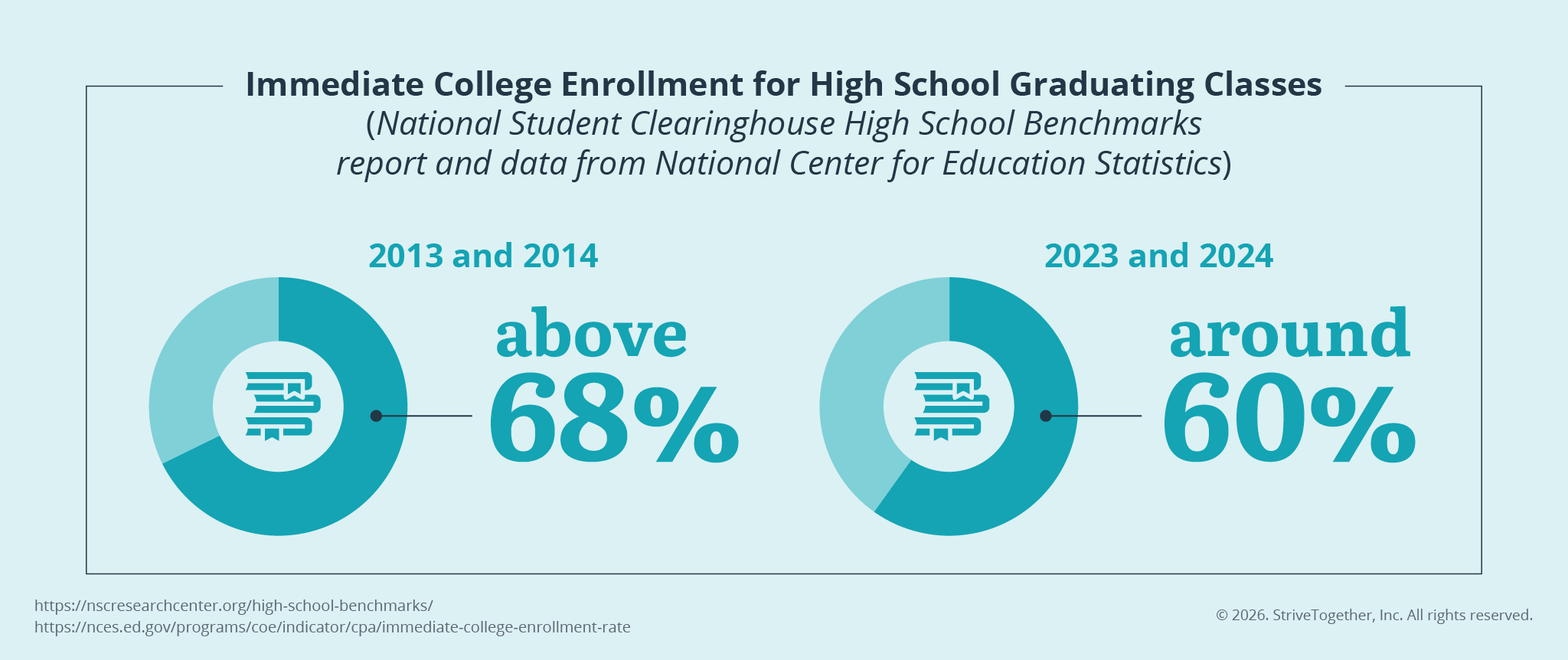
According to the National Student Clearinghouse’s High School Benchmarks report, immediate college enrollment held at around 60% for the high school graduating classes of 2023 and 2024, down from rates above 68% a decade earlier, according to National Center for Education Statistics data. Progress has stalled even as the economy increasingly rewards workers with education beyond high school.
In April 2026, the unemployment rate was 2.8% for people with a bachelor’s degree or higher, compared with 3.2% for people with some college or an associate degree, 4.7% for high school graduates and 6.4% for those without a high school diploma, according to the U.S. Bureau of Labor Statistics.
Average median salary increases as education level increases
Earnings follow a similar pattern as unemployment rates — as level of education increases, so does average median salary.
In 2022, 81% of Asian and 64% of white recent high school graduates enrolled in college within a year of graduation, compared with 59% of Black and 58% of Hispanic graduates, according to the College Board’s Education Pays report. Low-income high schools post an immediate enrollment rate that runs about 12 percentage points below higher-income high schools, according to the National Student Clearinghouse, and the gap widens further after enrollment. Among students who graduated high school in 2018, more than half of graduates from low-poverty high schools completed an associate degree or higher within six years, compared with only about one-quarter of graduates from high-poverty high schools.
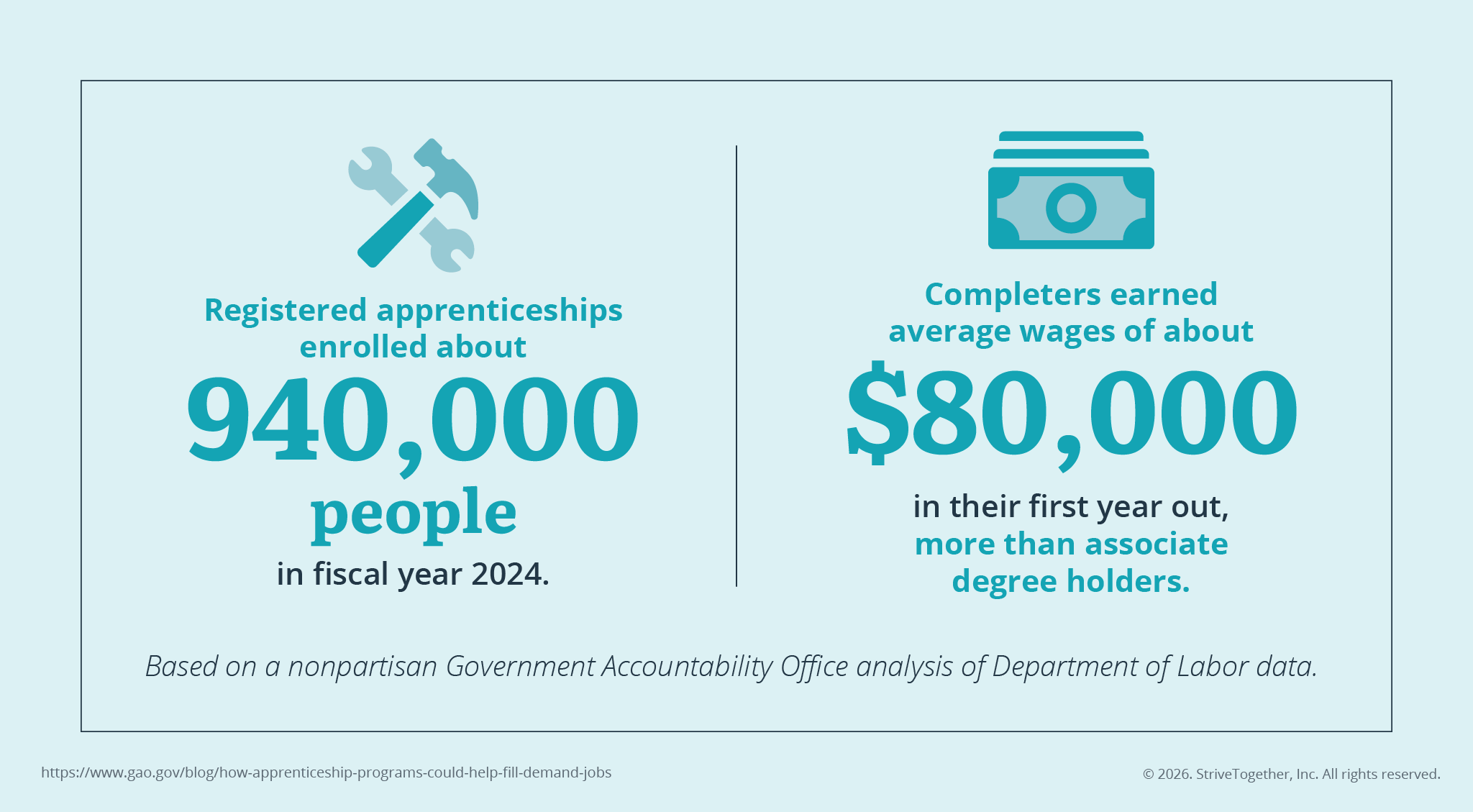
A four-year degree is not the only route to that payoff. Registered apprenticeships enrolled about 940,000 people in fiscal year 2024, and completers earned average wages of about $80,000 in their first year out, more than associate degree holders, according to a nonpartisan Government Accountability Office analysis of Department of Labor data.
A rigorous 10-state study by Mathematica found participants earn substantially more than similar workers who did not participate, though apprentices still make up only about 0.3% of the U.S. working-age population, compared with 2% to 3% in Germany and the United Kingdom, according to Inside Higher Ed.
Certificate enrollment is growing even faster, up nearly 10% in fall 2024 versus 5% for undergraduate enrollment overall, according to the Bipartisan Policy Center. Community colleges and many certificate programs deliver the strongest returns in the first decade after enrollment, though bachelor’s degrees pull ahead over a full career, according to Georgetown’s ROI research. Value still varies by field, so matching students to the credential that fits their goals matters as much as the credential itself.
Together, these gaps trace back to unequal access to advising, affordable pathways and financial aid across every kind of postsecondary path, not just four-year college. Left unaddressed, they carry into long-term income and employment gaps.
What Shapes Postsecondary Enrollment Outcomes
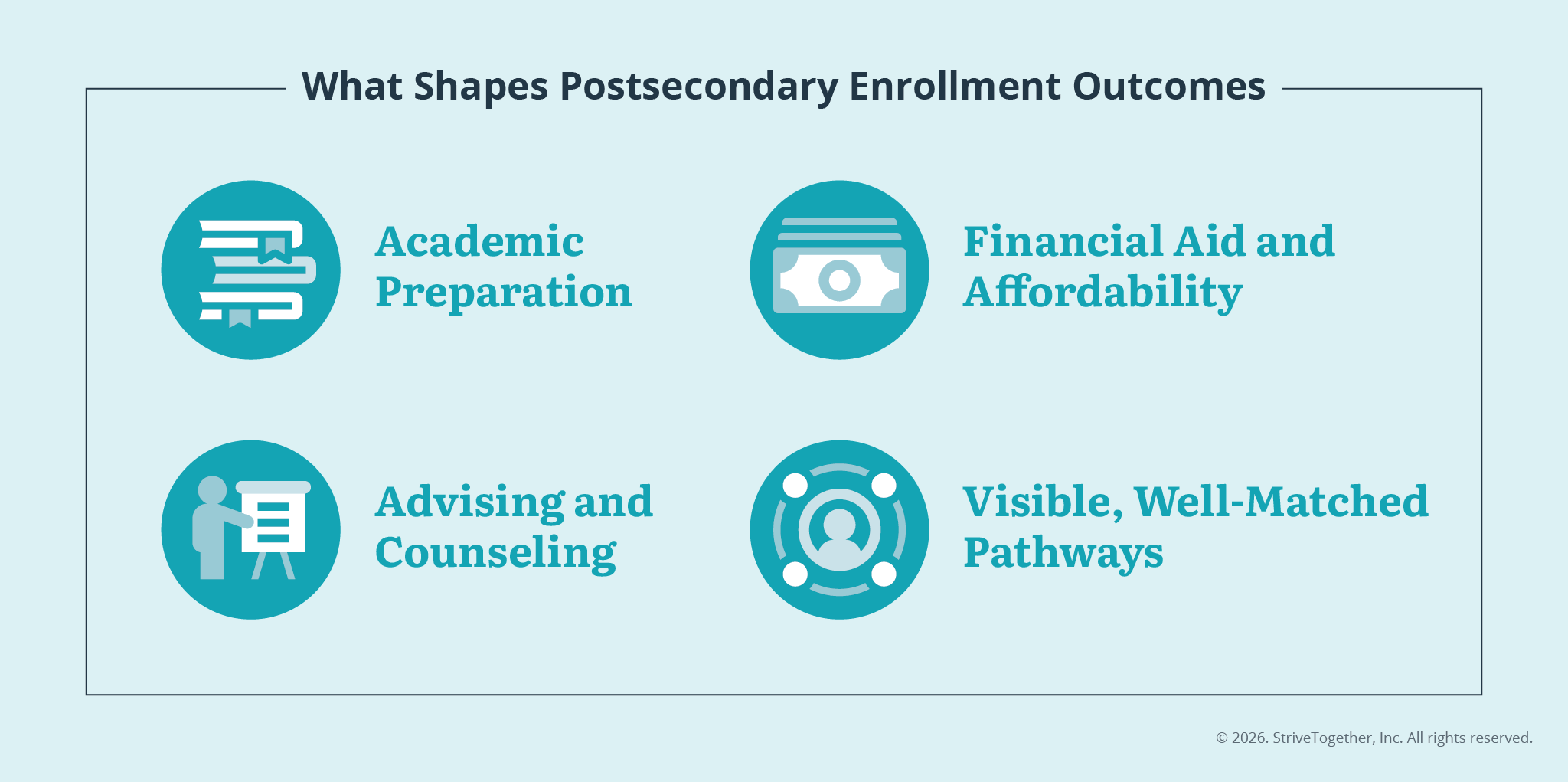
Postsecondary enrollment outcomes are shaped by several connected factors. These factors begin well before senior year and require schools and communities to work together.
Together, these factors determine whether postsecondary enrollment becomes a bridge to opportunity or a barrier to long-term success.
Building Strong Postsecondary Enrollment Systems
Improving postsecondary enrollment rates requires more than individual programs. It requires strong, aligned systems that support students from ninth grade through their first year after high school. An enrollment system includes the policies, practices and supports that help students apply, enroll and persist in the path that fits them best.
Strong systems begin with early identification, using data on academic progress, financial aid completion and college applications to spot students who need extra help before challenges grow. Some communities track a small set of predictive indicators covering preparation, application and enrollment steps, an approach researchers call momentum metrics, so staff can flag which students are falling off track early enough to intervene.

Systems also depend on advising, mentoring and family engagement to keep students connected through the transition. Coordinated outreach and advising that starts before senior year and continues into college can meaningfully raise the odds that a student who intended to enroll actually does.
Finally, strong systems connect high school learning to real-world opportunity. College and career pathways, dual enrollment programs and partnerships with employers help students see a clear path beyond graduation. Enrollment systems must also address disparities across race, income and ability by expanding access to well-matched institutions and removing barriers like unclear financial aid processes. When communities align around shared data and shared goals, enrollment becomes a shared community outcome.
Postsecondary Enrollment Strengthens the Cradle-to-Career Pathway
Postsecondary enrollment matters because it marks readiness. It shows that students have gained the skills, knowledge and confidence needed to take their next step, whether that is a two-year college, a four-year university, a technical program or an apprenticeship.
When students enroll prepared, they are better positioned to persist, complete a credential and reach long-term economic mobility. Communities that strengthen enrollment systems are not only increasing enrollment rates. They are building pathways that support lifelong learning and economic mobility.
Improving outcomes requires coordinated action across education, workforce and community systems. With shared data and shared accountability, communities can ensure that more students reach this milestone ready for what comes next.
To learn more about how communities can strengthen postsecondary enrollment outcomes, explore the StriveTogether Postsecondary Enrollment Playbook for guidance and examples from across the Cradle to Career Network.
Additional Resources

Why It Matters: StriveTogether® Collaborative Improvement™

Why Postsecondary Enrollment Matters