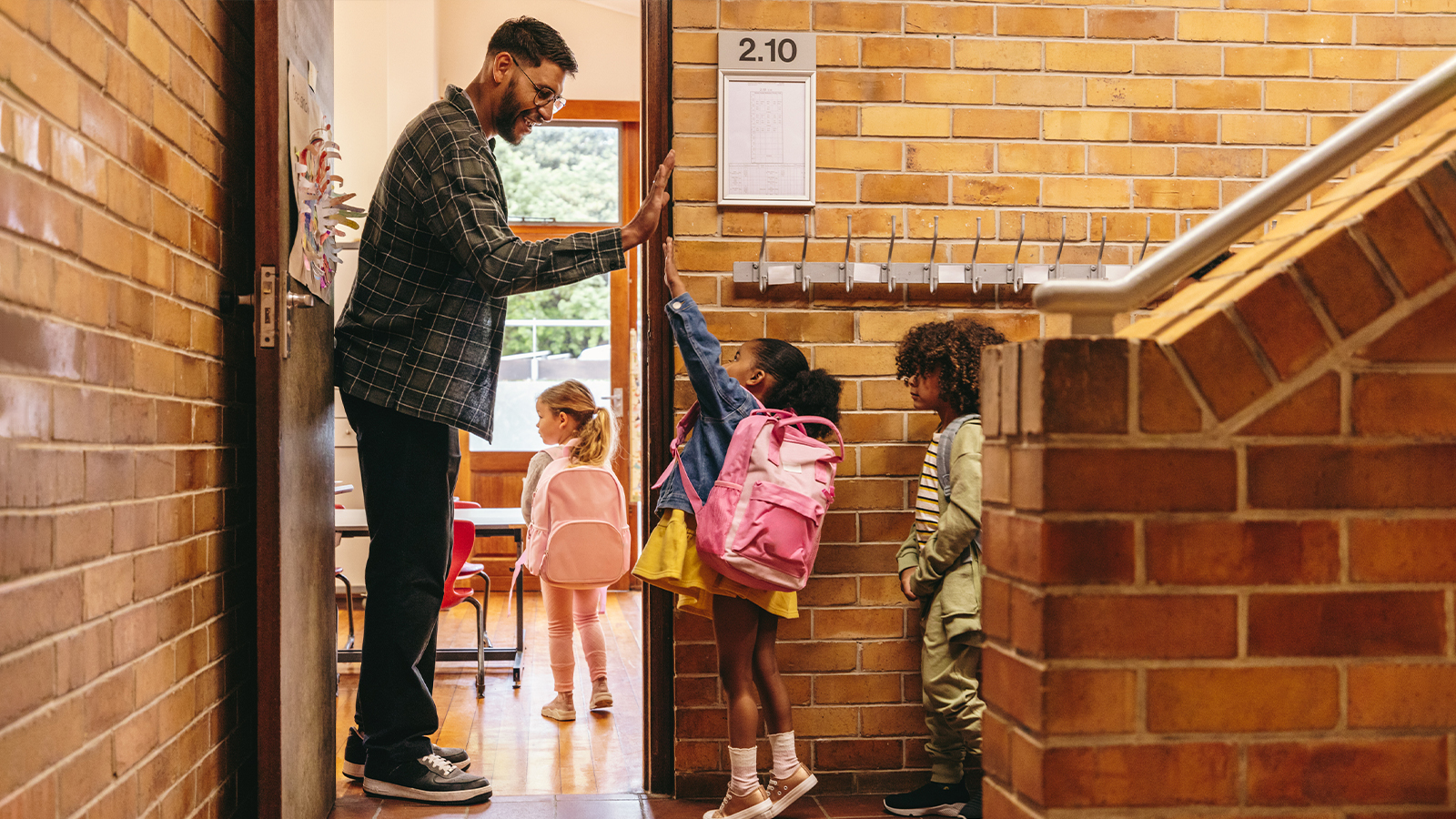
A strong start sets children up for future success. Kindergarten readiness is linked to later outcomes, like third-grade reading, high school graduation, college attendance and earnings. Communities can improve early outcomes through high-quality early learning, engaged caregivers, access to health care, and safe, inclusive schools.
This is part 8 of StriveTogether’s Cradle-to-Career Outcomes Playbook: Kindergarten Readiness. The playbook synthesizes research and practical guidance communities can use to improve kindergarten readiness.
Positive school environments create the conditions for safety, inclusivity and support by focusing on holistic child development and approaches. Young learners want to attend school consistently when environments are positive and supportive.
New to the Kindergarten Readiness Playbook?
Learn how to get the most value out of the Kindergarten Readiness Playbook by reviewing the below resource.
Question 8: Do young learners have access to quality pre-kindergarten environments and facilities?
Why it matters
Class size: Smaller classes (with a lower pupil-to-teacher ratio) give teachers the ability to identify the needs of young children and address them with individualized strategies. Research has found that smaller class sizes, especially in the early grades, result in increased student achievement (Rhode Island Kids Count).
Health and hygienic needs: Addressing health and hygiene needs in pre-kindergarten environments is crucial for creating safe and supportive learning environments. Young learners are especially vulnerable to illnesses, and promoting good hygiene practices helps prevent the spread of germs, reducing the frequency of illnesses that can disrupt learning. Meeting health needs — such as regular handwashing, proper sanitation and access to nutritious food — also supports children’s physical development and overall well-being. When centers and schools prioritize these needs, they help ensure that children are healthy, present and ready to engage in learning activities.
Percentage of program sites that have the infrastructure necessary to support student learning, in systems where focal populations make up at least half of the student population (STEP Forward with Data Framework).
Percentage of program sites that meet children and workforce members’ health and hygienic needs, in programs where focal populations make up at least half of the student population (STEP Forward with Data Framework).
Question 9: Do young learners attend schools with safe, inclusive and supportive environments?
Why it matters
Safe, inclusive and supportive environments: A sense of belonging in school and work contributes to improved achievement, well-being and health. When young learners feel they belong, they experience higher levels of motivation, engagement and tenacity (Education-to-Workforce Framework). Climate surveys, which measure experiences beyond academic ones, are typically used to understand the extent to which students and educators feel safe, seen and connected. Positive climate survey results are positively associated with stronger academic and behavioral outcomes (StriveTogether 2021). Children have safe, inclusive and supportive learning experiences when their identities are considered, reflected and celebrated in their learning environment. This kind of environment also offers resources that allow their teachers to provide an inclusive environment for children. Children who see themselves in books, in artwork, in characters and who have teachers who look like them have more equitable, engaging learning experiences (STEP Forward with Data Framework).
Inclusive workplace conditions: The administration of a pre-K program or school encompasses the policies, processes and infrastructure that facilitate how schools operate, as well as the individual(s) who lead the preschool system. Equitable administration occurs when school leaders share leadership and decision making beyond a defined leadership team — for example, they share decision-making power with families and workforce members, especially those from focal populations. Focal populations who are brought into decisions or whose perspectives are considered can provide insight and solutions that would best meet their needs (STEP Forward with Data Framework). Leaders will know that early childhood programs are functioning equitably when all system programs are sufficiently funded, implement culturally- and developmentally-affirming policies, and retain a qualified and supported workforce (STEP Forward with Data Framework).
School and workplace racial and ethnic diversity: Greater diversity is shown to reduce intergroup prejudice and improve intelligence and innovation (Education-to-Workforce Framework). Racial and ethnic diversity is positively associated with children’s language development in early learning programs (Education-to-Workforce Framework). Workplaces with a diverse team see better employee interpersonal skills and innovation, better financial performance and less conflict (Education-to-Workforce Framework).
School and workplace economic diversity: The disparity in average school poverty rates between white and Black students is the single most important predictor of differences between their academic achievement (Education-to-Workforce Framework). The relationship between economic segregation and outcomes begins in early childhood, where children’s academic achievement and social-emotional development have been linked to the average socioeconomic status of their classroom, regardless of a child’s own economic or demographic background (Education-to-Workforce Framework).
School safety: School safety is a core component of a school’s climate, which is linked to higher attendance and academic achievement (Education-to-Workforce Framework). Research shows disparities in students’ feelings of safety according to their race and ethnicity. For example, one study found that students in schools serving predominantly Black and Latine populations report feeling less safe and having less positive peer interactions than those at schools with predominantly white and Asian populations, on average (Education-to-Workforce Framework). Even within the same schools, Black and Latine students report feeling less safe than their white and Asian peers (Education-to-Workforce Framework).
School and family engagement: Early learning programs designed to teach parents how to better support their children’s development by providing stimulating interactions during daily routines and playtime at home are related to large improvements in children’s behavioral, health and some dimensions of social-emotional outcomes, as well as modest improvements in their cognitive abilities and overall life outcomes (Education-to-Workforce Framework). School engagement with families provides benefits to students academically and socially, both in short-term school success and long-term outcomes (Education-to-Workforce Framework). Although family engagement is key to students’ educational success, not all schools successfully build a culture that welcomes and engages all families, and especially families of color. For example, an analysis of parent survey data in California found that perceptions of how well the school encouraged parental involvement were significantly lower among Indigenous parents compared to other groups (Education-to-Workforce Framework).
Contributing factor | Key source: E-W Framework
Inclusive environments
Percentage of children in pre-K reporting positive feelings toward their school, as measured by questionnaires such as the Collaborative for Academic, Social, and Emotional Learning’s (CASEL) How I Feel About My School questionnaire, or percentage of classrooms demonstrating equitable socio cultural interactions, as measured by observational assessments, such as Assessing Classroom Sociocultural Equity Scale (ACSES) (Education-to-Workforce Framework).
Percentage of students in K-12 reporting belonging in school, as measured by surveys such as the Sense of Belonging subscale of the CORE Districts school culture and climate survey, the Classroom Belonging subscale of the Panorama Student Survey, or the Elevate survey’s Affirming Identities and Classroom Community scales (Education-to-Workforce Framework).
Percentage of students experiencing mechanical versus physical constraint and seclusion (Data source: Civil Rights Data Collection) (StriveTogether 2021).
Percentage of students experiencing school-related arrests (Data source: Civil Rights Data Collection) (StriveTogether 2021).
Percentage of students receiving in-school or out-of-school suspensions (Data source: Civil Rights Data Collection) (StriveTogether 2021).
Sense of belonging and connection to school community (Data sources: Youth Risk Behavior Survey; local school climate surveys) (StriveTogether 2021).
Student perceptions of their school’s inclusion of their history, culture and racial identity (Data sources: Local school climate surveys) (StriveTogether 2021).
Percentage of teachers who have received professional development in culturally-responsive pedagogy (National Education Association).
Percentage of teachers who have received professional learning time in equity and racial and social justice (National Education Association).
Percentage of system-level funding that is allocated to equity-focused activities targeted to children, families and/or workforce members from focal populations (STEP Forward with Data Framework).
Districts allocate funds to advance educators’ competence in culturally-responsive pedagogy (National Education Association).
Districts allocate funds to advance educators’ understanding of equity and racial and social justice (National Education Association).
Districts allocate funds to advance educators’ understanding of trauma-informed practices (National Education Association).
Districts allocate resources to a workforce wellness and safety program, ensuring educators of color and LGBTQ+ educators feel safe and cared for in their schools (National Education Association).
State develops a policy that requires annual reporting by school on school climate and student engagement (National Education Association).
Fostering positive learning environments for students, including by reducing class sizes, developing programs that prevent bullying, moving away from punitive disciplinary practices and applying other trauma-informed practices (Urban Institute).
Share of students attending high-poverty schools, by race or ethnicity (Urban Institute).
Creating more equitable school attendance boundaries (Urban Institute).
Developing centralized school lottery application systems that prioritize school diversity (Urban Institute).
Ending school and neighborhood segregation, including by expanding affordable housing in resource-rich neighborhoods and reforming zoning policies to allow for more diverse, high-density, mixed-income communities (Urban Institute).
Implementing more equitable school funding policies and advocating for reforms to state and federal funding (Urban Institute).
Percentage of students reporting high levels of physical, mental and emotional safety in school climate surveys, such as the U.S. Department of Education ED School Climate Surveys (EDSCLS), the Sense of Safety subscale within the CORE Districts school culture and climate survey, or the School Safety subscale within the Panorama Student Survey (Education–to-Workforce Framework).
Percentage of educators surveyed indicating they feel safe and cared for at their school (National Education Association).
Percentage of public school employees in each job category who have received in-service training on intervention techniques, such as restorative practices (National Education Association).
Schools report disaggregated data on incidents of student bullying on a daily or weekly basis (National Education Association).
Percentage of program sites that ensure the safety and security of children and workforce members, in programs where focal populations make up at least half of the student population (STEP Forward with Data Framework).
Districts educate all school personnel on intervention techniques in incidents of student bullying and harassment, such as restorative practices and Positive Behavioral Intervention and Supports (PBIS) (National Education Association).
Districts allocate resources toward interventions around student safety issues (e.g., LGBTQ+ bullying and harassment) (National Education Association).
Percentage of families from focal populations who report that they are consulted, involved, collaborate, or are a co-creator in systems-level changes, policies or programmatic decisions (STEP Forward with Data Framework).
Mean scores on family surveys, such as the Panorama Family-School Relationships Survey or CORE Districts School Culture & Climate Survey parent assessment of school-community engagement (Education-to-Workforce Framework).
Parent and family experiences, connection and relationships with school, teachers and other school staff (data sources: Local data collection, school climate surveys) (StriveTogether 2021).
Percentage of educators who have taken coursework, including continuing education, on family and community engagement (StriveTogether 2021).
Percentage of parents surveyed indicating knowledge of and satisfaction with parent and family services (StriveTogether 2021).
Percentage of parents surveyed indicating satisfactory access to school materials and information (National Education Association).
Percentage of parents surveyed indicating school-parent collaboration has contributed to improved student achievement (National Education Association).
Percentage of parents surveyed indicated that they had been made aware of opportunities to join decision-making groups focused on school improvement and annual planning, disaggregated by race, ethnicity and income (National Education Association).
Percentage of parents surveyed indicating they feel listened to and included, disaggregated by race, ethnicity and income (National Education Association).
Percentage of parents that attended a school training for families in the previous year (National Education Association).
Percentage of school personnel who have participated in professional learning designed to improve family and community engagement (National Education Association).
Percentage of families and percentage of pre-K teachers or caregivers reporting positive relationship quality with one another, using a tool such as the Family and Provider/Teacher Relationship Quality (FPTRQ) parent survey (Education-to-Workforce Framework).
Schools maintain partnerships/collaborations to provide development activities for caregivers, which may include family literacy and financial education (National Education Association).
Schools maintain partnerships/collaborations with community providers to offer support for at-risk youth. Support includes summer school, after-school programs, mentoring and tutoring (National Education Association).
Schools maintain partnerships/collaborations with community providers to provide access to family support services/social services (National Education Association).
Schools provide access to extended on-site services for students and families (e.g., school library, computer facilities, gym, etc.) (National Education Association).
Percentage of programs that provide referrals to families from focal populations about whole family services (STEP Forward with Data Framework).
Adult literacy, adult education and English as a Second Language (ESL) Programs (Rhode Island Kids Count).
Districts and schools include parents and families in decision making on school improvement and yearly planning, purposefully seeking input from underrepresented families, such as Indigenous families and other families of color (National Education Association).
Districts collect parent and caregiver feedback (methods of collection include surveys, focus groups, parent governing councils, etc.) (National Education Association).
Districts hire school-community liaisons who enhance outreach efforts with knowledge of a community’s history, language and cultural background (National Education Association).
Districts offer early education services for the home (e.g., home visitation, early literacy, prenatal, social services) (National Education Association).
Districts provide professional learning in family and community engagement for all school personnel, specifically highlighting engagement of underrepresented families, such as Indigenous families and other families of color (National Education Association).
Districts share information on academic standards, school procedures and student progress data in multiple formats and languages (National Education Association).
Districts support collaborations with educators and community-based organizations to provide home visits (National Education Association).
State maintains a state-level appointee or initiative for family and community engagement (National Education Association).
State maintains an information-sharing system readily available to families and communities in multiple formats and languages (National Education Association).
State provides districts with technical assistance and support to address engagement strategies (National Education Association).
State provides resources for an integrated system of academic enrichment and social services, such as the Community Schools model, to support children’s intellectual, social, emotional, physical and linguistic development (National Education Association).
State provides resources to school districts to engage families and the community on school district policies, processes and procedures (National Education Association).
State funds innovative engagement strategies targeting historically marginalized students, such as Indigenous students and students of color (National Education Association).
State policy provides employer incentives for parents and/or caregivers to participate in school-related activities (National Education Association).
State policy provides resources for professional learning around family and community engagement for all school personnel (National Education Association).
State policy supports family engagement connected to student learning as a driver of student academic performance and a vital component of meeting school improvement goals (National Education Association).
Question 10: Do young learners attend schools that support their social, emotional and physical development and well-being?
Why it matters
Access to health, mental health and social supports: Regular well-child visits provide an opportunity for health professionals to monitor children’s physical and behavioral health and development, provide age-appropriate guidance to parents and screen for maternal depression (Rhode Island Kids Count). Well-child visits screen children for common concerns in early childhood, including lead poisoning, hearing and vision problems, behavior problems and delayed speech and language development (Rhode Island Kids Count). Timely, age-appropriate immunizations usually indicate that a child has access to regular medical care. Vaccines are cost-effective tools that prevent children from developing severe diseases (Rhode Island Kids Count).
Social-emotional skills and well-being: Schools can be a critical place to access support for students’ physical, mental and social-emotional health. For example, three out of four students who ever access mental health services do so through their school (Education-to-Workforce Framework). Schools that provide access to nurses, school psychologists and social workers tend to see improved learning outcomes, school climate and student well-being (Education-to-Workforce Framework).
Contributing factor | Key source: E-W Framework
Access to health, mental health and social supports
Young children (ages 19-36 months) who complete the basic series of age-appropriate immunizations against measles, mumps, rubella, polio, diphtheria, tetanus, pertussis, haemophilus influenza and hepatitis B (series 4-3-1-3-3) (Project Thrive, NCCP).
Percentage of children ages 19-35 months who have been fully immunized (Rhode Island Kids Count).
Children ages 2-6 years receiving dental care in the last 12 months (Project Thrive, NCCP).
Children ages 2 to 5 who receive WIC services with a BMI at or above the 85th percentile (Project Thrive, NCCP).
Children hospitalized for asthma (ICD-9 Codes: 493.0-493.9) per 100,000 children less than 5 years of age (Project Thrive, NCCP).
Children under age 6 with blood lead levels at or above 10 micrograms per deciliter (Project Thrive, NCCP).
Substantiated cases of child abuse and neglect among children from birth to age 6 (Project Thrive, NCCP).
Children with special health care needs age 0-6 who receive coordinated, ongoing comprehensive care within a medical home (Project Thrive, NCCP).
Percentage of eligible students enrolled in free and reduced-price school breakfast and lunch programs (National Education Association).
Percentage of 2-year-olds with a recent well-child visit that included a lead screening, vision screening, hearing screening and comprehensive developmental screening (Rhode Island Kids Count).
Percentage of children under age 6 who received a well-child check-up in the past year (Rhode Island Kids Count).
Proportion of youth experiencing poor mental health (Data Source: Youth Risk Behavior Surveillance System) (StriveTogether 2021).
Child care centers that have access to ongoing health or mental health consultation (Project Thrive, NCCP).
Eligible schools are enrolled in free and reduced-price school breakfast and lunch programs (National Education Association).
Ratio of number of students to number of health, mental health and social services full-time equivalent (FTE) staff (for example, school nurses, psychologists and social workers) (Education-to-Workforce Framework).
Percentage of specialized instructional support personnel (SISP) surveyed indicating satisfaction with time dedicated toward collaboration (National Education Association).
Percentage of programs offering health, mental health and social services, or staff or consultants providing infant and early childhood mental health consultation (IECMHC) services (Education-to-Workforce Framework).
Proportion of schools with behavioral/mental health services and on-site staff (StriveTogether 2021).
Percentage of programs offering health, mental health and social services in-house, including staff or consultants providing infant and early childhood mental health consultation (IECMHC) services (STEP Forward with Data Framework).
Districts provide adequate resources for student-to-specialized instructional support personnel (SISP) to collaborate with teachers, education support professionals (ESPs), parents and students. (National Education Association).
Districts provide student-to-specialized instructional support personnel (SISP) with adequate time to collaborate with teachers and education support professionals (ESPs) (National Education Association).
Pediatricians use developmental milestone assessments, like the Ages & Stages Questionnaires (ASQ), during regular well visits.
School-based supports for child health and well-being, such as physicals, vaccinations, dental and vision care, therapy and other mental health services (Results for America).
Districts require a favorable student-to-specialized instructional support personnel (SISP) ratio (Optimal ratios include: school counselors – 250:1; school nurses – 750:1; school psychologists – 500-700:1; school social workers – 250:1) (National Education Association).
State and/or district pays for school-based health workforce, including nurses and counselors (National Education Association).
State requires that all school-age children are appropriately immunized before entering school (National Education Association).
Contributing factor | Key source: E-W Framework
Social-emotional skills and well-being
Percentage of students in K-12 reporting a high level of social awareness on surveys such as the CORE Districts SEL Survey social awareness scale, or percentage of students meeting benchmarks on teacher ratings of social skills drawn from Elliott and Gresham’s Social Skills Rating Scale. (Education-to-Workforce Framework)
Percentage of youth in K-12 with mental or emotional health needs as identified by a universal screening tool. For a list of mental health screening tools that may be appropriate for school-based use, see the following guide from the National Center on Safe Supportive Learning Environments: “Mental Health Screening Tools for Grades K-12” (Education-to-Workforce Framework).
Percentage of children in pre-K with identified health or developmental concerns as identified by a developmental screening tool. For a list of screening tools that may be appropriate for children younger than age 5, see the following guide from the Head Start Early Childhood Learning and Knowledge Center: “Birth to 5: Watch Me Thrive! A Compendium of Screening Measures for Young Children” (Education-to-Workforce Framework).
Question 11: Are young learners demonstrating consistent attendance?
Why it matters
Absenteeism: Research demonstrates a strong relationship between absenteeism and learning outcomes, and higher rates of absenteeism for disadvantaged students can widen achievement gaps (Birth to Grade 3 Indicator Framework). Absenteeism is a big challenge for young learners, with at least 10% of kindergarten and first graders nationwide chronically absent from school, with students living in poverty four times more likely to be chronically absent (New America).
Percentage of students who are present for more than 90% of their enrolled days, excluding students enrolled for fewer than 90 days (Education-to-Workforce Framework).
Percentage of students with less than 10 absences in a school year (or less than 5 percent of the school year) (National Education Association).
Percentage of enrolled preschool children from focal populations who are present for more than 90% of their enrolled days, excluding children enrolled for less than three months (STEP Forward with Data Framework).
Learner Engagement and Attendance Program (LEAP): A home visiting program that identifies and partners with families to improve student attendance and family engagement (Connecticut Department of Education).
School employs a tiered approach to improving attendance by promoting positive conditions for learning (Attendance Works).
Creating a culture of attendance by taking a positive, not punitive, approach to absenteeism that is centered on belonging and engagement, and helping everyone to understand why daily attendance matters in pre-K through 12th grade (Attendance Works).
States establish standards for accountability, adopt regulations and provide guidance that sets expectations for school districts and schools to achieve (Attendance Works).
States ensure consistent and comparable data across schools and districts by specifying how attendance concepts are defined and offering guidance on how to collect accurate data (Attendance Works).
The U.S. Department of Education collects and reports chronic absence data. States must track chronic absenteeism as a school quality indicator, along with more traditional academic measures for accountability in the Every Student Succeeds Act of 2015 (ESSA) (Attendance Works).
Question 12: Are there young learners that disproportionately experience exclusionary discipline?
Why it matters
Discipline Practices: Research documents persistent disparities in exclusionary discipline — that is, disciplinary actions that remove students from their educational setting, such as an in- or out-of-school suspension — along race, socioeconomic background and disability status (Education-to-Workforce Framework). Research also suggests that high rates of suspension and expulsion reduces students’ opportunity to learn, increases likelihood of dropping out or becoming disengaged from school and disproportionately affects Black and Latine students as well as students receiving special education (Birth to Grade 3 Indicator Framework). School practices play a key role in determining students’ disciplinary outcomes. Different approaches to discipline, such as restorative justice and positive behavioral interventions and supports (PBIS), may be related to improvements in school culture and climate (Education-to-Workforce Framework).
Contributing factor | Key source: E-W Framework
Equitable discipline practices
Children under age 6 who are expelled from child care or preschools due to behavioral problems (Project Thrive, NCCP).
Differences in the rates at which students from key demographic subgroups ever experience different forms of school discipline (office referrals, suspensions, expulsions, restraint and exclusion) relative to those students’ representation in their school population as a whole (Education-to-Workforce Framework).
Disproportionalities along the lines of key demographic characteristics in the level of school discipline experienced (for example, number of days suspended) (Education-to-Workforce Framework).
Schools collect and publicly report demographic data recording behavior and behavioral interventions leading to disciplinary exclusion from school (National Education Association).
Schools offer alternatives to traditional behavioral interventions, such as restorative practices (National Education Association).
Schools use Positive Behavior Intervention Supports (PBIS) (Results for America).
The Incredible Years: A series of early intervention programs for children ages 3-9 aimed to reduce the prevalence of behavioral and conduct issues (Results for America).
State policy requires schools to collect and publicly report demographic data recording behavior and behavioral interventions leading to disciplinary exclusion from school. Disciplinary actions include in-school/out-of-school suspensions, expulsions, arrests and referrals to law enforcement (National Education Association).
Policies support the integration of behavioral health services in schools to address underlying issues before they result in disciplinary actions.
Question 13: Are young learners demonstrating positive behavior?
Why it matters
Positive behavior: Young learner’s school experience is more positive and productive when they have a sense of personal well-being established through stable, caring relationships in their early lives. Emotional health and social competence enable children to participate in learning and form good relationships with teachers and peers (Rhode Island Kids Count). Success in school depends not only on academic skills, but also on the learning styles, habits and attitudes with which students approach learning (Rhode Island Kids Count). Student behavior is a strong predictor of later outcomes and is a component of many early warning indicators, along with attendance and course grades (Education-to-Workforce Framework).
Contributing factor | Key source: E-W Framework
Positive behavior
Percentage of children who often or very often exhibit positive social behaviors when interacting with their peers (Rhode Island Kids Count).
Percentage of kindergarten students with moderate to serious difficulty following directions (Rhode Island Kids Count).
Percentage of children who do not experience any of the following: in-school suspensions, out-of-school suspensions, disciplinary use of restraint and seclusion, or expulsions (Education-to-Workforce Framework).